Amit Shah Challenges Congress Chief Mallikarjun Kharge’s ‘Poisonous Snake’ Allegation, Calls for Voter Rebuttal
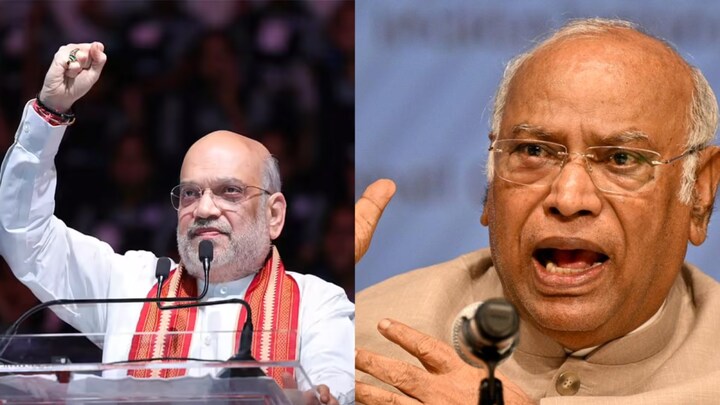
Amit Shah urges voters to deliver a decisive verdict against the Congress party in the upcoming elections.
Union Home Minister Amit Shah launched a vigorous counterattack against Congress president Mallikarjun Kharge after the latter likened the Bharatiya Janata Party and Rashtriya Swayamsevak Sangh to a “poisonous snake.” Amit Shah’s response, delivered from a public rally in Patharkandi, Assam, emphasized that the electorate must provide a clear and unmistakable verdict in the forthcoming polls.
During the rally, Amit Shah articulated his criticism in direct language, stating, “Mallikarjun Kharge is saying that Bharatiya Janata Party and Rashtriya Swayamsevak Sangh are snakes and should be killed.” Amit Shah then turned his address toward Mallikarjun Kharge, challenging the opposition leader to appear on the stage and confront the thousands of supporters gathered. Amit Shah asserted, “Mallikarjun Kharge ji, come up on the stage and look… there are thousands of people standing here. People on the ground are campaigning with full dedication. On the day of voting we have to give a reply to Rahul Baba. We must give such a reply that even with a telescope, Congress should not be visible.”
The catalyst for Amit Shah’s remarks was a statement made by Mallikarjun Kharge while campaigning in Kerala. In that statement, Mallikarjun Kharge invoked a passage from the Quran, claiming that the scripture instructs believers to kill a poisonous snake even during prayer. Mallikarjun Kharge then identified the RSS/BJP as that very snake, warning that failure to eliminate the organization would result in survival challenges.
Specifically, Mallikarjun Kharge said, “It is written in the Quran that even during the time of prayer, if you see a poisonous snake, you must kill it. The RSS/BJP is precisely that snake. If you do not kill them, you will not survive.” This comparison generated immediate backlash across the political spectrum, prompting a flurry of responses from multiple leaders and commentators.
Among the swiftest critics was Poonawalla, who described Mallikarjun Kharge’s remarks as “the lowest ebb for Congress.” Poonawalla characterized the statement as “the most undemocratic, emergency‑minded statement” and deemed it “shameful.” In a strongly worded appeal, Poonawalla called upon the Election Commission to intervene without delay, urging the regulatory body to take decisive action against the inflammatory rhetoric.
The reaction to Mallikarjun Kharge’s comments extended beyond the immediate political arena. During the same Kerala campaign visit, Mallikarjun Kharge also made a separate observation about the electorate, asserting that voters in the state were “educated and clever” and could not be misled “unlike those in Gujarat or other places.” This additional comment attracted its own wave of condemnation.
Gujarat Chief Minister Bhupendra Patel responded forcefully to Mallikarjun Kharge’s characterization of Gujarat voters. Bhupendra Patel asserted that the remarks insulted the state’s 6.5 crore residents, tarnished the legacy of Mahatma Gandhi and Sardar Vallabhbhai Patel, and demanded a formal apology from Mallikarjun Kharge. Bhupendra Patel emphasized the dignity of Gujarat’s electorate and the historical significance of the nation’s founding figures.
Bhupendra Patel’s demand for an apology underscored the broader sentiment that Mallikarjun Kharge’s statements were not merely partisan criticism but an affront to regional pride and national heritage. The call for an apology highlighted the expectation that political discourse should respect both the dignity of the electorate and the memory of iconic leaders.
The exchange between Amit Shah and Mallikarjun Kharge reflects a deeper contestation of political narratives as the election draws near. Amit Shah’s insistence that voters deliver a verdict “so strong that Congress would not be visible even with a telescope” signals an aggressive campaign strategy aimed at translating rhetorical dominance into ballot‑box success. Amit Shah’s framing positions the upcoming vote as a decisive moment for the electorate to reject what Amit Shah perceives as extremist or undemocratic rhetoric.
At the same time, Mallikarjun Kharge’s reliance on religious metaphor and targeted criticism of specific regional electorates illustrates a tactical effort to galvanize certain voter blocs. By invoking a Qur’anic injunction and drawing a distinction between “educated” Kerala voters and those in other states, Mallikarjun Kharge attempted to cast the opposition as morally and culturally threatening.
Analysts observing the clash have noted that the language employed by both Amit Shah and Mallikarjun Kharge transcends conventional policy debate, entering the realm of moral and existential confrontation. Amit Shah’s emphasis on an “invisible” Congress and Mallikarjun Kharge’s depiction of the Bharatiya Janata Party and Rashtriya Swayamsevak Sangh as a lethal serpent both serve to heighten emotional stakes, thereby mobilizing supporters through heightened urgency.
Such rhetoric, while potent in rally settings, also raises concerns about the tone of political engagement. Critics argue that the escalation of invective may erode the quality of democratic discourse, prompting bodies such as the Election Commission to examine whether the language crosses acceptable limits. Poonawalla’s plea for immediate action by the Election Commission underscores this apprehension.
In addition to the immediate political consequences, the exchange bears implications for inter‑regional relations within the country. Gujarat Chief Minister Bhupendra Patel’s condemnation of Mallikarjun Kharge’s remarks about Gujarat voters highlights the sensitivity surrounding regional identity and the expectation of equitable treatment across states. The demand for an apology reflects a broader insistence that national dialogue honor the contributions of each region without resorting to demeaning generalizations.
Similarly, the invocation of religious text by Mallikarjun Kharge during a campaign in a state with a significant Muslim population adds another layer of complexity. The reference to a Qur’anic directive on dealing with poisonous snakes intertwines religious symbolism with political antagonism, potentially influencing communal perceptions and voter behavior.
Looking ahead, the narrative set by Amit Shah’s rally in Patharkandi may shape campaign strategies for the remaining contesting parties. Amit Shah’s call for a “befitting reply” suggests that the forthcoming election will be framed not merely as a contest of policies but as a moral reckoning. The insistence that the electorate deliver a verdict that renders Congress “invisible” elevates the stakes for both parties, demanding mobilization, messaging, and voter outreach that align with this high‑intensity framing.
The requirement for the electorate to deliver a decisive and unmistakable answer may also intensify voter turnout efforts, as each side strives to demonstrate that their supporters are not only numerous but also resolutely committed to the narrative they have crafted. The election day, therefore, becomes a litmus test for which rhetorical vision the public embraces.
Ultimately, the showdown between Amit Shah and Mallikarjun Kharge underscores the potency of language in contemporary Indian politics. The juxtaposition of a “poisonous snake” metaphor against an appeal for an “invisible” opposition reveals a battle for symbolic supremacy as much as a struggle for votes. Both leaders have employed vivid, confrontational imagery to galvanize supporters, thereby illustrating the centrality of narrative framing in shaping voter perception.
Whether the electorate will respond in the manner Amit Shah envisions—rendering Congress invisible to the point that even a telescope cannot detect it—remains a question that only the ballot can answer. The outcome will inevitably influence how future political discourse is conducted, potentially prompting a reassessment of the balance between robust criticism and respect for democratic norms.