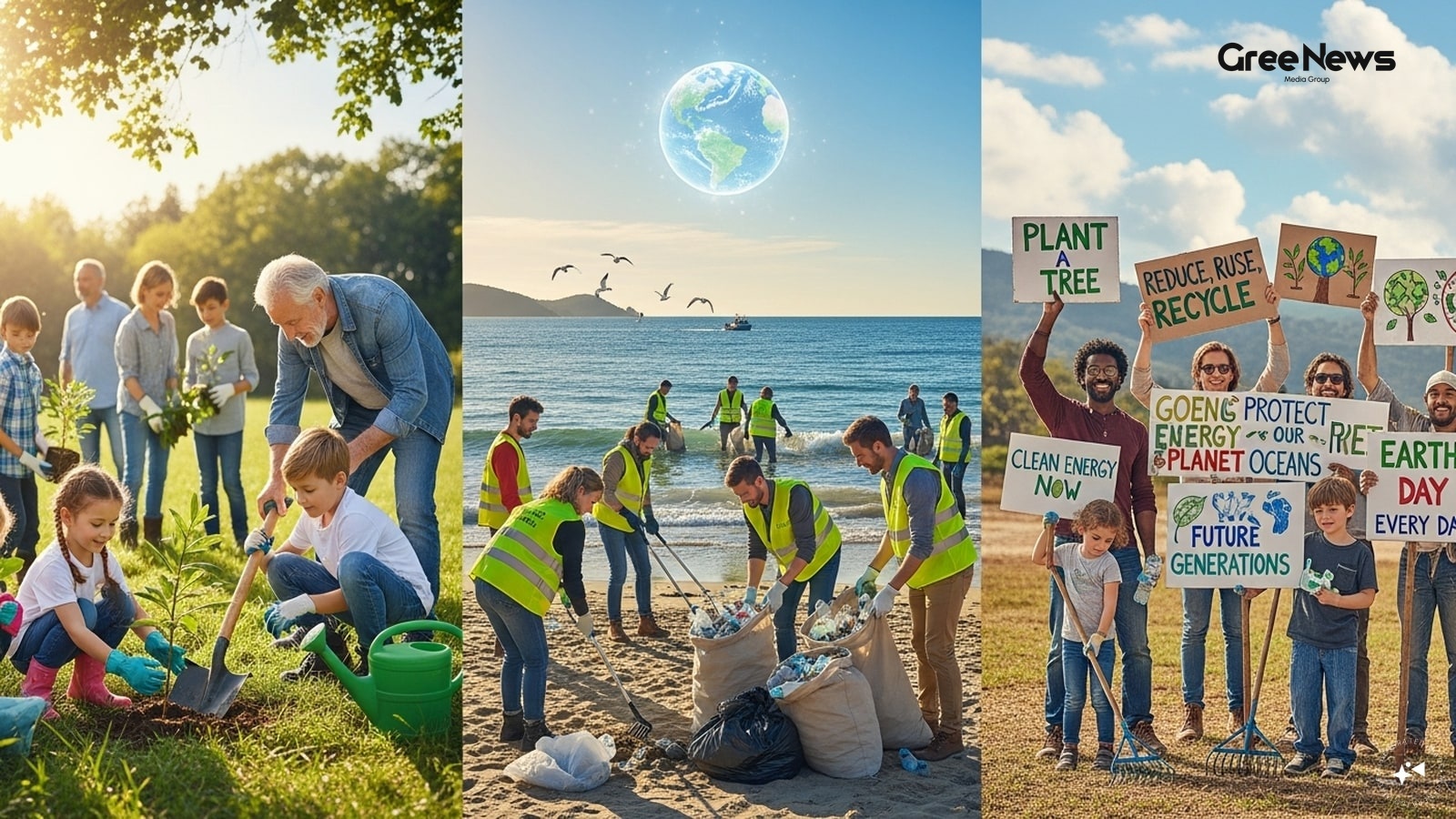
This World Earth Day, industries across hospitality, banking, food, manufacturing, and technology are moving beyond sustainability promises embedding measurable impact at scale.
Honestly, when I started reading the latest news India about Earth Day, I expected the same old statements about going Green. But what I found was a noticeable shift in how sustainability is being understood this year. It’s no longer just an aspiration or a corporate buzz‑word. In most cases, companies are actually testing their ideas through systems, scale and measurable outcomes whether in hospitality, banking, quick service restaurants, manufacturing or climate finance.
What emerged across sectors wasn’t a one‑size‑fits‑all model, but a shared direction: sustainability is moving from isolated initiatives to integrated operating frameworks. This caught people’s attention because it felt like the narrative was finally turning into proof.
Hospitality: From responsible luxury to measurable impact
Let me tell you about my stay at an ITC hotel. I was there for a conference, and as I walked into the lobby I noticed subtle signs digital screens showing real‑time water usage, QR codes linking to biodiversity reports, even a little plaque stating the property’s LEED certification. Amaan R Kidwai, Area Manager Luxury Hotels (North) & General Manager, ITC Maurya, told me that sustainability is no longer a differentiator, it’s an expectation. Their “Responsible Luxury” ethos is now woven into every guest‑facing experience from eco‑conscious spa treatments and Green banquets to heritage walks and locally sourced cuisine.
What really surprised me was the emphasis on measurement. The hotel staff showed me dashboards tracking biodiversity counts, soil carbon levels, water recharge, renewable energy use and emissions intensity. It felt like they had turned what was once a narrative into a quantifiable performance sheet. This level of transparency is something you rarely see in the breaking news about hospitality.
Properties such as ITC Maurya, ITC Mughal and ITC Grand Bharat illustrate how sustainability is being embedded into the very infrastructure through LEED certifications, zero water discharge systems and design choices that reduce carbon dependence. In my conversation with the team, the message was clear: in hospitality, sustainability has evolved from storytelling to performance‑led accountability.
Banking and CSR: Building ecosystems, not interventions
Switching gears, I visited an HDFC Bank branch that was part of the Parivartan initiative. Nusrat Pathan, Head CSR, explained that environmental progress cannot be separated from social equity. As I walked through a small village that had received solar lights, I saw over 69,000 lights already installed across 22 states a figure that sounded like trending news India for the whole country.
The scale was impressive: clean energy access in 1,000 villages, more than 14,500 water‑conservation structures, afforestation drives, chemical‑free farming projects and even ice stupas in Ladakh. These aren’t symbolic gestures; they’re attempts to reshape local ecosystems. I could sense the community’s pride when they showed me a newly built rainwater harvesting tank that would help them during the dry season.
What stood out was the integration of innovation with community needs. Whether it’s planting trees or introducing chemical‑free farming, the underlying insight is that sustainability gains durability only when people see direct economic and livelihood value. This is the kind of story that goes viral on social media, but the real impact is felt on the ground.
Food and QSR: Rethinking supply chains and circularity
Next, I dropped by a McDonald’s outlet in North India. Rajeev Ranjan, Managing Director, McDonald’s India North and East, gave me a quick tour of their kitchen and pointed out the changes. Their sustainability approach now spans sourcing, packaging, energy and waste management. For example, the packaging is FSC‑certified, the coffee comes from Rainforest Alliance farms and the edible oil is mass‑balance certified.
The most fascinating part was the push towards circularity. Used cooking oil is being turned into biodiesel under the FSSAI’s RUCO initiative I actually saw a small biodiesel unit tucked behind the restaurant. They are also investing heavily in solar power for their outlets, signalling a shift towards long‑term energy resilience.
What this reflects is a broader transition: sustainability in food isn’t just about a single ingredient, it’s about the entire production and consumption system. It reminded me of a piece of breaking news India that talked about the fast‑food sector’s carbon footprints the reality on the ground now looks a lot cleaner.
Water and plastics: From stewardship to accountability
When I reached the headquarters of Bisleri International, K Ganesh, Director Sustainability & Corporate Affairs, walked me through Project Nayi Umeed. The project has harvested over 31 billion litres of rainwater, aiming to strengthen agricultural resilience and reduce migration pressures. In most cases, you hear about water scarcity, but here they are actually collecting rainwater at a massive scale.
At the same time, their “Bottles for Change” programme tackles plastic waste through collection, segregation and recycling infrastructure, supported by material‑recovery facilities and multi‑stakeholder partnerships. It’s a dual focus on water and waste that shows sustainability is no longer about merely minimising harm, but about actively restoring and regenerating ecosystems.
Seeing the numbers on the screen billions of litres, thousands of tonnes of plastic recycled made me realise that these initiatives could become the next viral news story, if only more people knew about them.
Industry and manufacturing: Precision, efficiency, and scale
In the industrial zone, I spoke with Mayank Singhal, Vice Chairperson & Managing Director of PI Industries. He emphasised water stewardship as a critical test of sustainability. Their factories run on closed‑loop systems, achieve zero liquid discharge and partner with farmers to promote water‑efficient practices. It felt like watching a precision lab where every drop of water is accounted for.
Just next door, Honeywell’s process technologies division, led by Ranjit Kulkarni, Vice President & General Manager, is focusing on “molecular management” maximising resource value while minimising waste and emissions. Their plants use advanced sensors that constantly tweak process parameters to cut down on energy use. It’s a technical, systems‑driven understanding of sustainability that prioritises precision, efficiency and lifecycle thinking.
Seeing these high‑tech solutions, I could picture a future article under trending news India about Indian manufacturers leading the world in Green tech.
Technology and ESG: Enabling systems‑level change
My visit to UST’s sustainability lab was perhaps the most eye‑opening. Fousmi Abdul Gasoor, Global Lead for ESG and Sustainability Services, showed me how AI, digital twins and advanced analytics are being used to reduce inefficiencies and emissions. They simulate entire supply chains, identify hotspots and suggest optimisations something that would have been pure fantasy a few years ago.
But what really struck me was the emphasis on community‑led initiatives alongside tech from lake rejuvenation to biodiversity restoration. It reinforced the idea that technology must work hand‑in‑hand with local participation.
This blend of high‑tech tools with grassroots action is exactly the kind of story that could become the next viral news piece if we tell it right.
Communities and livelihoods: The missing link
Across all these sectors, a common theme kept popping up: sustainability works best when it’s economically meaningful at the grassroots level. I sat down with Rishi Pathania, Vice President and CSR Head of Jindal Foundation, and he explained how linking environmental stewardship with livelihood security through agriculture programmes, dairy farming and apiculture creates stronger, more resilient communities.
This reinforced a critical insight: sustainability cannot be sustained unless it is socially and economically embedded. It’s like the old saying, “you reap what you sow”, but on a much larger, systemic scale.
Collaboration: The architecture of impact
Perhaps the most defining shift, however, lies in how sustainability is being financed and scaled. At AVPN, Aravindan Srinivasan, Executive Director, Climate Action, described a move away from isolated commitments towards collaborative capital systems. The Climate Investment Facilitation Programme in Maharashtra, for instance, brings together public, private and philanthropic capital to fund climate infrastructure at scale.
This marks a departure from fragmented efforts towards what he calls an “architecture of collaboration”. Outcomes are now being produced collectively rather than by single entities. It reminded me of a trending news piece about climate finance that highlighted the power of partnership.
From narrative to proof
What ties all these diverse perspectives together is a clear transition: sustainability is no longer defined by intent, messaging or isolated projects. It is being judged by:
- Systems that integrate across functions
- Metrics that demonstrate real impact
- Partnerships that enable scale
- Community engagement that ensures longevity
On World Earth Day, the conversation isn’t about whether sustainability matters that part is settled. The pressing question now is whether organisations are willing and able to operationalise it with discipline, transparency and scale.
Because the future of sustainability will not be shaped by who shouts the loudest. It will be defined by who builds the most credible, measurable and enduring systems.