CBSE Announces Mandatory Third Language, AI, and Vocational Education Under New Curriculum
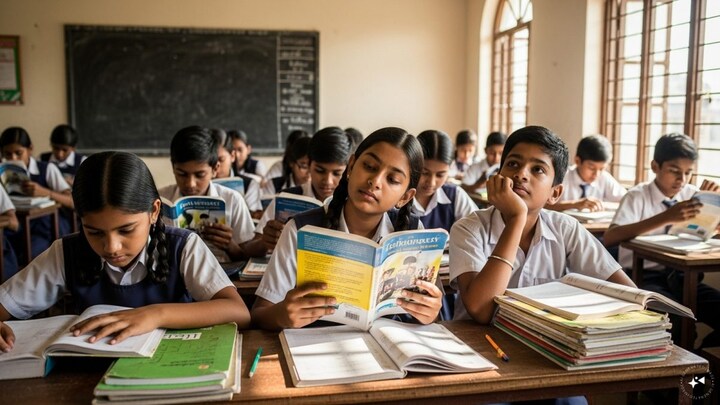
The National Education Policy (NEP) 2020 proposes that students study three languages up to Class 10, in contrast to the existing arrangement where they typically learn only two.
Third Language Becomes Compulsory from Class 6
CBSE has released the new school curriculum for Class 9 students, confirming that a third language will be compulsory from Class 6 beginning the 2026‑27 academic session. Under this framework, every learner will be required to study at least two Indian languages in addition to a third language, thereby expanding the linguistic exposure that students receive during their formative years.
The National Education Policy (NEP) 2020 explicitly recommends that pupils engage with three languages up to Class 10, a shift from the long‑standing practice of studying only two languages. This policy direction is now being operationalised through the CBSE curriculum, ensuring that the three‑language formula becomes a structural feature of school education.
CBSE Chairman Rahul Singh clarified that the third language, designated as R3, will not be mandatory for the current cohort of Class 9 learners. Instead, R3‑level textbooks will be rolled out for Class 6 students in the present academic year. CBSE Chairman Rahul Singh explained that students who begin their secondary schooling this year will sit for board examinations in 2031, a point by which the three‑language model is expected to be fully entrenched.
Language Choice and Hierarchy
CBSE outlines a clear hierarchy for language selection. In schools where English is introduced at the Class 6 level, English will be classified as the foreign language, while students must also enrol in two Indian language courses. If learners opt for another foreign language such as French or German, the requirement to study two Indian languages remains unchanged. This dual‑language mandate ensures that Indian linguistic heritage is preserved even when alternate foreign languages are pursued.
The structure therefore guarantees that irrespective of the foreign language chosen, the curriculum will always incorporate two Indian language components. This arrangement aligns with the broader objectives of the National Education Policy (NEP) 2020, which seeks to promote multilingual proficiency and cultural continuity.
Vocational Education Becomes a Core Subject
Vocational Education Mandatory
The revised curriculum also designates art education, vocational education, and physical education as compulsory subjects for Classes 9 and 10. Textbooks for art education and physical education will be introduced alongside the existing material, providing a structured learning path for these disciplines.
During the current academic year, Class 10 learners will undergo school‑based assessments for art and physical education, a method that will continue in the immediate future. From the 2027‑28 academic session onward, vocational education will transition to a mandatory status, complete with an annual or board examination. This shift marks a decisive move toward integrating practical skill development into mainstream secondary education.
While vocational education will be assessed through formal examinations, art and physical education will retain internal, school‑based assessment mechanisms. This blended assessment strategy is intended to balance academic rigour with creative and physical development.
Computational Thinking and Artificial Intelligence
In addition to language and vocational components, computational thinking and artificial intelligence (AI) will become compulsory subjects for Classes 9 and 10. In the current academic session, these topics will be introduced as modules that are evaluated through internal assessments. The intent is to familiarise learners with digital literacy concepts before elevating the subjects to board‑exam status.
By 2029, computational thinking and AI will be formalised as board examination subjects for Class 10, reflecting the growing importance of technology in contemporary education. Moreover, the curriculum rollout for these subjects will commence for Classes 3 to 8 during the current academic year, ensuring a gradual buildup of competency across lower grades.
Assessment Framework and Examination Timeline
The assessment architecture for the new curriculum differentiates between subjects that will be examined through board examinations and those evaluated via school‑based assessments. For the third language (R3), board examinations will be introduced for Class 10 students in the year that aligns with the full implementation of the three‑language model, projected to be 2031.
Vocational education will adopt an annual or board examination model from the 2027‑28 academic session, providing a standardized measure of skill acquisition. In contrast, art education and physical education will continue to rely on internal assessments conducted by individual schools, preserving flexibility for creative expression and physical training.
Computational thinking and AI will follow a two‑stage assessment pathway: internal module assessments in the initial year, followed by board examinations for Class 10 in 2029. This phased approach is designed to give learners ample time to develop foundational knowledge before facing high‑stakes examinations.
Implications for Learners and Schools
For students, the mandatory inclusion of a third language from Class 6 expands linguistic competence and aligns with the multilingual ethos promoted by the National Education Policy (NEP) 2020. The additional requirement will necessitate careful scheduling and resource allocation within schools to accommodate the increased instructional load.
Schools will be tasked with preparing R3‑level textbooks for Class 6, training educators to deliver the new language content, and integrating vocational, art, and physical education materials into existing curricula. The transition also calls for the development of assessment tools that capture both knowledge and practical skill, especially in the domain of vocational education.
Teachers will need to adapt pedagogical strategies to address the diverse language needs of learners, while also incorporating computational thinking and AI concepts at an early stage. Professional development programmes will likely play a crucial role in equipping educators with the requisite expertise.
Conclusion
The CBSE curriculum overhaul, guided by the National Education Policy (NEP) 2020, represents a comprehensive effort to enrich secondary education with multilingual proficiency, technological literacy, and practical skill development. By mandating a third language from Class 6, introducing compulsory AI and computational thinking, and embedding vocational education as a core subject, CBSE aims to produce well‑rounded graduates equipped for the challenges of the 21st century.
While the implementation timeline stretches across several academic sessions, the phased rollout ensures that learners, teachers, and institutions can adapt progressively. The strategic emphasis on language, technology, and vocation underscores a forward‑looking vision for Indian education, one that balances cultural heritage with modern competencies.