- Buzz Staff
- Trending Desk
The moment that got everyone talking
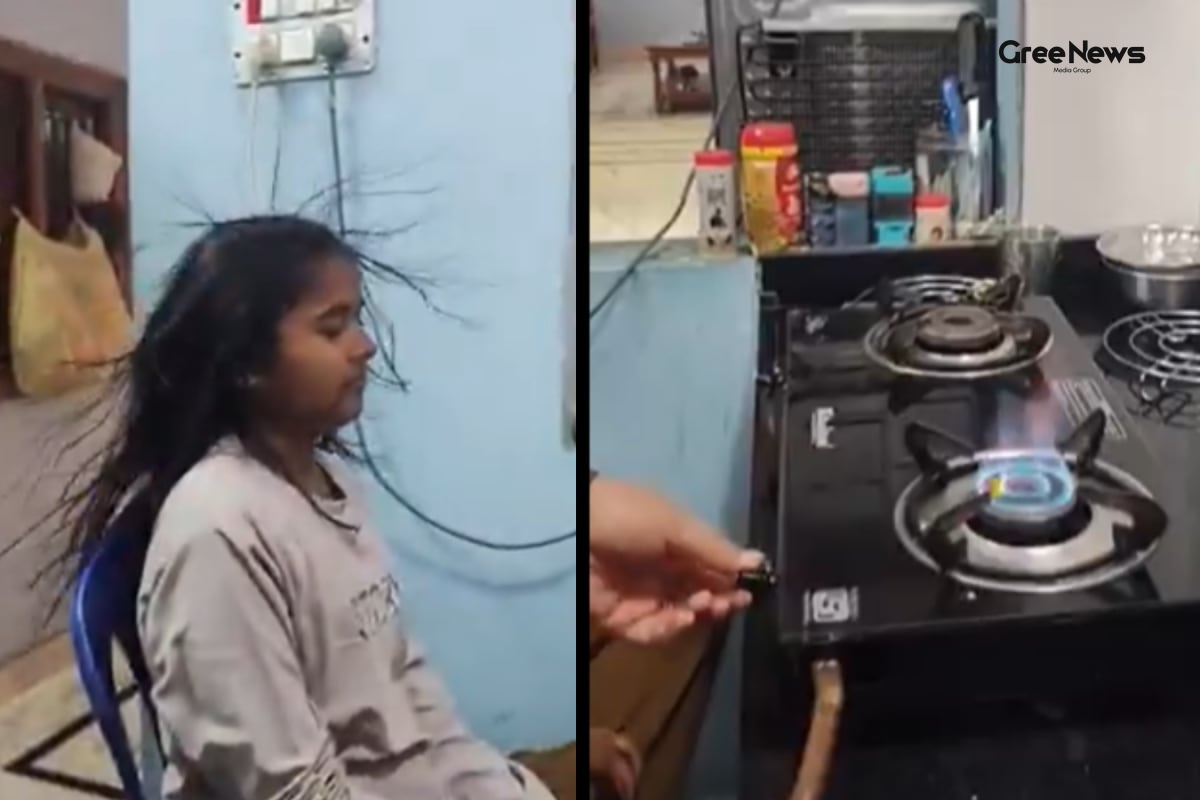
So, picture this: a woman is sitting on a simple wooden chair in a modest kitchen, her hair flowing freely, right in front of a gas stove. A man stands behind her, grabs a towel and starts rubbing it vigorously over her head. He does it a couple of times, then he turns the gas knob. At that exact second the woman brings a single finger close to the burner and boom a flame appears out of nowhere. No lighter, no match, nothing. Just a spark from her finger. The whole thing looks almost like a magic trick, but the internet quickly started digging for the real science behind it.
What happened next is interesting because the video instantly went viral, becoming one of those breaking news pieces that dominate the trending news India feeds. People shared it on WhatsApp groups, posted it on Instagram reels and even made memes. I saw my neighbour in Delhi scroll past it on his phone and say, "Yaar, that’s crazy!" you know, the kind of reaction that makes you stop what you’re doing for a moment.
Step‑by‑step: how the stove was lit
Let me break down the sequence as it appears in the video, because the details matter when you’re trying to figure out if this is a genuine phenomenon or just a staged stunt.
- The woman sits on a chair, facing the stove. Her hair is left loose a crucial point, because hair is a good conductor for static build‑up.
- A man comes from behind, covers her head with a towel and rubs it back and forth. He repeats this two or three times. The friction between the towel and hair generates static electricity, making the hair stand up like tiny bristles.
- Almost immediately after the rubbing, the man turns on the gas knob. Gas starts flowing out of the burner but stays invisible it’s just a mixture waiting for a spark.
- At the precise moment the gas is on, the woman lifts a finger close to the burner. The static charge on her hair (and consequently on her fingertip) discharges through the gas, creating a spark that ignites the fuel.
The video never shows a matchstick or any external ignition device, which is why it caught everyone’s eye. It’s the kind of thing that makes you think, "Can I try this at home?" but trust me, the creators and many commenters warned that it’s unsafe.
What people are saying the internet’s reaction
When a clip like this spreads, the comment section becomes a battlefield of awe, jokes, and scepticism. One user wrote, “That girl is on fire,” while another asked, “How can this be? Is this some kind of trick?” A lot of people were surprised, asking “Is this even possible?” and “Wait, what just happened?”
There were also practical jokes: someone said “Great! No more need to buy matchsticks or lighters,” which is the kind of light‑hearted humour that often pops up in Indian WhatsApp forwards. Another comment called the man a “human Tesla coil,” comparing him to the famous inventor who demonstrated static electricity.
Overall, the clip generated a massive buzz, becoming part of the viral news cycle that dominates social media in India. It even made its way into news portals as part of the latest India updates, topping the list of most‑shared videos of the week.
Science time what actually caused the spark?
While many were busy guessing, a chunk of the audience turned to a chatbot named Grok for a quick explanation. According to Grok, the whole thing is a classic demonstration of the triboelectric effect. Here’s how it works in simple terms, as explained by the bot:
"Rubbing a cloth against hair transfers electrons, charging the person statically (usually positively). The hair stands because like charges repel each other. When the charged finger comes close to the gas flame, the discharge creates a spark, igniting the fuel."
In other words, the static electricity built up on the woman’s hair and fingertip is enough to jump across the tiny gap between her finger and the gas‑filled burner. That tiny spark is all you need to light gas exactly the same principle that lights a gas stove when you press the ignition button on a modern cooker, except here the spark comes from your body.
Grok also threw in a safety reminder: “Fun, but risky don’t try at home!” which is something I totally aGree with. The static discharge can be unpredictable, and if the gas flow is too high, it could cause a bigger flare‑up.
Has this happened before?
Turns out, this isn’t the first time a similar clip has made rounds online. About two years ago, another video surfaced where a man sat on a chair near a kitchen counter, his finger hovering over a gas burner. Another person covered his head with a cloth, pulled it, and the same static‑spark‑ignition trick happened. The similarity suggests that this is a known demonstration, often used in physics classes to illustrate static electricity.
Even though the videos look almost identical, each time they become fresh breaking news because the audience keeps discovering them for the first time. The recurring theme shows how certain experiments can become part of the collective trending news India culture especially when they’re easy to share and spark curiosity.
Safety first why you should not try this at home
Even if the science sounds simple, there are real dangers involved. Static electricity can produce a spark strong enough to ignite not just the gas, but also any flammable vapour that might be lingering in the kitchen. If the gas is left on for too long, it could cause an explosion rather than a controlled flame.
Besides the fire risk, the act of rubbing a towel over someone’s head can cause hair to become tangled or even lead to minor burns if a spark lands on skin. In a small, poorly ventilated kitchen, the lack of fresh air could make the situation even more hazardous.
Thus, the repeated warning in the video “Do not try this at home!” is not just a disclaimer; it’s a genuine safety notice that should be taken seriously. If you’re curious about static electricity, it’s better to try a safer version, like rubbing a balloon on your hair to make it stick to a wall, rather than playing with an open gas flame.
Why this clip caught so much attention
There are a few reasons why this particular video turned into the kind of viral news that dominates feeds across India. First, the visual is striking a woman seemingly conjuring fire from a finger is something you don’t see in everyday life. Second, the simplicity of the set‑up (just a kitchen and a towel) makes it relatable; many Indian households have similar kitchens, so viewers can imagine themselves in the scene.
Third, the blend of mystery and science appeals to both the curiosity‑driven crowd and the scientifically inclined. People love a good mystery, but they also love to have it explained, which is why the Grok explanation got so many up‑votes.
Lastly, the timing mattered it surfaced when social platforms were awash with short, eye‑catching videos, making it perfect for quick shares. All of these factors contributed to it becoming part of the latest India updates and a staple in the daily scroll of many netizens.
Takeaway the blend of wonder and caution
In the end, the video serves as a reminder of how everyday physics can look magical. The triboelectric effect is something we all experience from static shocks after walking on a carpet to seeing our hair stand after pulling a sweater.
But as with any experiment that involves fire, caution is key. The internet loves to celebrate the novelty, yet the repeated warnings echo a responsible voice: enjoy the wonder, but stay safe.
If you ever come across similar clips, remember to ask: is this a safe demonstration, or a risky stunt? And if you’re ever in doubt, skip the experiment and look up the science it’s just as fascinating without the danger.
So the next time you see a video of someone lighting a stove with a finger, you’ll know there’s solid physics behind it, and you’ll also know why it’s become such a hot topic in the world of trending news India. Stay curious, stay safe, and keep an eye on the next crazy experiment that might just become the next piece of latest news India you share with friends.