Turning Retirement Into a Playground of Gigantic Objects
Steve Wainwright, a 62‑year‑old former engineer, discovered that the routine of cooking and cleaning offers only a limited window of engagement once the daily grind has ended. After stepping away from a career with the East of England Ambulance Service in Melbourn, Cambridgeshire, Steve Wainwright found the quiet of retirement surprisingly empty. Rather than succumb to inactivity, Steve Wainwright chose to channel creative energy into a hobby that would fill both time and space within the family home.
“Once retired you can only cook and clean for so many hours,” Steve Wainwright explained, emphasizing the desire for a more stimulating pursuit. The result? A series of supersized models that transform everyday items into monumental works of art.
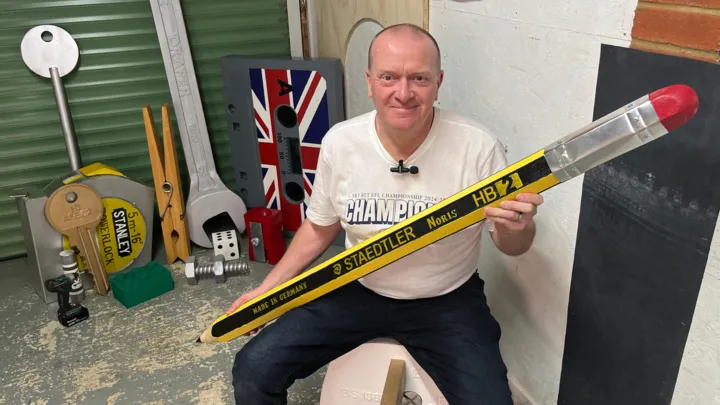
Residing in Peterborough with Cat Thompson, Steve Wainwright has turned the family residence into a living gallery. The interior walls of the garage and the converted summer room now host a parade of objects that were once commonplace, now magnified to a scale that challenges perception.
Conceptual Roots and the Decision to Enlarge
The idea germinated during a quiet afternoon when Steve Wainwright was searching for a new project to occupy the mind. The notion of scaling familiar objects emerged as an attractive challenge, partly because of a self‑deprecating admission: “I’m not very good at maths, so I made them ten times the size.” This whimsical rationale set the tone for a series of creations that are simultaneously playful and technically ambitious.
Each object is deliberately chosen for its recognizability. By selecting items such as a pencil, a clothes peg, an audio cassette and a 13‑amp plug, Steve Wainwright ensures that observers can instantly identify the inspiration while marveling at the sheer scale. The decision to replicate these particular objects also reflects a nostalgic connection to the era of analog technology, recalling the aesthetic of 1980s cinema where everyday items become larger‑than‑life symbols.
Materials, Methods, and the Craftsmanship Behind the Gigantism
Steve Wainwright’s engineering background informs the selection of materials and construction techniques. The majority of the pieces combine wood, metal and plastic in a layered approach that balances durability with visual fidelity. For instance, the giant pencil begins with a robust wooden core that provides structural support. Over this core, metal bands are added to mimic the metal ferrule found on standard pencils, while a plastic coating reproduces the familiar yellow paint finish.
The clothes peg, towering over a garden fence, follows a similar methodology. A sturdy timber frame forms the backbone, metal hinges are affixed to recreate the functional movement, and a smooth plastic overlay gives the appearance of the usual bright orange hue. Throughout each build, Steve Wainwright employs a sequence of cutting, shaping, drilling and sanding, followed by meticulous painting to achieve a polished final product.
Time commitment is a significant factor; Steve Wainwright typically spends up to two weeks on a single piece, from initial design sketches to the final coat of varnish. The financial outlay, meanwhile, accumulates to approximately £2,500, a sum that covers the cost of lumber, sheet metal, plastic panels, paints, fasteners and specialised tools required for the scaling process.
From Novelty to Function: Repurposing Supersized Items
While many of the oversized objects serve primarily as visual spectacles, Steve Wainwright has also ingeniously repurposed several pieces into functional household items. The giant tape measure, for example, has been transformed into a coffee table, its long graduated surface providing a unique tabletop that doubles as a conversation starter. Similarly, the massive 13‑amp plug has been retrofitted into a bespoke cupboard, offering storage space concealed within a recognisable electrical form.
These adaptations underline Steve Wainwright’s practical mindset: each whimsical creation can also integrate into daily life, blurring the line between art and utility. This dual purpose adds a layer of relevance that extends beyond mere decoration, allowing the family to interact with the pieces in a tangible manner.
The Garden Workshop: A Self‑Made Production Hub
The heart of the operation lies within a garden workshop that Steve Wainwright constructed independently. This purpose‑built space provides the essential tools, workbenches and storage required for the ambitious builds. Organized with sections for cutting, assembly and finishing, the workshop resembles a small‑scale industrial studio where each oversized project progresses from raw material to finished sculpture.
Steve Wainwright’s hands‑on involvement in erecting the workshop itself mirrors the same do‑it‑yourself ethos that guides the creation of the giant objects. The workshop’s walls are lined with shelves that hold spare lumber, metal sheets, and assorted hardware, while a dedicated painting area ensures that each piece receives the necessary time for coats to dry without contaminating other works in progress.
Community Interaction and the Market for Giants
Word of Steve Wainwright’s projects has travelled through local networks, leading to modest sales of certain pieces to neighbours and acquaintances. These transactions have occurred primarily through word of mouth, reflecting a grassroots interest in owning a piece of the oversized collection. Despite these occasional sales, Steve Wainwright emphasizes that the primary motivation remains personal enjoyment and the satisfaction of crafting something extraordinary.
Local residents who acquire a Steve Wainwright piece often comment on the novelty factor, noting how a familiar object, when magnified, becomes a striking focal point in any setting. The conversational value, combined with the functional adaptations, makes each piece a distinctive addition to a home or garden.
Family Perspective: Support and Shared Experience
Cat Thompson, 53, has observed the transformation of the family home with a mixture of amusement and admiration. “Steve Wainwright is just doing something rather than moping around the house all day,” Cat Thompson remarked, highlighting the positive impact of the hobby on daily life. Cat Thompson also noted the practical arrangement of the creations, explaining that “Steve Wainwright puts the stuff mainly on the garage wall and we have a summer room where Steve Wainwright keeps more of the stuff – but, it’s manageable.” This organizational approach ensures that the oversized pieces remain a feature rather than a source of clutter.
Cat Thompson further expressed appreciation for the way the hobby keeps Steve Wainwright occupied and “out of mischief.” The collaborative atmosphere in the garden workshop, where Cat Thompson occasionally assists with finishing touches or provides logistical support, reinforces the sense that the project is a shared family endeavour rather than an isolated pastime.
Reflection on a Life Reimagined After Work
Steve Wainwright’s journey from a career in emergency services to a self‑designed world of supersized objects illustrates the potential for creativity to flourish in later life. By applying engineering expertise to a whimsical concept, Steve Wainwright has built a living exhibit that not only entertains but also serves functional purposes. The project demonstrates how retirement can become a catalyst for exploring new interests, repurposing skills, and fostering a sense of accomplishment that extends beyond professional achievement.
The combination of technical precision, artistic vision, and a playful disregard for conventional size has resonated with the local community, inspiring curiosity and admiration. As the garden workshop continues to produce new pieces, the collection grows, each addition adding another layer to the narrative of a retiree who refused to let idle time dictate his days. In doing so, Steve Wainwright has crafted a tangible reminder that imagination knows no age limits, and that even the most ordinary objects can become extraordinary when viewed through a lens of scale and creativity.