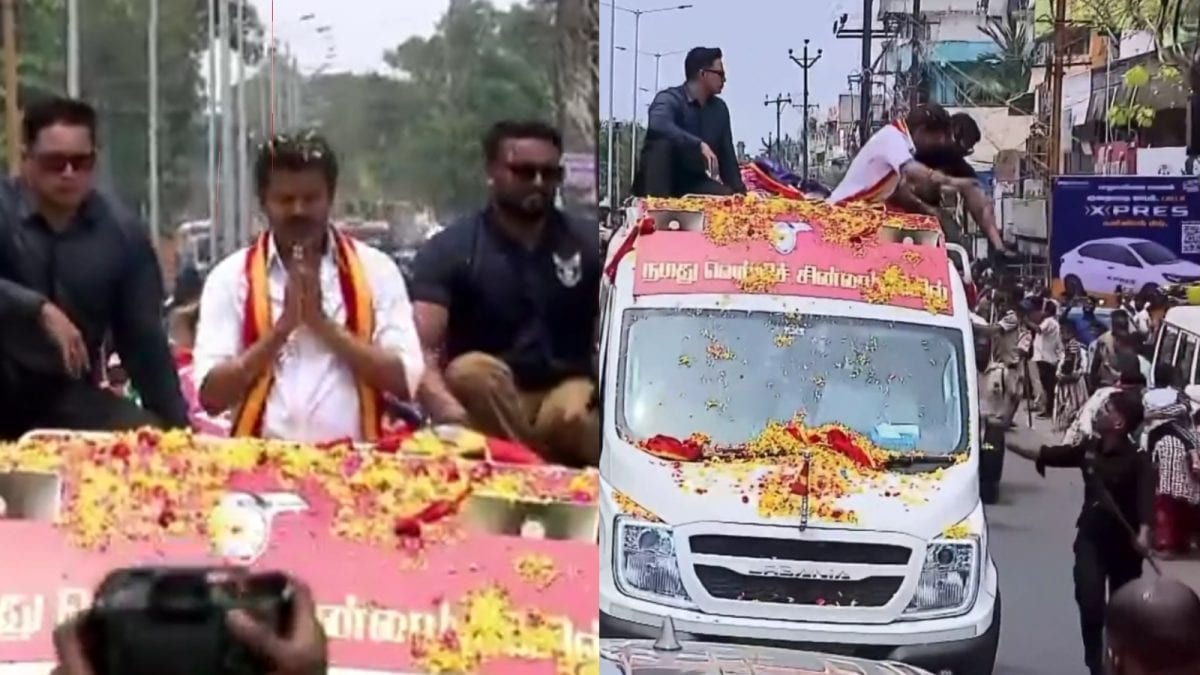
Viral Clip Shows Thalapathy Vijay’s Reaction at the Puducherry Rally
When I first saw the video, I thought it was some staged drama because the whole thing looked so raw. In the footage, Thalapathy Vijay is seated inside a decorated vehicle, waving at supporters who have gathered along the road in Puducherry. Suddenly, a security personnel moves an elderly man aside to make room for the vehicle. The elderly man, who is visibly shocked, tries to stand his ground, but the security personnel pushes him a little harder. Right then, Thalapathy Vijay leans forward, eyes narrowing, and raises a hand as if to stop the whole thing. The moment feels like a sudden pause in a bustling market where someone finally says, “Hold on, that’s not right.”
What strikes me most is the look on Thalapathy Vijay’s face – a mix of genuine surprise and irritation. It is not a rehearsed expression; you can see the frown forming, the eyebrows drawing together, and the voice that follows is low but firm. Thalapathy Vijay calls out the security personnel, asking why the elderly man was treated that way. The words are simple, “Why did you push him?” yet the tone carries a weight of responsibility that seems to come from more than just a momentary annoyance. It is as if Thalapathy Vijay is reminding the security team that the crowd isn’t just a static backdrop, but a living group of people, many of whom are senior citizens who deserve respect.
The video spreads like wildfire across social media platforms. Within hours, the clip has been shared by thousands of users, each adding their own commentary, emojis, and sometimes witty captions that compare the scene to a typical Chennai auto‑rickshaw discussion where the driver stops for an elderly passenger. The rapid spread of the clip reflects how quickly an ordinary incident can become a talking point when a public figure like Thalapathy Vijay is involved.
Fans Flood Social Media with Praise for Thalapathy Vijay’s Intervention
Scrolling through the comment sections, I noticed a pattern: people were not just commenting about the security lapse, but were deeply appreciative of Thalapathy Vijay’s quick stand. Some fans wrote, “Thalapathy Vijay’s care for his people never fades,” while others added, “Great leadership qualities – you can’t ignore the elderly.” It felt like a chorus of voices echoing in a temple courtyard, each chant reinforcing the same belief that Thalapathy Vijay is still connected to the common man.
One comment even compared the incident to the feeling of watching a neighbour help an old lady cross a busy street in a Hyderabad suburb. The notion was simple: when a well‑known figure like Thalapathy Vijay behaves like any caring neighbour, it resonates with ordinary folks who daily see youngsters helping grandparents at bus stops or markets. The ripple effect is clear – Thalapathy Vijay’s reaction becomes a benchmark for how leaders should act in public.
In a few short days, the praise turned into a broader conversation about empathy in politics. People started sharing stories of their own experiences at rallies where security teams were either too aggressive or, conversely, too lax. In one anecdote, a supporter from Coimbatore mentioned how a security guard once offered a can of water to a child standing under a scorching sun during a film promotion. The stories built a tapestry of expectations: a leader who not only speaks about the people but also watches over them in real time.
Thalapathy Vijay’s Full‑Time Commitment to Tamilaga Vettri Kazhagam (TVK)
Beyond this particular incident, it is essential to understand the larger backdrop – Thalapathy Vijay has officially shifted all focus to politics. In the last year, Thalapathy Vijay announced the formation of a political party called Tamilaga Vettri Kazhagam (TVK). The party name itself carries a promise of progress for Tamil people, and it signals a transition from the silver screen to the political arena. The announcement was made through a press conference that felt more like a movie premiere, complete with banners, a crowd chanting slogans, and a sense of anticipation that one usually associates with a new film release.
When I watched that press conference, I could see the same intensity that Thalapathy Vijay brings to his film roles. He declared that the upcoming movie Jana Nayagan would be the final on‑screen appearance. This declaration underscores a decisive moment: a star who has spent decades entertaining millions now wants to channel that energy towards service. The decision to step away from acting entirely, especially while still at the peak of popularity, adds a layer of authenticity to Thalapathy Vijay’s actions at rallies – it’s not a flash in the pan, but a committed shift.
Supporters of Tamilaga Vettri Kazhagam (TVK) often liken the party’s philosophy to that of a beloved renovation of an old house – you keep the foundation strong while upgrading the rooms to meet modern needs. The party’s agenda focuses on youth employment, education, and infrastructure development, topics that frequently surface in Thalapathy Vijay’s speeches. The slogan “Jana Nayagan” itself translates to “people’s hero,” a role that Thalapathy Vijay wants to embody not just on screen but also in the legislative corridors.
Recollection of Earlier Rally Controversy in Karur
It is worth noting that the Puducherry episode is not the first time Thalapathy Vijay’s rallies have attracted intense scrutiny. Back in September of the previous year, a rally in Karur turned chaotic. A sudden stampede unfolded, leading to multiple casualties and injuries. The images from that day showed panicked crowds, police trying to control the flow, and a sense of urgency that felt like a festival that went awry. The incident left a lingering concern about crowd‑control measures at large gatherings, especially when the crowd is highly enthusiastic.
Even though the Karur incident was far more severe, the recent Puducherry clip brings back the conversation about safety and the responsibilities of political organizers. While the elderly man’s push was a relatively minor breach of protocol compared to a stampede, it still shines a light on how quickly a small oversight can become a point of public debate. The comparison also serves as a reminder that Thalapathy Vijay’s team has been learning from past experiences, trying to balance the excitement of supporters with the practical need for order.
Observers often highlight that the Karur rally reminded political parties across the state to invest in better barricades, trained volunteers, and clear signage – much like how a well‑planned wedding in Kerala ensures that every guest knows where to sit. The Puducherry incident, though less dramatic, still underscores that every rally, no matter how small, needs a solid plan for the vulnerable sections of the audience.
What This Means for Crowd Management and Future Rallies
From a personal perspective, watching these events unfold feels like seeing a familiar cricket match where the umpire gives a gentle warning before calling a big decision. The warning – in this case, Thalapathy Vijay’s own admonishment – acts as a cue for the entire crew to tighten up. Security personnel at future rallies will likely receive more explicit instructions about how to handle senior citizens, children, and people with mobility issues. It is a bit like the way local transport drivers in Delhi now receive training to assist passengers with disabilities.
Moreover, the viral nature of the video means that any misstep will be broadcast instantly to millions. This reality pushes organizers to be more cautious, much like how a chef in Chennai’s bustling market stalls has to watch every spice jar to avoid a sour taste. The fear of negative publicity can be a powerful motivator for better planning.
Finally, the public’s reaction – a mixture of praise, critique, and hopeful expectation – shows that people want leaders who are approachable and vigilant. When Thalapathy Vijay steps in to protect an elderly man, it sends a message that the leader’s concern extends beyond speeches to real‑time actions. In a country where political rallies can attract crowds the size of a small city, that personal touch can be as important as any policy document.
In conclusion, the Puducherry rally incident, captured in a short yet impactful video, serves as a micro‑cosm of the larger challenges and expectations faced by Thalapathy Vijay and Tamilaga Vettri Kazhagam (TVK). It highlights the need for empathy, thorough planning, and swift corrective measures. As supporters continue to share their thoughts, the hope is that these lessons will translate into smoother, safer, and more inclusive gatherings across the nation.