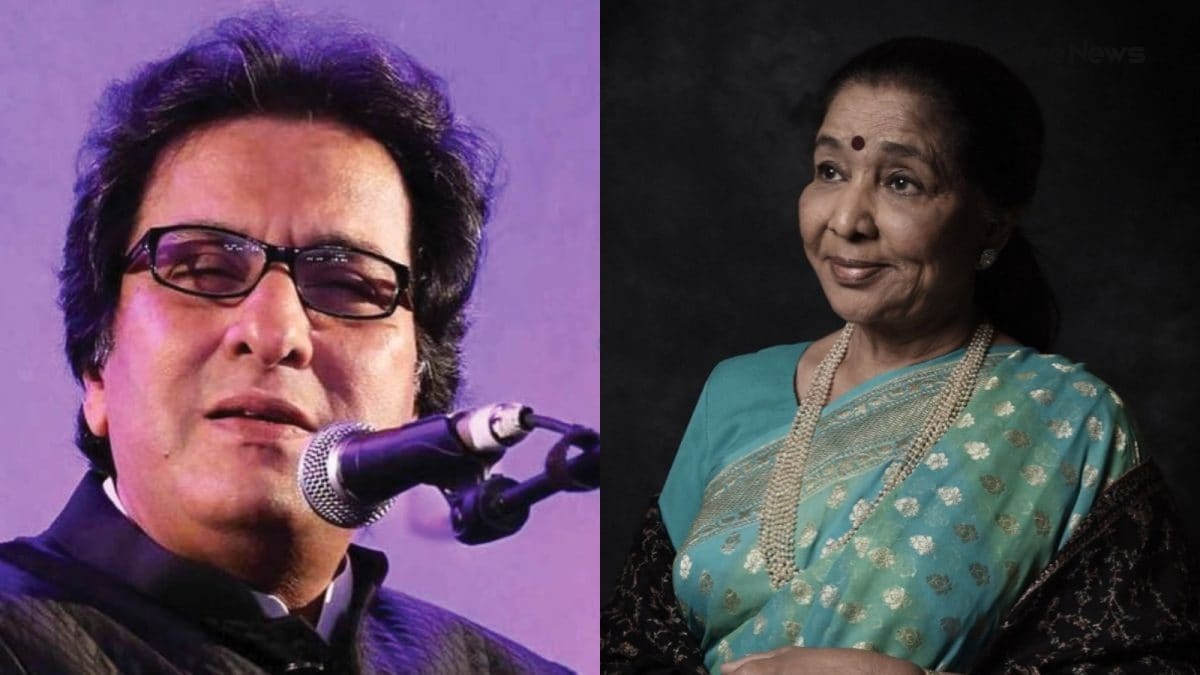
Talat Aziz recalls his last call with Asha Bhosle, sharing how she stayed positive and even sang on the phone despite being unwell.
When I first heard about Asha Bhosle’s passing, it felt like the music world had lost a part of its soul. As someone who had the privilege of sharing a few moments with her, I wanted to talk about that last conversation because it says a lot about how she faced life with a smile, a tune, and an unwavering spirit.
The unexpected video call
It was a regular day when my phone rang with a video call from Asha Bhoslet. I was in the middle of some work, but the moment I saw her face, my mind went back to the many studios we both visited years ago. I asked, “Kaise ho Asha-ji?” She answered, “Zara tabiyat theek nahi hai aajkal.” Even though she sounded under the weather, there was a spark in her eyes.
We started talking about the good old times the golden era of Bollywood, the legendary Lata ji, and the countless songs that shaped our childhoods. She laughed about a few funny incidents from the recording rooms, and I could hear her trying to keep the conversation light. She even said, “Ek kaam karo tum, jab vapas aaoge Mauritius se toh aake milna, baith ke baatein karenge.” I promised, thinking we’d have plenty of time, but destiny had other plans.
What really struck me was her tone. Despite the obvious fatigue, she was eager to talk, to reminisce, and to plan a future meet‑up. It felt like a scene straight out of a movie two singers, decades of memories, and a promise that never got fulfilled.
She sang on the phone a true artist’s heart
Now, here’s the part that surprised many of us. While we were chatting, Asha asked, “Meri aawaz kaisi lag rahi hai?” I could hear a faint strain in her voice, as if she was humming a fragment of a song. I replied, “Aap gaa rahi hain aur keh rahi hain meri tabiyat kharab hai, lekin sur bhi barabar lag rahe hain, kamaal hai.” It wasn’t just a casual question; she was genuinely testing her voice, checking if the melody still resonated.
She sang a short line, her voice still carrying that unmistakable texture that has enchanted listeners for decades. Even with a cold, her pitch was intact, her emotions still woven into every note. It was like she was telling the world, “I may be unwell, but I am still Asha Bhosle, the singer.” That moment, captured only in my memory, spread like viral news among those who heard about it later.
After the call the news that shocked everyone
Later that day, I spoke to Asha’s daughter‑in‑law. She told me that Asha was in a critical condition at a renowned hospital in Mumbai. I remember the heaviness in her voice, the worry that seemed to echo through the corridors. It was a stark contrast to the upbeat conversation we just had.
Only a short while after that, I got the heartbreaking news of her passing. It hit me hard because just minutes before, I could hear her humming, and now she was gone. The entire entertainment industry, from veteran actors to young singers, expressed their grief, making this story one of the most talked‑about pieces in the breaking news segment across India.
Tributes and the nation’s response
The moment the news broke, trending news India filled my feeds. Social media lit up with tributes, each post celebrating a different facet of Asha Bhosle’s career. Some talked about her iconic cabaret numbers, others recalled the soulful ghazals she rendered. A lot of people shared personal anecdotes a mother who sang “Piya Tu Ab To Aaja” to her children, a student who learned classical notes from her recordings, a fellow artist who once sang a duet with her on a rainy studio set.
Even today, the discussions continue. Fans are still sharing old videos, requesting her songs on radio stations, and quoting her lyrics in everyday conversations. It’s clear that Asha’s voice is not just music; it’s a part of our cultural fabric, and that’s why this story remains a part of the latest news India for weeks.
Remembering a legend Asha Bhosle’s unmatched legacy
Asha Bhosle’s journey spans over seven decades, during which she recorded thousands of songs in numerous languages Hindi, Marathi, Bengali, and even English. From the mischievous “Dum Maaro Dum” to the soulful “Chura Liya Hai Tumne Jo Dil Ko,” the range of emotions she could paint with her voice was immense.
She didn’t just stick to one genre. Classical ragas, light-hearted pop, ghazals, and western‑influenced numbers all found a home in her repertoire. She worked with legends like R.D. Burman, A.R. Rahman, and Shankar‑Ehsaan‑Loy, constantly reinventing herself. In fact, many younger singers say they learn a “Bhosle technique” for breath control just by listening to her recordings.
Her contributions were recognized with some of the highest civilian honours the Padma Vibhushan and the Dadasaheb Phalke Award, among many others. She also received several national awards for specific songs, reinforcing her status as a timeless icon.
Even beyond the music halls, Asha’s personality shone. She was known for her witty repartee, sharp sense of humor, and the ability to make anyone feel at ease. During a live interview once, when asked about her favorite song, she laughed and said, “Har gaana mera dost hai.” That’s the kind of attitude that made her beloved across generations.
What we can learn from her last moments
Listening to Talat Aziz’s recollection, there’s a lesson hidden in Asha’s approach to life. No matter how tough the situation, she chose to sing, to talk, to stay positive. Her last phone call was not a quiet resignation; it was a vibrant declaration that music was still her language.
In the midst of a health crisis, many of us might retreat, but Asha turned the phone into a stage. She asked about her voice, tested it, and sang. That small act became a source of inspiration for many, especially because it happened at a time when the nation was already grieving her impending loss.
For anyone facing challenges, her story reminds us that even in the darkest hours, there’s room for creativity, for a smile, and for a little song. It’s a message that resonates deeply in India’s current climate, where many are seeking hope amidst uncertainty.
Conclusion A voice that will forever echo
Talint Aziz’s memory of that final call adds a personal touch to the wave of tribute that has become a part of the breaking news and viral news landscape in the country. It reminds us that Asha Bhosle was more than a playback singer; she was a beacon of resilience, an artist who never stopped singing, even when her health faltered.
As India updates its cultural history, Asha’s songs will continue to be played at family gatherings, in film studios, and on radio stations that still celebrate her contributions. Her voice will keep echoing in the hearts of millions, and the story of her last call will be told and retold, keeping her spirit alive for generations to come.