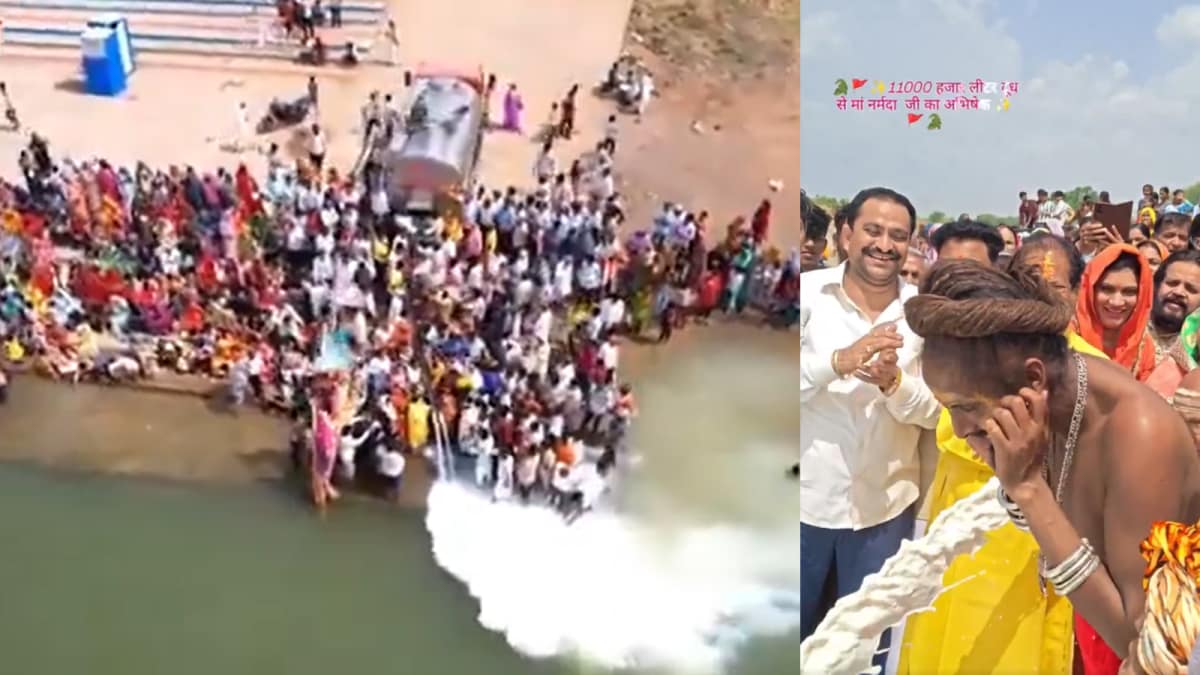
11,000 Litres Of Milk Poured Into Narmada: Organisers claim it purifies the river and brings prosperity
So, there was this big religious gathering at Satdev village, which lies in the Bherunda area of Sehore district, Madhya Pradesh. The place is about ninety kilometres from the district headquarters, and the people there are pretty devout. They follow a saint called Dada Ji Baba, and to mark the end of a twenty‑one day Mahayagna, they performed a Maha Abhishek ritual on a Wednesday. The highlight? They brought in tankers loaded with milk—roughly eleven thousand litres—to pour straight into the Narmada River.
Now, the amount of milk they used is not just a drop in the bucket; it’s the equivalent of Rs 5.5 lakh to Rs 8 lakh, depending on the market price. Sadhus in saffron robes were chanting mantras, waving their hands, and letting the milk flow into the water as if it were a holy offering. According to the organisers, the whole point was to cleanse the river and invoke prosperity for the community.
How the Video Went Viral (And Why Everyone Started Talking)
Honestly, I first heard about it when the video started popping up on my X feed while I was scrolling through memes about upcoming festivals. The clip shows a line of white tankers stopping at the riverbank, the milk being released, and a chorus of chanting in the background. Within hours, the video had been shared thousands of times, and the comment section turned into a battlefield.
People were posting everything from genuine shock to biting sarcasm. One user wrote, “In an ideal world, that’s a criminal offence,” while another said it was “like killing our rivers.” Even the comedian‑writer Varun Grover jumped in with his typical dry humor, tweeting, “Chill guys. Urea se banaaya hua doodh tha,” which loosely translates to “Relax, folks. It was milk made from urea.” The mix of outrage and jokes made the post trend faster than a Delhi metro at rush hour.
What Experts Are Saying About the Ecological Impact
Environmentalists were quick to point out that dumping such a large quantity of organic matter into a river is not a harmless act. Ajay Dube, an activist who works with river‑conservation groups, warned that the sudden influx of milk could deplete dissolved oxygen levels. He explained that fish and other aquatic life rely on oxygen in the water, and when organic waste breaks down, it sucks up that oxygen, leaving the river dead‑ish.
Subhash Pandey, another well‑known environmentalist, called the milk a “significant organic pollutant.” He said the situation could lead to eutrophication—basically, an over‑growth of algae that blocks sunlight and further reduces oxygen. He even referenced similar dairy‑effluent incidents in other parts of the world where rivers turned Green, smelt terrible, and became unsafe for drinking.
Both of them stressed that the Narmada is already under stress from industrial discharge, agricultural runoff, and the regular demands of a growing population. Adding a massive load of milk on top of that could tip the balance, especially in a stretch where towns depend on the river for drinking water.
The Timing That Made Everyone Angry
The real spark for the public outrage was the timing. Just a few weeks earlier, a video from Mahoba district in Uttar Pradesh surfaced, showing a school cook allegedly diluting two half‑litre milk packets into a bucket of water to serve as the mid‑day meal for an entire class. The contrast could not have been sharper: on one side, a handful of milk meant for thousands of children; on the other, thousands of litres being poured into a river that many people still rely on for clean water.
Social media timelines were flooded with side‑by‑side comparisons, memes, and angry comments. It felt like a punch in the gut for many parents who already struggle to provide proper nutrition for their kids. The whole thing became a symbol of what many see as a deep inequality: the rich performing grand rituals while the poor are left with sub‑par basics.
Why the Narmada River Is So Important (And Why It’s Already Strained)
Just to give some context, the Narmada River runs for about 1,312 kilometres, cutting across Madhya Pradesh, Maharashtra and Gujarat before spilling into the Arabian Sea. It’s called the lifeline of Madhya Pradesh because countless towns, villages and farms depend on its water for irrigation, drinking and even cultural rituals.
Over the years, the river has seen a lot of pressure—large dams, sand mining, industrial effluents, and agricultural runoff. In many stretches, the water quality has been flagged as unsafe for direct consumption. So when a ritual involves dumping a massive amount of milk, it isn’t just a symbolic act; it becomes a tangible ecological stressor.
People living along the banks have reported that the water sometimes smells like a dairy product after festivals. While that might sound funny, the reality is that the extra organic load can change the river’s chemical composition, making it harder for people to treat the water for drinking or cooking.
Personal Reflection: How I Felt Watching the Video
When I first watched the clip, I was sitting at breakfast with my family, sipping my chai, and the screen showed white milk swirling into the deep brown water. My first thought was, “Wow, that’s a lot of milk!” Then the comments started rolling in, and I felt a mix of disbelief and disappointment. I’m from a small town in Madhya Pradesh, and I’ve seen the Narmada at its best—full of fish, clear in the early mornings, and a place where my grandparents used to bathe.
Seeing it being used in a way that might harm it felt like an insult to those memories. At the same time, I understand why people want to honour their saints and perform traditional rites. It’s just that sometimes tradition needs to evolve with the times, you know?
What Supporters Are Saying: Defending the Ritual
On the other side of the argument, many devotees defended the ceremony. They said that the milk offering is an age‑old practice, meant to appease river‑gods and bring good harvests. Some even quoted scriptures that talk about “Abhishek” – the ritual of pouring sacred liquids over a deity or a natural element.
One local leader from Satdev village said, “We are not dumping waste; we are offering respect. The milk is pure, and we chant prayers for the river’s health.” He also pointed out that the ceremony was performed after a long and strict purification process, which, in their belief, mitigated any negative impact.
These supporters argue that the ritual brings social cohesion, a sense of identity, and even tourism to the area. The whole event attracted a few hundred pilgrims, some of whom bought local snacks and boosted the small economy.
Balancing Faith and Ecology: Possible Middle Grounds
Many experts suggest that traditions can adapt without losing their essence. For instance, using a smaller quantity of milk, or perhaps symbolic offerings like flower petals, could still convey devotion while sparing the river.
There have been cases where temple committees switched to using water mixed with turmeric or rose water for rituals, citing environmental concerns. In Kerala, some temples now use cow dung, which is considered holy, but they spread it on the ground instead of dumping into water bodies.
If the devotees of Dada Ji Baba could consider a similar compromise—perhaps a ‘dry ceremony’ where the milk is used to wash idols and then the leftover water is filtered and reused—the community might preserve both faith and the river’s health.
Legal and Policy Angles: Is This Even Allowed?
Legally, the Indian Water (Prevention and Control of Pollution) Act prohibits the dumping of any waste that can jeopardise water quality. While the law mainly targets industrial discharges, some environmental lawyers argue that large organic loads—like 11,000 litres of milk—could also be considered a pollutant.
In a few states, local panchayats have started issuing guidelines for river‑related ceremonies, requiring organisers to get clearance and to ensure that any offerings are biodegradable and won’t cause harm. So far, it’s unclear whether the Satdev ceremony had any official permission, or if it slipped through a regulatory grey zone.
Whether or not the authorities will step in remains to be seen, but the episode has certainly raised awareness about the need for clearer guidelines on religious practices that involve natural water bodies.
Looking Ahead: What This Means for Future Rituals
Going forward, I think we’ll see more debates like this, especially as India continues to urbanise and climate pressures mount. People will keep wanting to honour their traditions, but the environment can’t be ignored. The conversation is slowly shifting toward “Green spirituality,” where seekers try to make worship eco‑friendly.
Some NGOs are already working with temples and ashrams to develop guidelines: using less water, planting trees as part of the ceremony, or even hosting “clean‑river” drives after the rituals. If these ideas catch on, maybe you’ll hear about a Maha Abhishek that ends with volunteers cleaning up the riverbank instead of pouring milk.
In the end, the story of milk in the Narmada is more than just a headline; it’s a snapshot of a nation wrestling with its past, present and future. And as someone who grew up hearing the Narmada’s songs in lullabies, I hope we find a way to keep those songs alive without drowning them in milk.