AFCON Row Deepens: Morocco Claims Referee Was "Told Not To Penalise" Senegal – Report
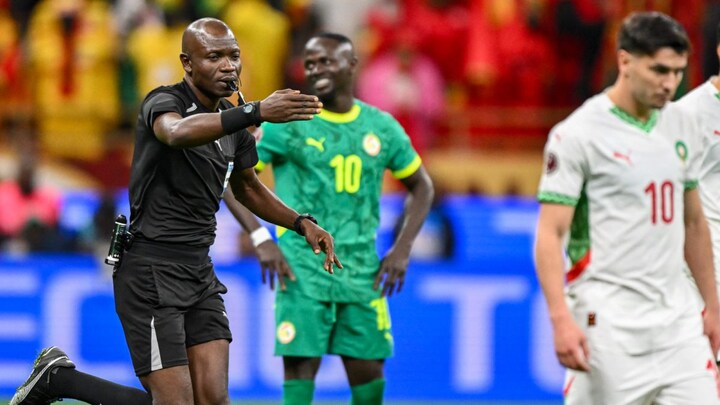
Fresh reports claim referees were instructed not to penalise Senegal during their protest. Morocco were later awarded the title after CAF ruled it a forfeit.
When observers believed the controversy surrounding the African Cup of Nations final had reached its apex, a fresh twist emerged that added another layer of complexity to an already tangled narrative.
The ongoing debate over the "real winner" of the final—a match that featured Senegal and Morocco—has now been joined by allegations that match officials received explicit instructions to refrain from issuing disciplinary measures against Senegal during an on‑field protest that temporarily halted play.
What Unfolded in Rabat
The incident took place in Rabat, where Senegal, under the guidance of coach Pape Thiaw, walked off the field for approximately fifteen minutes. The walk‑off was triggered by the awarding of a late penalty to Morocco, a decision that ignited intense frustration among Senegal players and provoked a volatile atmosphere among spectators.
When the referee signalled the resumption of play, Morocco’s forward Brahim Diaz attempted a daring Panenka from the penalty spot. Edouard Mendy, standing in goal for Senegal, produced a spectacular save that preserved the deadlock.
Extra time saw Senegal break the stalemate through a powerful strike from forward Pape Gueye, granting Senegal a 1‑0 lead that appeared decisive.
Nevertheless, the match did not conclude on the pitch. CAF later classified Senegal’s walk‑off as a forfeit, stripping Senegal of the championship title and awarding the victory to Morocco. Senegal responded by lodging an appeal before the Court of Arbitration for Sport, contesting CAF’s interpretation of the events.
Morocco’s New Strategic Angle
A report from the outlet RMCSport has introduced an additional dimension to the saga. According to the report, after Morocco’s federation appealed the initial disciplinary ruling, federation secretary‑general Tarik Najem submitted a dossier that alleged covert pressure exerted on the match referee.
The report highlights the involvement of Olivier Safari, a senior CAF official, who allegedly made emphatic statements during a CAF executive meeting held in Tanzania. The reported quotation reads:
“Olivier Safari is said to have acknowledged that institutional instructions were given [during the interruption] to the match referee not to sanction Senegalese players with a yellow card… ‘in order to preserve the match’ upon their return to the field.”
If the quotation reflects an authentic exchange, the implication is that two Senegal players who were already on the brink of disciplinary action could have faced dismissal had the referee been permitted to enforce the rules without interference.
Unanswered Questions and Technicalities
The central question that now dominates discussion is whether the referee operated under undue pressure to sustain the continuity of the match at any cost. While no yellow cards were issued to the teammates of Sadio Mane during the episode, CAF’s appeals jury ultimately relied on a different provision of the competition regulations: the act of abandoning the field was interpreted as an abandonment of the match, a technicality that automatically transferred the championship to Morocco.
The emergence of the alleged instruction to the referee complicates the narrative, suggesting that the decision to avoid punitive measures against Senegal may have been motivated by a desire to keep the contest alive rather than by pure sporting considerations.
Legal Battle and Future Implications
Senegal’s challenge before the Court of Arbitration for Sport continues to examine whether CAF’s application of the forfeit rule was consistent with the statutes governing the tournament. The legal proceedings also aim to assess whether the purported communication from Olivier Safari, as reported by RMCSport, constitutes a breach of procedural fairness.
Should the arbitration panel find merit in Senegal’s arguments, the outcome could entail a revision of the final result, a reinstatement of Senegal’s title claim, or at the very least, a formal acknowledgment of procedural irregularities.
Beyond the immediate legal ramifications, the controversy raises broader concerns about the integrity of officiating in high‑stakes continental competitions. Stakeholders, including national federations, players, and fans, are likely to demand transparent guidelines that safeguard referees from external influence, ensuring that disciplinary actions are applied uniformly and without prejudice.
Summary of the Ongoing Drama
The African Cup of Nations final between Senegal and Morocco has evolved into a multi‑faceted dispute involving on‑field protest, regulatory interpretation, alleged institutional interference, and an ongoing legal contest. The core facts remain unchanged: a late penalty awarded to Morocco sparked Senegal’s walk‑off; the walk‑off was classified as a forfeit by CAF; Morocco was consequently declared champion; and new allegations suggest that the match referee may have been instructed to avoid penalising Senegalese players during the interruption.
As the arbitration process proceeds, the football community watches closely, aware that the resolution will not only shape the legacy of this particular tournament but also set precedents for how disciplinary matters are addressed in future continental championships.