‘Dhurandhar CM’ vs ‘Lyari Raj’: Uttar Pradesh’s Hoarding War Draws Bollywood, Crime Lore, and Election Drama
Street‑Level Campaigning Begins Long Before Election Day
Even though the next Uttar Pradesh Legislative Assembly election remains more than a year away, political actors have already transformed the state’s urban corridors and rural junctions into a sprawling visual battlefield. Massive posters and hoardings inspired by the hit Bollywood film Dhurandhar now dominate busy intersections, railway platforms, and even the vicinity of the chief minister’s residence in Lucknow. The rapid emergence of these billboards has sparked a heated controversy that intertwines cinema, criminal mythology, and the looming electoral showdown.
Dissecting the Message on the Posters
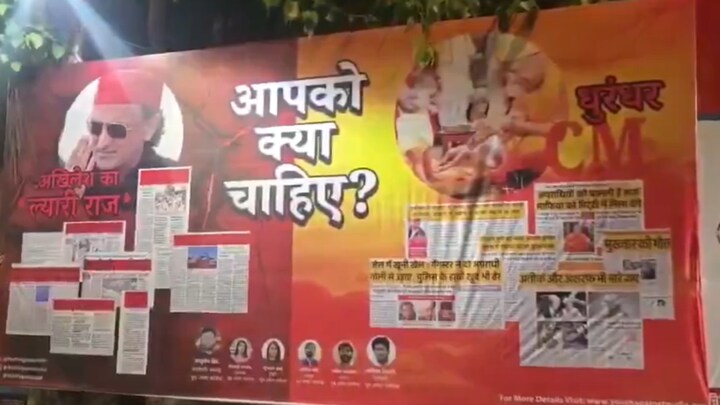
A standout billboard positioned outside the railway station in Amethi declares, “What do you want — ‘Dhurandhar’ work, or Akhilesh Yadav’s ‘Lyari Raj’?” The design pits two political figures against each other in stark, symbolic contrast. On the left, Akhilesh Yadav is rendered in the visual style of Rehman Dakait, the Pakistani gangster antagonist of Dhurandhar, with surrounding newspaper cut‑outs that allege misconduct during the previous Samajwadi Party government. On the right, Yogi Adityanath is presented as the “Dhurandhar CM,” depicted performing religious rituals while a collage of headlines highlights the demise of notorious gangsters such as Mukhtar Ansari and Atiq Ahmad under Yogi Adityanath’s tenure.
Understanding the ‘Lyari Raj’ Reference
The phrase “Lyari Raj” draws its power from the neighborhood of Lyari in Karachi, Pakistan, a locality historically notorious for violent gang confrontations and lawlessness. The Dhurandhar film markets this setting as a symbol of unchecked criminality. By branding Akhilesh Yadav’s past administration as a “Lyari Raj,” the creators of the hoarding deliver a pointed accusation that the former government was tantamount to a law‑less enclave, a metaphor designed to sting supporters of the Samajwadi Party and sway undecided voters.
Who Is Behind the Hoardings?
The visual campaign has been claimed by a collective that identifies itself as Youth Against Mafia. The posters prominently display the names and photographs of the group’s executive president, its general secretary, and the in‑charge for Pratapgarh. The general secretary of Youth Against Mafia, Abhinav Tiwari, articulated the group’s objective as a desire to raise awareness among the generation that grew up with smartphones and social media about the transformation of Uttar Pradesh under the current administration compared with the previous rule.
Each iteration of the Youth Against Mafia banner repeats the organization’s full title, refrains from using shorthand, and stresses that the campaign is a grassroots effort aimed at “exposing mafia links” and “celebrating development.” By repeating the full name Youth Against Mafia in every paragraph, the narrative avoids any inadvertent pronoun substitution that could dilute the group’s identity.
Geographic Spread of the Campaign
The hoardings have appeared in a sweeping arc across Uttar Pradesh. In the capital city of Lucknow, the billboards dominate the arterial Aashiana, Bangla Bazaar, and PGI neighborhoods. Further north, the district of Malihabad showcases the same visual dichotomy, while Sitapur, Hardoi, Jaunpur, Barabanki, Azamgarh, and Gonda have also installed the posters at market entrances and bus depots. The presence of the campaign in the satellite metropolis of Noida signals an intention to reach the urban, middle‑class demographic that frequently commutes across the Delhi‑National Capital Region. The district of Pratapgarh and the politically symbolic town of Amethi add a rural dimension, ensuring that the message permeates both agrarian and metropolitan constituencies.
Every location mirrors the same stylistic choices: a bold headline, the juxtaposition of the two political figures, and a collage of newspaper excerpts that reinforce the central accusation. By replicating the design across such a varied landscape, the campaign simultaneously amplifies its reach and creates a visual uniformity that makes it instantly recognizable to passersby.
Samajwadi Party’s Immediate Reaction
Within hours of the hoardings’ appearance, Samajwadi Party affiliates mobilized to dismantle the installations. In Lucknow’s Aashiana area, a video circulated showing Samajwadi Party workers unfastening the large printed sheet and pulling it down. Similar actions were recorded in the Bangla Bazaar and PGI districts, where Samajwadi Party supporters removed the billboards and deposited the torn fabric in designated bins. The Samajwadi Party’s response was not limited to physical removal; the party also launched a parallel visual counter‑campaign.
Samajwadi Party spokesperson Fakhrul Hasan Chand dismissed the alleged mafia connections as “misleading,” asserting that official records would reveal links between figures such as Atiq Ahmad and members of the Bharatiya Janata Party. Fakhrul Hasan Chand also questioned the present administration’s law‑and‑order record, claiming that even the premises of the judiciary were not fully secure under the current governance. In the district of Amethi, Samajwadi Party spokesperson Rajesh Mishra labeled the posters as a sign of the ruling Bharatiya Janata Party government’s “frustration and desperation.”
Samajwadi Party’s Counter‑Hoarding Strategy
Beyond tearing down the Youth Against Mafia posters, the Samajwadi Party erected its own set of billboards outside its regional office. The first Samajwadi Party poster crowns Akhilesh Yadav as a “Dhurandhar” — a term that translates to a capable, efficient leader — and positions his governance record in direct contrast with the Bharatiya Janata Party, bearing the bold banner “Fark Saaf Hai” (The Difference Is Clear). A second Samajwadi Party poster, titled “Uttar Pradesh Mein Dhua‑Dhaar Raj,” compiles newspaper clippings that highlight alleged failures, scandals, and controversial decisions made during the current administration.
Both Samajwadi Party posters employ a visual language that mirrors the Youth Against Mafia designs, thereby creating a visual dialogue on the same public surfaces. This tit‑for‑tat approach ensures that voters encountering one side of the argument are immediately presented with the opposing narrative, fostering a contested media environment that extends beyond traditional press coverage.
Why a Bollywood Blockbuster Has Become a Political Weapon
The film Dhurandhar, directed by Aditya Dhar and headlined by Ranveer Singh, shattered box‑office expectations shortly after its release. Its sequel, Dhurandhar: The Revenge, continued the cultural momentum, keeping the film’s themes and characters fresh in public consciousness. The storyline’s focus on a charismatic, incorruptible hero confronting entrenched criminal syndicates resonated strongly with a populace that frequently frames political discourse in terms of good versus evil, development versus decay.
By appropriating the visual iconography of Dhurandhar, both Youth Against Mafia and the Samajwadi Party have tapped into a shared cultural reference point that instantly conveys complex political judgments through a single, recognizable image. This strategy transforms a piece of entertainment into a shorthand for political legitimacy, allowing the parties to communicate nuanced accusations without resorting to lengthy textual explanations.
The deployment of cinematic motifs on political hoardings underscores a broader trend in Indian electoral politics: the merging of popular culture, media spectacle, and partisan messaging. As the next Uttar Pradesh Legislative Assembly election approaches, the state’s political actors appear increasingly willing to blur the lines between filmic heroism and real‑world governance, presenting the electorate with a dramatized narrative that mirrors the stakes of a blockbuster showdown.
Implications for the Upcoming Electoral Contest
The proliferation of Dhurandhar‑themed hoardings signals that the contest for Uttar Pradesh’s political dominance is already being waged on the streets, long before the formal campaign period begins. By embedding their messages within a cultural framework that resonates across age groups, both the Bharatiya Janata Party and the Samajwadi Party are attempting to shape voter perception at a subconscious level. The use of stark visual contrasts, coupled with accusations of mafia influence, suggests an escalation in the intensity of political rhetoric.
Furthermore, the involvement of a self‑described youth organization, Youth Against Mafia, introduces a new layer of civil‑society participation that aligns itself with a particular narrative about law enforcement and development. The organization’s emphasis on educating “Generation Z” about the perceived transformation of Uttar Pradesh indicates a strategic targeting of younger voters who are increasingly active on digital platforms and are likely to be swayed by visual storytelling.
Meanwhile, the Samajwadi Party’s rapid mobilization to dismantle rival posters and replace them with counter‑messages demonstrates an equally aggressive approach to controlling the visual space. The party’s insistence on framing the Bharatiya Janata Party’s governance as fraught with insecurity and desperation reflects an effort to recast the current administration’s achievements in a negative light.
Collectively, these developments illustrate that the upcoming electoral contest in Uttar Pradesh will be fought not only in polling booths but also across billboards, railway platforms, and city squares. The dynamic interplay between cinema, organized political messaging, and grassroots activism creates a multi‑dimensional battlefront that could shape voter attitudes for months to come.