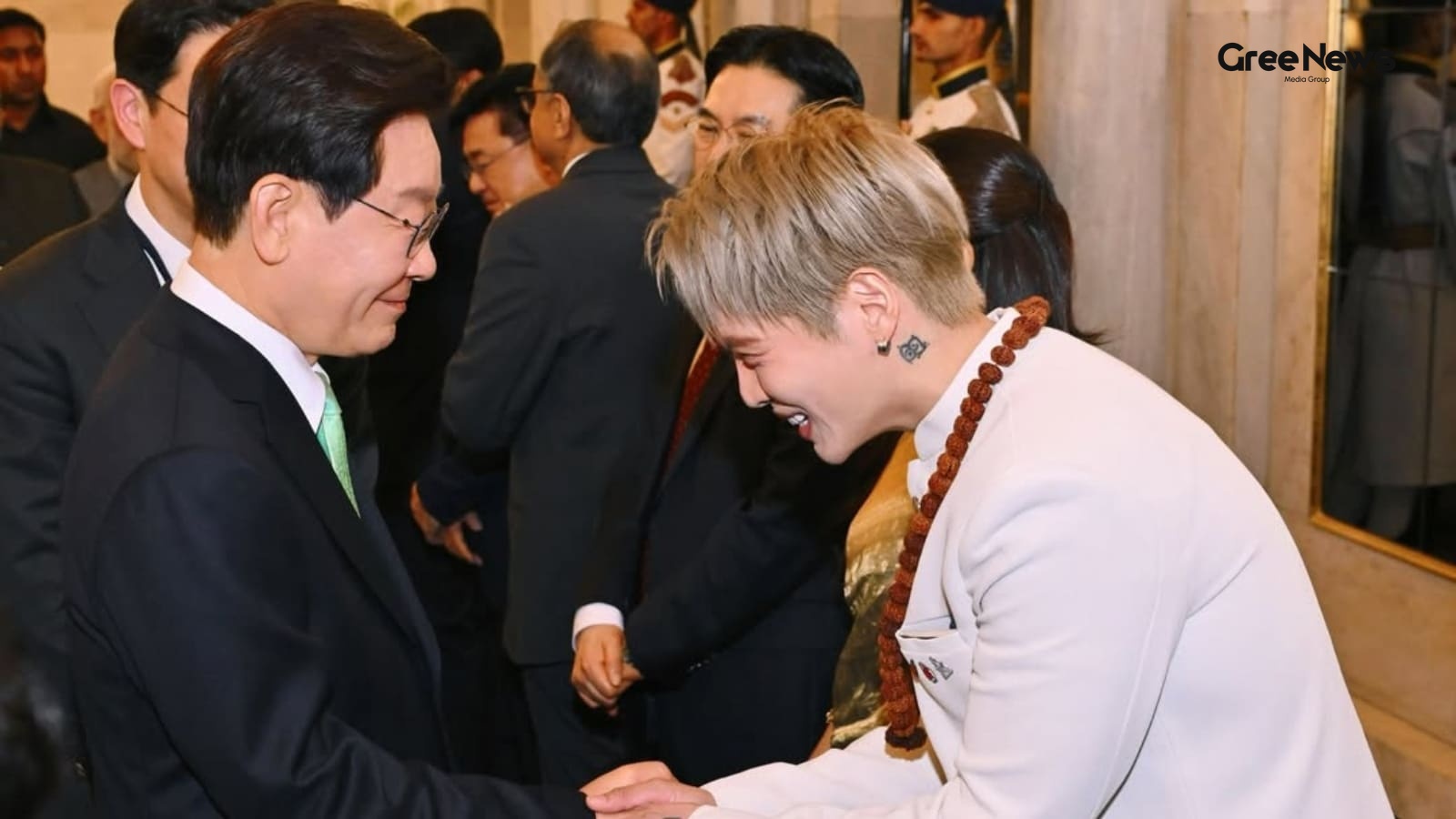
AOORA recently met South Korean President Lee Jae‑myung and Indian President Droupadi Murmu in New Delhi.
It all went down at Rashtrapati Bhavan, where a grand state banquet was organised for President Lee Jae‑myung’s visit. The highlight? AOORA, the South Korean sensation who’s also a former Bigg Boss 17 contestant, not only shook hands but actually taught President Lee Jae‑myung how to say “Namaste”. The video of that moment instantly became viral news, with people sharing it across Instagram, Twitter and even the local cable news channels. In most cases, a simple Greeting doesn’t get that much attention, but here it felt like a cultural bridge was being built right before our eyes.
What happened next is interesting the whole episode sparked a wave of curiosity about AOORA’s background, his music, and why he’s become such a hot topic in India. Let’s dive a little deeper, shall we?
Who Is K‑Pop Singer AOORA?
For those who might not be familiar, AOORA’s real name is Park Min‑jun. He first made his mark as a member of the boy group Double‑A (AA) back in his early days. The group had a decent following in South Korea, but it was AOORA’s solo experiments that really set him apart. He started mixing traditional Korean pop vibes with Indian musical elements think sitar riffs, tabla beats, and even a dash of Bollywood orchestration.
His first Indian‑inspired track, “Punjab”, was a surprise hit. The song featured catchy Hindi lyrics over a synth‑driven K‑pop beat, and it slowly became a go‑to playlist on many Indian parties. Then there was “Holi Re Rasiya”, a track that blended the festive spirit of Holi with AOORA’s signature high‑energy vocals. The song’s video even showed him dancing in a colorful Holi‑themed setting, which made the Indian audience feel a sense of ownership over his music. In fact, the track topped several streaming charts, and you could hear it in gyms, college canteens, and even on auto‑rickshaw rides across the country.
Beyond the music, what really endears AOORA to Indian fans is his genuine effort to learn Hindi and understand Indian culture. He often posts videos trying out Indian dishes, attempting to speak Hindi on his Instagram Live, and sharing his experiences with Indian festivals. This authenticity is why when he stepped into the Bigg Boss 17 house, the reaction was both surprised and excited he was the first South Korean participant ever in that reality show’s long history.
During his stint on Bigg Boss 17, AOORA tried his best to converse in Hindi with fellow contestants, while also teaching them a few Korean phrases. He was a bit rusty, but his attempts were endearing. He even organised a small “K‑pop night” in the house, where he performed a mash‑up of his Indian hits with some classic Korean tracks. Although he was eventually evicted, finishing 10th, his presence left an indelible mark many housemates later said they learned a lot about Korean culture because of him.
President Lee Jae‑myung’s Visit to India A Diplomatic Milestone
President Lee Jae‑myung arrived in India for a three‑day state visit, the first by a South Korean head of state in over eight years. Accompanied by First Lady Kim Hea‑kyung, President Lee’s itinerary included meetings with top Indian officials, cultural exchanges, and business delegations. The trip is being seen as a pivotal move for Seoul’s outreach to the Global South, especially as both nations look to strengthen trade, technology, and defence ties.
In most cases, state visits are full of formal speeches and signed aGreements, but this one had an extra sparkle thanks to AOORA’s presence. The fact that a K‑pop star could meet the President at Rashtrapati Bhavan and share a traditional Indian Greeting made headlines all over the country. People were scrolling through their feeds, seeing the photo of President Lee Jae‑myung bowing his head slightly while saying “Namaste” alongside AOORA, and thinking, “Wow, this is a sign of true cultural respect.”
That moment became a trending news story across multiple platforms from television news bulletins to the “latest news India” sections of online portals. Commentators pointed out that such informal interactions can sometimes speak louder than formal diplomatic language, especially when they involve people popular with the younger generation.
Why This Moment Matters for India‑South Korea Relations
From a broader perspective, the meeting is more than a photo‑op. It symbolizes a growing people‑to‑people connection. Over the past few years, South Korean movies, dramas, and music have found massive audiences in India. Likewise, Indian yoga, cuisine, and festivals have become trendy among South Korean youth. AOORA’s career epitomises this cultural blend, and his interaction with President Lee Jae‑myung underscores how soft power can complement traditional diplomacy.
Industry experts say that such exchanges can lead to tangible benefits think of joint music productions, co‑production of movies, or even collaborative tech projects. The fact that a popular artist like AOORA is part of these narratives makes the story more relatable, especially for Gen‑Z and millennials who follow both Bollywood and K‑pop fervently. As a result, this episode quickly turned into viral news, generating countless memes and discussions on platforms like TikTok and YouTube.
Many people were surprised by this, as they hadn’t expected a reality‑show participant to be part of a high‑level diplomatic event. Yet, it shows that the lines between entertainment and politics are becoming increasingly fluid, especially in the age of digital media where “viral news” can influence public perception and even policy conversations.
AOORA’s Impact on Indian Fans A Personal Take
Speaking from my own experience, I first heard AOORA’s “Punjab” while on a train heading to Chennai. The song’s hook got stuck in my head, and soon I was humming it while waiting for my chai. A few weeks later, I saw the video of him learning “Namaste” with President Lee Jae‑myung and thought, “That’s the same guy who makes my commute more fun!” It felt like a proud moment my favourite K‑pop artist was being recognized on a global diplomatic stage.
When I told my friends about the story, most of them rushed to watch the clip, and we ended up having a whole discussion over instant noodles about cultural exchange and how music can break barriers. That’s the power of trending news it brings people together, even if it’s just over a shared video.
Also, I noticed that after the banquet, several Indian musicians started posting covers of AOORA’s songs, adding traditional Indian instruments. This ripple effect is a clear sign that his influence is not fleeting; it’s planting seeds for future collaborations and perhaps even a new fusion genre that we might see dominating the “latest news India” feeds in the coming years.
What the Future Holds More Collaborations?
Given the warm reception AOORA received, I wouldn’t be surprised if we see a full‑blown India‑South Korea musical tour soon. Both governments have expressed interest in promoting cultural exchanges, and now there’s a proven success story that can be expanded. Imagine a concert where AOORA performs live with Indian singers, mixing Hindi and Korean verses on stage that would be a headline‑making event for sure.
There’s also talk about AOORA possibly collaborating with Bollywood composers for an upcoming film soundtrack. If that happens, it will definitely become a piece of breaking news, and fans will be glued to every update. The momentum from his meeting with President Lee Jae‑myung could well be the catalyst for such projects.
In any case, the entire episode from the state banquet to the viral “Namaste” moment shows how a single interaction can generate a cascade of interest, both in the media and among everyday people. It also reminds us that the lines between entertainment, politics, and cultural diplomacy are blending, creating a vibrant space for fresh narratives in the Indian media landscape.