Artemis II Astronauts Reveal Stunning Milky Way Panorama Captured From Deep Space
NASA shares an image of our galaxy that shows countless stars sparkling sharply, a visual effect made possible by the complete absence of Earth’s atmospheric interference.
Milky Way Unveiled in Unprecedented Clarity
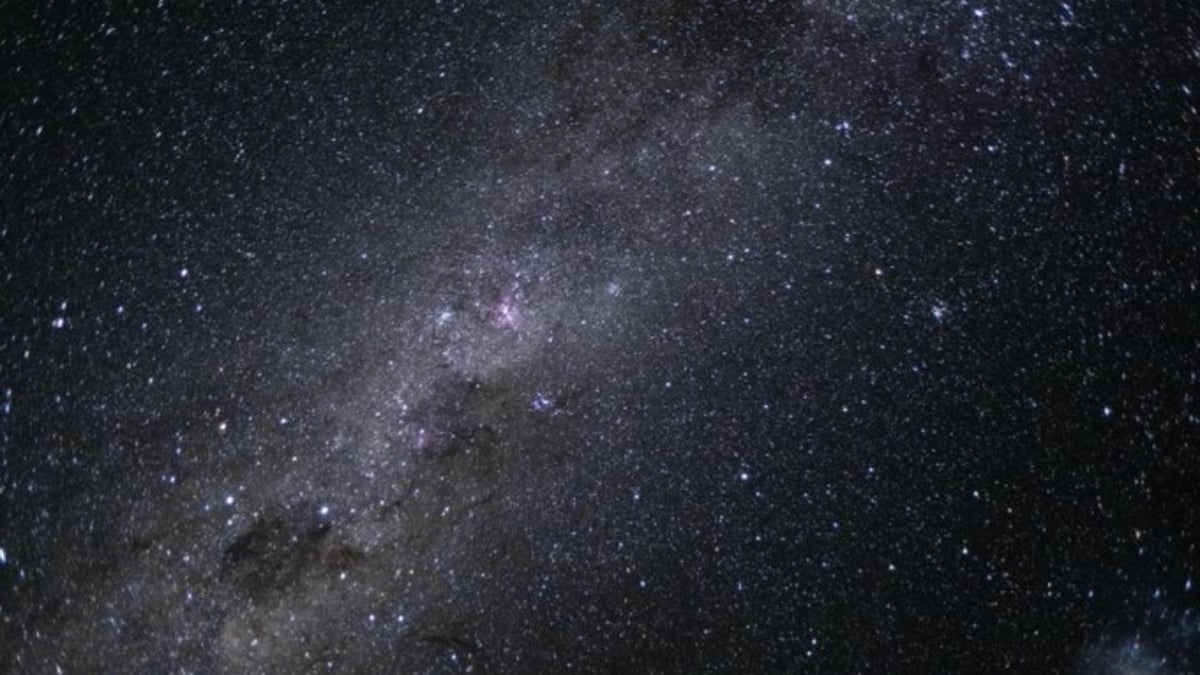
The picture posted by NASA on its social networks depicts a star‑filled expanse that stretches across the dark void of space. In the frame, thousands of individual stars flicker with intense clarity, each point of light unsoftened by any atmospheric haze. Bright clouds of interstellar dust drift amid the stellar backdrop, adding texture and depth to the composition.
According to the caption that accompanied the upload, the view illustrates the elegant spiral architecture of the Milky Way. Two prominent arms are described as wrapping away from the termini of a central bar of stars, a pattern that is plainly visible when atmospheric distortion is removed.
The original post, made on Instagram by NASA, quoted the following description: “A starfield filled with thousands of stars and shining clouds of dust. The Milky Way’s elegant spiral structure is dominated by just two arms wrapping off the ends of a central bar of stars.” This wording underscores the scientific significance of the visual, while also emphasizing its aesthetic impact.
Context of the Artemis II Journey
Artemis II represents humanity’s first crewed expedition to the Moon’s neighbourhood since the final Apollo landing. The mission follows a ten‑day trajectory that carries the Orion spacecraft around the Moon and then returns the four astronauts to Earth.
The four astronauts involved in Artemis II are NASA commander Reid Wiseman, NASA pilot Victor Glover, NASA mission specialist Christina Koch and Canadian Space Agency mission specialist Jeremy Hansen. Each astronaut occupies a defined role aboard the Orion spacecraft, contributing to navigation, vehicle operation, scientific observation and mission coordination.
During the cruise phase, the Orion spacecraft passed beyond the Moon’s sphere of influence, reaching the greatest distance ever traveled by humans from Earth: 252,756 miles (406,771 kilometres). This distance marks a new record for human‑occupied spacecraft, surpassing all prior benchmarks set during the Apollo era.
After completing the lunar fly‑by, the Orion spacecraft re‑entered the dominant gravitational pull of Earth. Guided by Earth’s gravity, the Orion capsule accelerated toward the planet at a speed exceeding 1,700 miles per hour, propelling the Artemis II astronauts back toward home.
Earlier Visuals from the Orion Spacecraft
Prior to the release of the Milky Way panorama, Artemis II astronauts shared an image that captured Earth as it appeared from the Orion spacecraft. That earlier photograph offered a terrestrial perspective, contrasting sharply with the later galactic view that showcases the universe beyond our planetary environment.
The switch from an Earth‑focused photograph to a deep‑space Milky Way image illustrates the breadth of visual data gathered during the Artemis II mission. Both images were disseminated through NASA’s official social media channels, allowing the public to experience the stark differences between looking outward from within the planet’s atmosphere and looking outward from the vacuum of space.
Scientific and Aesthetic Value of a Atmosphere‑Free View
When an observer is situated above Earth’s atmosphere, light from distant stars travels unimpeded, preserving its original intensity and color. The lack of atmospheric scattering removes the twinkling effect that typically softens stellar points when viewed from the ground. Consequently, the Artemis II photograph portrays each star with a pinpoint sharpness that would be impossible to achieve from any terrestrial observatory.
The luminous dust clouds captured in the image are also rendered with greater contrast. In a ground‑based setting, atmospheric particles often blur such diffuse features, but the Orion spacecraft’s position in space allows these clouds to appear as distinct, glowing structures woven among the stars.
Beyond the scientific merits, the photograph serves as a visual reminder of humanity’s expanding reach. By presenting the Milky Way in its unaltered form, NASA provides both scientists and the general public with a reference point for the scale and structure of our galaxy when observed from a location free of terrestrial interference.
Mission Overview and Technical Highlights
Artemis II follows a meticulously planned flight profile that includes launch, trans‑lunar injection, lunar fly‑by, deep‑space cruise, return‑trans‑Earth injection and re‑entry. The Orion spacecraft, designed for deep‑space operations, is equipped with life‑support systems, guidance, navigation and control modules that enable the safe transport of Reid Wiseman, Victor Glover, Christina Koch and Jeremy Hansen throughout the mission’s duration.
During the deep‑space segment, the Orion spacecraft’s instrumentation captured the Milky Way image that NASA later released. The camera system utilized on the Orion spacecraft is capable of operating in the harsh environment of space, preserving image fidelity despite extreme temperature fluctuations and radiation exposure.
The Artemis II flight path placed the Orion spacecraft at the farthest human‑occupied point from Earth, a milestone that underscores the technical proficiency required to navigate beyond the Moon’s gravitational sphere and then re‑engage Earth’s pull. The velocity of more than 1,700 miles per hour during the return phase demonstrates the effectiveness of the spacecraft’s propulsion and guidance systems in achieving a timely and accurate trajectory back to Earth.
Public Engagement and Outreach
NASA’s decision to share the Milky Way photograph through its social media platforms reflects an ongoing commitment to public outreach. By providing high‑resolution imagery taken directly from the Orion spacecraft, NASA enables audiences around the globe to experience the same view that Reid Wiseman, Victor Glover, Christina Koch and Jeremy Hansen observed during their historic journey.
The photograph’s caption, as posted by NASA, not only describes the visual elements but also educates viewers about the structural composition of the Milky Way. By highlighting the two main spiral arms and the central stellar bar, the caption adds an informative layer that deepens the audience’s understanding of galactic morphology.
Through such sharing, NASA reinforces the link between scientific discovery and public inspiration, encouraging a sense of connection to the broader cosmos that exists beyond Earth’s atmosphere.
Future Implications for Artemis and Beyond
The successful capture and dissemination of a clear Milky Way image marks a significant achievement for Artemis II. It demonstrates that the Orion spacecraft can serve as a platform for high‑quality astronomical imaging, a capability that may prove valuable for subsequent Artemis missions and other deep‑space endeavors.
As Artemis II paves the way for future crewed lunar landings, the data gathered—including visual records of the galaxy—contribute to a growing repository of knowledge that will support mission planning, navigation and scientific analysis for missions that venture farther from Earth.
Reid Wiseman, Victor Glover, Christina Koch and Jeremy Hansen, by participating in this historic flight, have helped expand humanity’s visual record of the universe, augmenting both the scientific community’s resources and the public’s appreciation of the space environment.