Delhi Assembly Breach: Police Say Sarabjit Singh Is Mentally Unwell, Undergoing Treatment
Counsel for Sarabjit Singh informed the court that Sarabjit Singh suffers from mental health problems and is presently receiving medical care.
Court Decision and Counsel’s Claim
The Tis Hazari Court ordered that Sarabjit Singh, the individual accused of breaching security at the Delhi Assembly, remain in police custody for a period of eight days. This decision came despite a vigorous argument from the counsel representing Sarabjit Singh, who contended that Sarabjit Singh experiences significant mental health challenges and is currently under professional medical supervision.
The order to remand Sarabjit Singh was issued after the Delhi Police formally requested continued detention. The police argued that further investigative steps are essential, including the tracing of the automobile employed by Sarabjit Singh during the incident and a thorough examination of any broader conspiracy or terror‑related elements that might be linked to the breach.
In opposition to the police request, the counsel for Sarabjit Singh appeared before the bench and asserted unequivocally that Sarabjit Singh suffers from mental health issues and is receiving ongoing treatment. The counsel emphasized that these health concerns should be a decisive factor when determining the appropriate custodial measures for Sarabjit Singh.
Background of Sarabjit Singh’s Movements
According to the defence narrative, Sarabjit Singh left his home in Pilibhit without notifying any family member and traveled to Chandigarh with the expressed intention of visiting his sister. Upon arriving in Chandigarh, Sarabjit Singh reportedly proceeded to a local Gurdwara, where he spent an indeterminate amount of time. Throughout this interval, Sarabjit Singh’s family remained unaware of his exact whereabouts or his activities.
The defence further explained that, after learning that a nephew of Sarabjit Singh had gone missing, Sarabjit Singh made the decision to travel to Delhi. The defence’s position includes a claim that Sarabjit Singh mistakenly entered the Delhi Assembly complex, mistakenly believing that the location was a Gurdwara. This narrative seeks to frame the incident as a consequence of confusion rather than a premeditated act.
The presiding judge, however, expressed reservations regarding this line of reasoning. Noting that Sarabjit Singh had embarked on a long journey that involved driving from Pilibhit to Chandigarh and subsequently to Delhi, the judge observed that the assertion of complete mental incapacity required a more detailed examination. The judge indicated that the pattern of travel demonstrated a level of deliberation that could be inconsistent with a claim of total mental unfitness.
Police representatives informed the court that Sarabjit Singh discarded his mobile phone in the immediate aftermath of the breach, thereby complicating efforts to trace communications or locate the device. Law enforcement officials confirmed that a dedicated team is actively pursuing the recovery of the discarded phone, recognizing its potential evidentiary value.
Investigators are also exploring the mechanisms by which Sarabjit Singh managed to penetrate the heightened security perimeter surrounding the Delhi Assembly complex. Questions remain regarding whether Sarabjit Singh acted entirely alone or whether other individuals may have provided assistance, direction, or encouragement that facilitated the breach.
Chronology of Events Leading to the Breach
Preliminary investigative findings indicate that Sarabjit Singh departed his residence in Pilibhit early in the sequence of events. Family members reported that communication with Sarabjit Singh ceased after a single night of contact, leaving relatives uncertain about his subsequent itinerary.
Following the departure from Pilibhit, Sarabjit Singh is understood to have reached the city of Bareilly before continuing his journey onward, eventually arriving in Delhi on the day the security breach took place. Throughout this period, Sarabjit Singh did not disclose any intended destination or purpose to family members, heightening concerns about his state of mind and intentions.
Relatives have conveyed to investigators that Sarabjit Singh’s behavior, while unusual, is not entirely without precedent. They described a pattern in which Sarabjit Singh experiences episodes marked by erratic conduct, self‑isolation, and a marked disregard for familial guidance. These episodes, according to family testimony, have occurred intermittently over an extended timeframe.
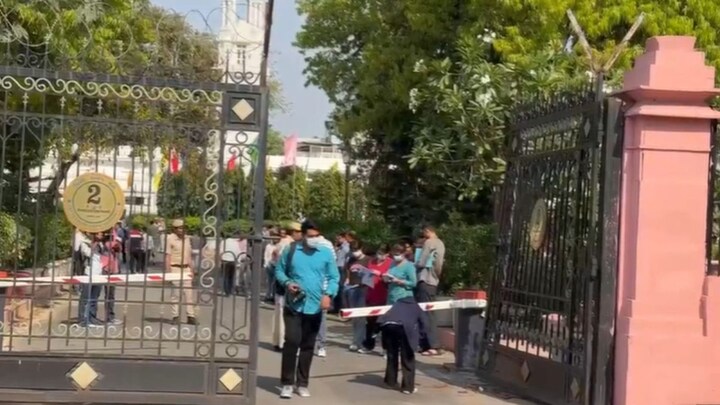
Initial police reports detail that Sarabjit Singh entered the premises of the Delhi Assembly alone, utilizing Gate No. 2 as the point of entry. The entry appears to have been executed by driving a personal vehicle at considerable speed, allowing the vehicle to breach the gate’s barrier. Once inside the secured complex, Sarabjit Singh approached the official automobile assigned to Assembly Speaker Vijender Gupta. At that moment, the vehicle was unlocked because the driver had stepped away briefly, providing Sarabjit Singh an opportunity to interact with the car.
According to sources, Sarabjit Singh placed a bouquet of flowers and a garland inside the unlocked vehicle, subsequently taking a brief moment to sit inside the car. After this brief interlude, Sarabjit Singh exited the vehicle and proceeded toward the office of Assembly Speaker Vijender Gupta. Upon reaching the vicinity of the office, Sarabjit Singh placed an additional bouquet outside the doorway before retracing his steps to the point of entry.
Sarabjit Singh then departed the Delhi Assembly complex using the same vehicle that had been employed to gain unauthorized access. Law enforcement officers intercepted Sarabjit Singh shortly thereafter near a checkpoint located in the Roopnagar area, specifically at a site known as A Nala. During this interception, Sarabjit Singh was taken into police custody, and the vehicle used during the breach was seized for forensic examination.
The investigative team continues to examine a range of variables, including the precise motive behind Sarabjit Singh’s actions, the sequence of movements that led to the breach, and any possible affiliations or influences that may have guided Sarabjit Singh’s conduct. The overarching objective remains to construct a comprehensive understanding of the incident while upholding the principles of due process.