- Sports Desk
- Trending Desk
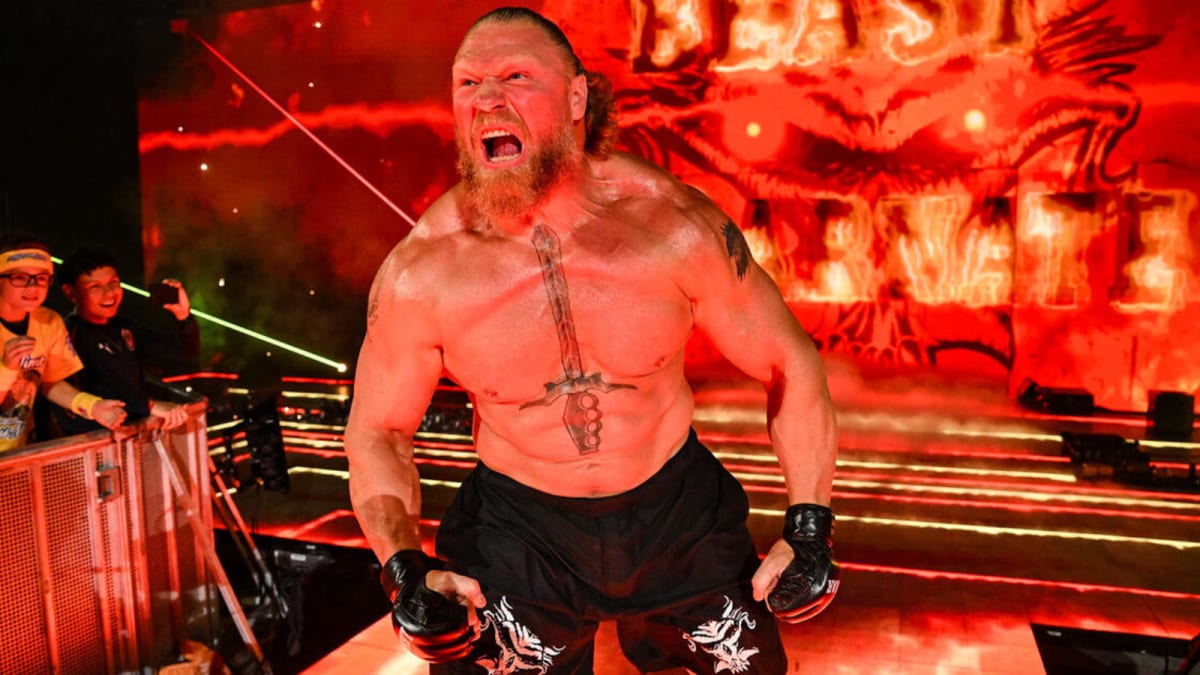
An incident dating back to the 2022 Royal Rumble is now at the centre of a controversy related to Lesnar.
Former World Wrestling Entertainment superstar Matt Riddle has stirred up a lot of chatter by saying that the company’s producers actually carry “fears” when it comes to the mighty Brock Lesnar. He made this claim on the ‘Rewind, Recap, Relive’ podcast, where he also gave a detailed account of what went down during the 2022 Royal Rumble production meeting.
Riddle recalled that after his own match, tensions were rising between Lesnar and the higher‑ups during the final meeting before the live show. According to him, Lesnar was still fuming after a grueling encounter with Bobby Lashley, and he barged into the room demanding his way.
Matt Riddle on Brock Lesnar’s backstage aura
“I forgot who was supposed to win. Maybe it was Brock. But Brock comes in and he’s heated. I’m pretty sure he got smacked pretty good in that Bobby Lashley match. They both German‑suplexed each other, really cracky. Not flat — like Bobby landed on his head, Brock landed awkwardly. Two jacked guys going hard,” Riddle said on the podcast, reminiscing about the chaos that followed the Royal Rumble.
He added, “So we’re at the end of the Rumble. It’s like the last five or six of us, we’re calling spots. And Brock comes in there and goes, ‘I just did business. That’s how it’s done. You guys are going to do business for me.’”
“Every producer fears Brock Lesnar. It’s kind of — I respect everybody, I love everybody — but I hate seeing people get scared. You shouldn’t be,” he continued, stressing that the fear was not just a personal feeling but something that seemed to ripple through the entire production team.
‘He Grabbed Me By My Neck’ – A chilling moment
Riddle didn’t stop at just saying producers were scared; he also claimed that Lesnar had actually grabbed his neck during the heated exchange. “If this guy attacks you, have him arrested. That’s against the rules. We are a society. You can’t just act like a Neanderthal,” he said, laughing a little while recalling the incident.
“Granted, he is intimidating. He grabbed me by my neck before, but I wasn’t intimidated. He grabbed me quite gently, actually. He does know how to work,” Riddle remarked, showing his typical wrestler’s composure even while describing a pretty unnerving scenario.
Later he added, “He didn’t want to talk or put anything together. He just said, ‘Do business for me.’ So it was like, okay… Randy, I’ll clothesline you. Everybody else, I’ll belly‑to‑belly you over the top or F5 you out. We were all getting thrown out by Brock.”
For many Indian fans watching from the living room, the image of a massive wrestler grabbing someone by the neck may feel as dramatic as a heated argument between two captains in a cricket dressing‑room. The idea of a single star wielding such influence behind the scenes is both fascinating and a little scary.
Why Lesnar’s reputation matters to producers
To understand why producers might actually feel a little jittery, it helps to look at Brock Lesnar’s career in a broader context. He isn’t just a big guy with a lot of muscles; he’s a former NCAA wrestling champion, a UFC heavyweight, and a man who has headlined dozens of WrestleMania events. In Indian terms, think of him as the Virat Kohli of WWE – everybody knows his name and his presence changes the whole game.
Because of that, when Lesnar steps into a room, the air feels different. The producers, who usually have the final say on match outcomes, story arcs, and even the background music, suddenly have to accommodate a talent who can literally bench‑press the entire crew if need be.
Riddle’s narrative suggests that every time Lesnar showed up upset – like after the brutal match with Lashley – the creative team had to rethink their plans. In most cases, they would probably try to keep the peace rather than risk a fallout that could cost the company a massive pay‑per‑view draw.
Behind‑the‑scenes production dynamics in WWE
WWE’s production process is a complex machine. From the writers who draft weekly storylines to the producers who choreograph the actual in‑ring spots, everyone works in sync, much like a big Indian wedding where each family member has a specific role. When a star like Lesnar walks in, the whole choreography can be thrown off.
During a typical live event, producers sit in a control room, monitoring camera angles, pyrotechnics, and the timing of each move. They also have to coordinate with the wrestlers on‑the‑fly, making sure that any mis‑step doesn’t become a disaster on live TV. If someone with Lesnar’s stature starts demanding “do business for me”, the producers have to either bend or risk a showdown.
Matt Riddle’s claim that producers are actually “fearing” Lesnar signals a shift from the usual power balance. Instead of the writers dictating the story, the star is trying to steer it himself. This can lead to a scenario where the final product is more of a compromise than a fully‑crafted narrative.
Riddle’s own experience and why he spoke up
Matt Riddle, who himself has a background in MMA and a reputation for being a straight‑talking guy, may have felt that the situation needed calling out. In India, we have a saying – “saat samundar ke paar, sach bolna hi sabse bada kaam hota hai.” Speaking the truth, even if it makes people uncomfortable, is considered a sign of integrity.
Riddle’s decision to share his story on a public podcast suggests that he wanted to bring some transparency to a world that is often shrouded in scripted drama. By highlighting the backstage fear, he also indirectly points to a larger issue: how much power does a superstar really have, and is it healthy for the creative ecosystem?
Even though his tone is casual and peppered with humor (“He grabbed me quite gently”), the underlying message is serious – if producers are genuinely scared, it may affect the quality of storytelling and the overall safety culture in the locker rooms.
Implications for WWE’s future storylines
If the producers are indeed walking on eggshells around Lesnar, future storylines might tilt more in his favour, regardless of whether the narrative makes sense. That could lead to repetitive plots where Lesnar simply wins or dominates without real challenges. Fans, especially those in India who love a good underdog story, might start feeling that the product is becoming predictable.
On the other hand, WWE could use this behind‑the‑scenes tension as a storyline itself – turning the fear into a dramatic angle where other wrestlers band together to stand up to the “monster”. In Indian cinema, we often see the ‘villain‑turned‑hero’ arc, and WWE could adopt a similar approach, turning the fear into an on‑screen redemption story.
But it would require the producers to regain confidence and re‑establish authority. That could involve stricter backstage protocols, clearer communication channels, or perhaps bringing in neutral mediators – much like how Indian sports teams sometimes invite former players to resolve internal disputes.
Final thoughts – a glimpse into a world few see
Matt Riddle’s revelations give us a rare window into the backstage drama of WWE, an arena usually kept behind the glitter and roar of the arena. While the story may sound sensational – producers fearing a single wrestler, a neck‑grab that feels like a scene from a Hollywood thriller – it also reflects the human side of an industry built on larger‑than‑life characters.
For the everyday fan sitting in a Delhi living‑room, the takeaway is simple: even the biggest stars have their own insecurities, and those who work behind the curtain feel the pressure too. Whether WWE decides to address these fears openly or keep them under wraps, the conversation started by Riddle will likely linger on for a while.
In the end, wrestling, like any sport or entertainment, is about a balance between power, storytelling, and respect. As long as the producers can find that balance, the fans – in Mumbai, Kolkata, Bangalore, or anywhere else – will continue to cheer for the drama, the drama that is both on the mat and behind it.