Honestly, when I first heard about a river that actually boils, I thought it was some kind of viral news prank. You know how we often see headlines about mysterious places that turn out to be hoaxes? Well, this one turned out to be real, and it’s been making its way into the trending news India feeds and even the latest news India portals.
The river’s name is Shanay‑Timpishka, which loosely translates to “boiling water” in the local tongue. It lies hidden in the dense Amazon rainforest of Peru, specifically in a region called Mayantuyacu. This place is not advertised on any tourist brochure; it’s about 700 kilometres away from the nearest volcanic centre, which is why the whole thing initially seemed like a myth that would belong only in folklore.
What got me really hooked, though, was the fact that scientists have actually measured parts of the river reaching temperatures close to 100°C hot enough to cause severe burns within seconds. In other words, the water is practically at the boiling point of pure water at sea level. If you imagine the steam rising from a hot cup of chai on a rainy monsoon day, now multiply that by a whole river, you get a picture of what the locals describe as a “steam‑filled flow”.
How I Stumbled Upon the Story
My curiosity was sparked while scrolling through my phone’s news feed one evening. A headline about a “river that boils” popped up alongside the usual political updates and cricket scores. It was listed as breaking news, and the thumbnail showed a mist‑laden waterway cutting through lush Green trees. I clicked on it, expecting a short video, but instead landed on an in‑depth article about researchers venturing into the Amazon to study this phenomenon.
What caught people’s attention was not just the heat itself, but the fact that the river isn’t near any volcano. In most cases, when you hear about boiling water coming out of the ground, you think of geysers or volcanic hot springs. Here, the heat source is completely different, and that is where the story gets fascinating.
According to the research led by geoscientist Andrés Ruzo, the water’s journey starts deep beneath the Earth’s surface. Groundwater finds its way down through narrow crevices, sinking until it reaches layers where the planet’s natural geothermal gradient the increase in temperature with depth heats it up considerably. Then, the hot water resurfaces through fractures, emerging as a scalding river. Basically, it’s a natural heat pump powered by the Earth’s interior, not by any volcanic activity.
The Physical Layout Size, Length, and Heat
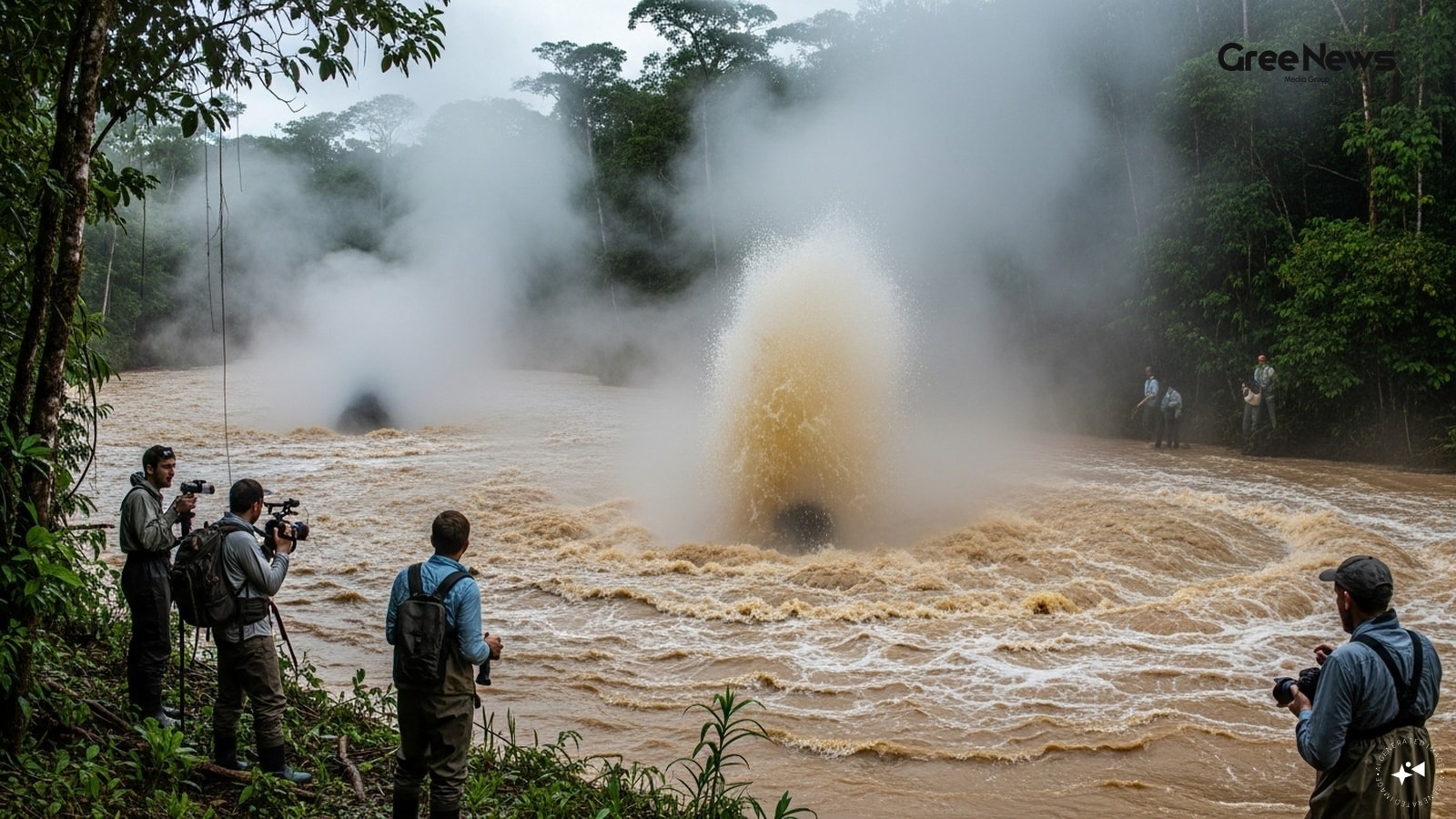
The river stretches roughly 6.4 kilometres from its source to where it merges with cooler streams. Its width can expand up to 25 metres in certain sections, and the depth varies by a few metres, enough to conceal a person if they weren’t careful. In some spots the water is visibly steaming, while in others you can see small bubbles popping up as if the river were constantly trying to escape its own heat.
Imagine walking along a riverbank in the monsoon, the air heavy with humidity, and then seeing a plume of steam rise right before your eyes that’s the kind of surreal experience travellers talk about. It’s also why the place is a magnet for adventure seekers and, of course, journalists chasing viral news. The river’s temperature can instantly scald small animals; there are reports of frogs and birds that fall in being burnt to ash within seconds. Their charred remains are sometimes found along the banks, a grim reminder of the river’s unforgiving nature.
Even though the water is perilously hot, it is not a uniform wall of fire. There are pockets where the temperature dips enough for certain hardy organisms to survive. This patchwork of extreme and tolerable zones makes the river a natural laboratory for studying life under thermal stress.
Life That Defies the Heat
Now, you might think that a river that can boil a frog would be a dead zone, but nature has a way of surprising us. Scientists have collected samples that reveal a range of microorganisms thriving in the hot water. These include thermophilic bacteria that love high temperatures, some of which are being studied for potential industrial applications think of enzymes that work in extreme heat, useful in processes like bio‑fuel production.
In addition to microbes, there are a few invertebrates and tiny crustaceans that have adapted to the harsh environment. Their bodies have special proteins that prevent their tissues from denaturing at near‑boiling temperatures. It’s similar to how some Indian fish in hot springs of Manikaran survive, though the temperatures there are much lower. The river’s ecosystem is still largely a mystery, and researchers are constantly discovering new species that could rewrite what we know about thermal tolerance.
What’s even more interesting is that these lifeforms have been evolving in isolation for centuries, away from any volcanic influence. This makes the Shanay‑Timpishka a unique case study, not only for geologists but also for biologists looking at evolutionary pathways in extreme conditions.
Cultural Significance A Sacred River for the Asháninka
Beyond the scientific intrigue, the river holds profound cultural value. The Asháninka, an indigenous tribe that lives in the surrounding forest, consider the Shanay‑Timpishka a sacred place. According to their tradition, the river is the embodiment of a giant serpent spirit called Yacumama. The name Yacumama translates to “Mother of Water”, and it’s believed to guard the river and the surrounding forest.
This belief isn’t just folklore; it influences how the community interacts with the river. They perform rituals and offer prayers before venturing near the banks, especially during ceremonial events. The river’s heat is seen as a divine attribute, a sign of the spirit’s power. In most cases, the tribe’s knowledge about the river predates any scientific study, showing how indigenous wisdom can complement modern research.
In many ways, the river serves as a bridge between ancient spirituality and contemporary science. The Asháninka’s reverence for the river has helped protect it from commercial exploitation, allowing researchers like Andrés Ruzo to study it relatively undisturbed. It’s a clear example of how cultural preservation can go hand‑in‑hand with scientific discovery.
Why This Story Is Trending Worldwide
So why am I sharing this in such detail? Because the story has become one of those pieces of breaking news that spreads like wildfire on social media. From TikTok reels showing steam rising from the river to detailed podcasts dissecting the geothermal mechanics, the Shanay‑Timpishka is now part of trending news India feeds and even features in sections of international science magazines.
What happened next is interesting: after the initial coverage, a wave of curiosity‑driven travellers started planning trips to see the river (though most are cautioned against getting too close). The Indian tourism community began debating the safety of such expeditions, and travel blogs started adding the river to their list of “must‑see natural wonders”. This surge of interest has unintentionally raised awareness about the Asháninka’s cultural heritage as well, prompting NGOs to highlight the need for protecting their lands.
In most cases, the river’s mysterious nature has captured the imagination of readers who love a good blend of science and myth. It’s the kind of story that stays in the mind, making people think about the hidden powers of the Earth, the resilience of life, and the deep connections humans have with nature.
Personal Reflections What I Took Away
Personally, I’m still amazed every time I think about it. Growing up in a small Indian town, I was used to hearing stories about hot springs in places like Manikaran or the geothermal activity in places like Deccan traps. But a river that boils in the middle of the Amazon, far from any known volcanic zone, feels like something out of a mythic adventure novel.
It also reminded me of the importance of listening to local knowledge. The Asháninka’s reverence for the river existed long before any satellite imagery or scientific paper could confirm its unique temperature. Their stories were the first clues that led researchers like Andrés Ruzo to investigate.
And finally, I think this tale underscores how science and culture can coexist. While the river’s geothermal explanation satisfies our analytical minds, the spiritual narrative keeps the wonder alive. It’s a perfect example of how breaking news can be both informative and awe‑inspiring, feeding the hungry curiosity of readers across India and beyond.






.jpg)