Razor‑Sharp Chinese Manja Rips Through Rider’s Helmet, Survivor Credits Gear With Saving Life
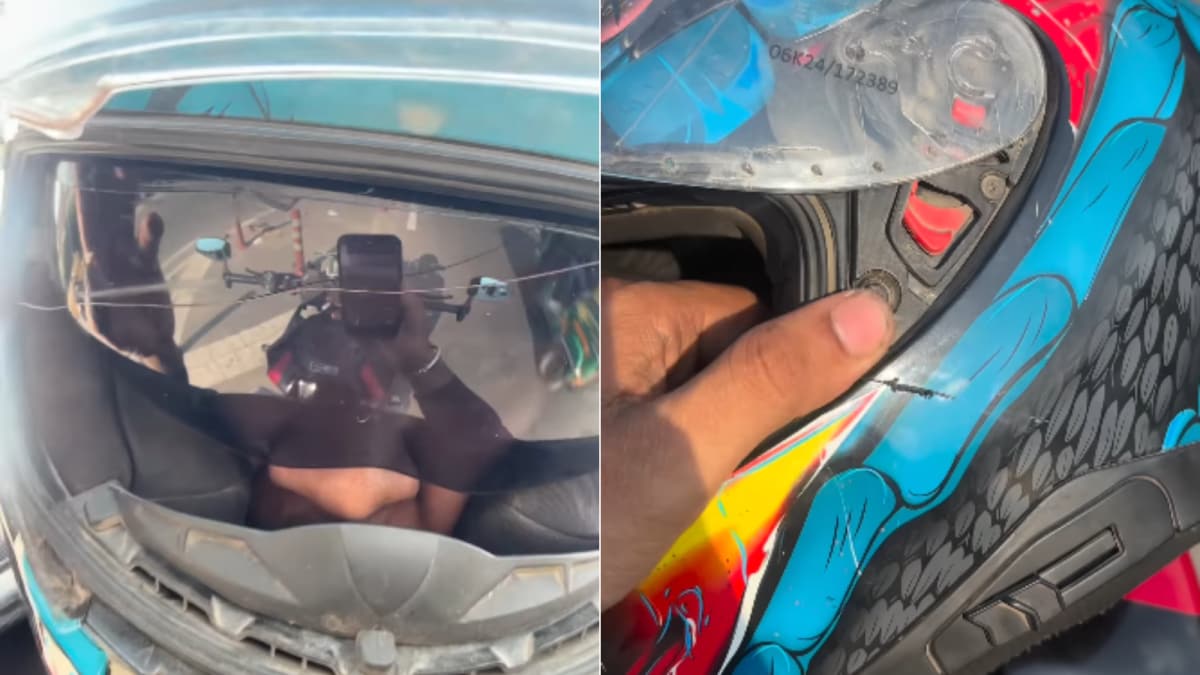
A motorcyclist’s helmet bears deep cuts after a Chinese manja strike, with the rider crediting it for saving his life. The viral video has reignited concerns over its continued use.
Background of the Incident
Yash, a motorcycle enthusiast who regularly shares riding experiences on a popular social‑media platform under the handle thatwanabeinfluencer, posted a short video that quickly went viral. The footage shows Yash wearing a standard open‑face helmet, then removing the headgear to reveal a series of deep, irregular cuts on both the outer shell and the visor. The damage is unmistakable and points to a violent encounter with a thin yet extremely sharp filament.
The filament in question is identified as Chinese manja, a synthetic kite string that is coated with a mixture of glass or metal powder to produce an almost invisible, razor‑sharp edge. Chinese manja is widely known for its ability to cut through foliage, and it has historically been used in kite‑fighting competitions. However, the same cutting power makes Chinese manja a hazard on public roads, especially for two‑wheelers.
In the video, Yash explains that while traveling at a normal riding speed, a strand of Chinese manja intersected the path of the motorcycle, striking the helmet at an angle that caused the string to slice through the material. The motion of the motorcycle and the tension in the strand combined to generate enough force for the line to penetrate the protective layers of the helmet.
Detailed Observation of the Damage
Close inspection of the helmet shows that the cuts are not superficial scratches; they are deep enough to expose the inner foam that is meant to absorb impact energy. The visor, a clear polycarbonate shield, also bears a jagged incision that mirrors the pattern on the outer shell. The alignment of the cuts suggests that the Chinese manja entered the helmet at a shallow angle before exiting near the edge of the visor, creating a tear that resembles a slashing motion rather than a blunt impact.
Yash points out that the helmet’s structural integrity remained largely intact despite the incisions. Modern helmets are engineered with a hard outer shell, a tough inner liner, and an impact‑absorbing foam core. The presence of the cuts demonstrates that Chinese manja can breach the outer shell, yet the internal foam continued to perform its protective role, potentially preventing a skull fracture.
The visor, often the most vulnerable component during a high‑speed collision, survived the encounter with only a single deep cut. The cut’s depth raises concerns about the possibility of the visor cracking under additional stress, such as a subsequent crash or a sudden impact with debris.
Yash’s Statement on Survival and Helmet Importance
In the recorded narration, Yash emphasizes that the helmet was a lifesaving device. The exact words spoken are, “If Yash had not been wearing a helmet, Yash would not be alive right now. That is the biggest reason Yash keeps telling people to wear a helmet. Just look at this. Can you see it? Look closely. This kite string actually cut through Yash’s helmet.”
Yash also describes a hypothetical scenario in which the Chinese manja would have struck the face directly. In that imagined case, the string could have caused severe mandibular injury, facial lacerations, or even fatal trauma. The emphasis on the protective role of the helmet serves as a reminder to the riding community that high‑quality headgear can be the difference between life and death when confronting unexpected hazards.
Yash’s call to action urges fellow motorcyclists to invest in helmets that meet stringent safety standards, stressing that the cost of a reliable helmet is negligible compared to the value of a human life.
Public Reaction and Online Discourse
The video sparked an immediate surge of comments across multiple platforms. Many viewers expressed shock at the visible damage and admiration for Yash’s willingness to share the experience as a cautionary tale. A recurring theme in the comments is frustration over the continued presence of Chinese manja in local markets despite legal restrictions.
“Even after being banned in India, this Chinese manja is still available in the market. It’s disappointing to see how some people prioritize entertainment over safety, using something so harmful without considering its consequences reflects a deeply irresponsible mindset.”
“Some rides remind us why we should never take off our helmets while riding. Glad Yash is safe.”
“No idea why these dangerous items are trading in the market… value of life in India is absolutely zero.”
“Wear helmet for your own safety 🙌 not to save yourself from traffic challan.”
You were really lucky. That helmet literally saved your life.
These reactions underline a collective concern that the illegal availability of Chinese manja continues to pose a severe risk to commuters, especially motorcyclists who rely heavily on helmets for protection.
Legal Status and Enforcement Challenges
Chinese manja has been listed as a prohibited item in several Indian states, where authorities have cited the string’s ability to cause grievous bodily harm. Despite the legal bans, the market for Chinese manja persists, often through informal channels such as roadside stalls, online marketplaces, and cross‑border trade.
The persistence of Chinese manja can be linked to cultural practices surrounding kite‑fighting festivals, where participants seek the sharpest possible string to gain a competitive edge. The allure of a “sharper” string creates a demand that outweighs public safety considerations in many localities.
Enforcement agencies have occasionally conducted raids and seized stocks of Chinese manja, yet the practice continues to reappear. This cycle of seizure and re‑supply points to a systemic weakness in monitoring and a lack of coordinated effort among law‑enforcement bodies.
Yash’s incident adds a contemporary example to the ongoing debate, illustrating how the presence of Chinese manja in public spaces can intersect with everyday traffic, creating dangerous scenarios that extend far beyond kite‑fighting arenas.
Safety Recommendations for Motorcyclists
Based on the observed damage and Yash’s testimony, several practical recommendations emerge for riders seeking to mitigate the risk posed by hidden hazards such as Chinese manja:
- Wear a certified helmet at all times: Full‑face helmets provide the most comprehensive coverage, protecting both the skull and the face. Open‑face helmets, while offering good protection for the top of the head, leave the facial region exposed.
- Inspect helmets regularly: Look for signs of wear, cracks, or cuts, especially after any unexpected encounter with debris or suspected sharp objects.
- Maintain a safe following distance: Increasing the distance between the motorcycle and surrounding traffic reduces the chance of intersecting stray strings or other low‑profile obstacles.
- Report sightings of Chinese manja: Immediate notification to local authorities can help curb the distribution of dangerous strings in the community.
- Stay aware during kite‑fighting festivals: During periods when kite fighting is popular, be extra vigilant, as the density of Chinese manja on the ground and in the air rises dramatically.
Adhering to these measures can dramatically lower the probability of a collision with a sharp filament, and can increase overall road safety for motorcyclists.
Expert Perspective on Helmet Performance
While the article does not introduce new factual data, experts in protective equipment consistently emphasize that a helmet’s ability to save lives depends on its construction layers. The outer shell, typically made of polycarbonate, fiberglass, or carbon fiber, is designed to deflect and spread impact forces. Beneath this shell lies a layer of expanded polystyrene (EPS) foam that compresses upon impact to absorb kinetic energy.
In the case of a sharp filament such as Chinese manja, the outer shell can be penetrated, but the EPS foam remains largely effective at cushioning the skull. This dual‑layer design explains why Yash’s helmet, despite visible cuts, likely prevented fatal injuries. Experts advise that even when the outer shell shows damage, the inner foam can continue to perform its protective function, underscoring the importance of not discarding a helmet after a single incident without professional assessment.
Conclusion
The viral footage of Yash’s helmet riddled with Chinese manja cuts serves as a stark reminder that dangerous objects can appear in the most unexpected places. Yash’s personal testimony highlights the critical role of wearing a certified helmet at all times, especially on busy roads where hidden hazards may exist.
Public outcry over the continued market presence of Chinese manja signals a growing demand for stricter enforcement and greater public awareness. By combining personal responsibility—through consistent helmet use—and collective action—by reporting illegal sales of Chinese manja—motorcyclists can help safeguard themselves and their fellow commuters.
Yash’s experience, captured in a short yet powerful video, will likely continue to circulate as an educational tool, reinforcing the message that a simple piece of safety equipment can be the difference between life and death when faced with a razor‑sharp strand of Chinese manja.