- Lifestyle Desk
Scientists have discovered a natural ‘gold factory’ deep in the Pacific Ocean. The study reveals how volcanic processes under the seabed help form valuable gold deposits
Honestly, when I first read about a ‘gold factory’ sitting quietly under the ocean, my mind went straight to the movies – you know, those treasure‑hunt flicks where divers find chests full of glittering loot. But this isn’t a story about pirates or lost ships; it’s about real science, real rocks, and real gold, forming in a place most of us never even think about. It turns out that deep down, under miles of water, volcanic activity is quietly cooking up precious metal in a way that most of us would find hard to imagine.
How the Gold Factory Works – A Simple Walk‑through
Let me try to break it down the way I would explain it to my cousin who is studying engineering, but who doesn’t really follow heavy geology jargon. Imagine the ocean floor as a huge kitchen. Under that kitchen there’s a massive stove – a volcano that keeps spitting out hot magma. When this magma meets the cold seawater, it creates a sort of natural pressure cooker. The heat melts the rock and releases a cocktail of chemicals, among which are tiny amounts of gold dissolved in the fluid.
Now, this hot fluid doesn’t just sit there. It rises up through cracks and fissures, carrying along all the dissolved minerals. As it travels upward, the temperature drops, and the chemistry changes – a bit like how sugar crystals form when you let a hot syrup cool. When the conditions are right, the gold particles start to settle out of the fluid and attach themselves to the walls of the cracks, building up tiny veins of gold over thousands, even millions, of years.
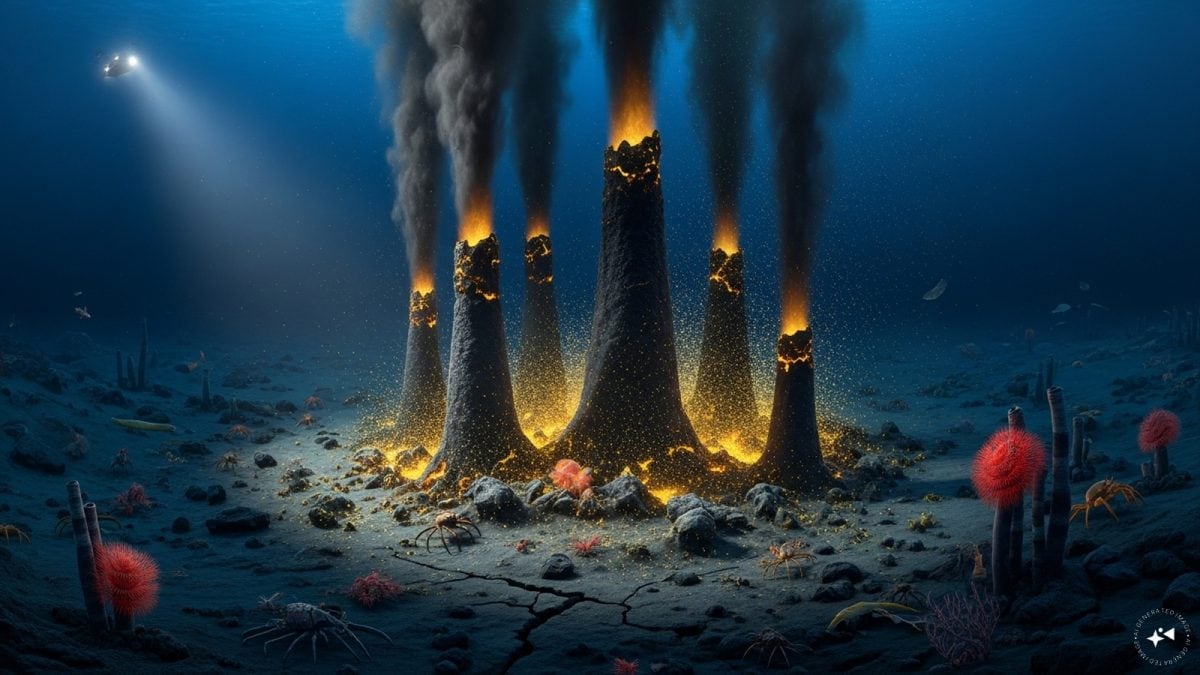
What the scientists actually observed were these hydrothermal vents – little chimney‑like structures that spew out super‑heated, mineral‑rich water. The vents act like the exhaust pipes of our underwater kitchen, flashing the gold‑laden fluid into the surrounding seawater where it eventually settles.
In most cases, the process is extremely slow, but the sheer scale of the ocean floor means that even a tiny rate of deposition can add up to a massive amount of gold over geological time. It’s kind of like saving a few rupees every day – you might think it’s nothing, but after decades it becomes a substantial sum.
The Volcanic ‘Factory’ Under the Pacific – What Researchers Found
Actually, the team of scientists used special submersibles equipped with high‑resolution cameras and sampling tools to go down to a depth of over three kilometres, which is deeper than most commercial aircraft fly. They collected fluid samples directly from the vents and analysed them back on the surface. The results were astonishing: the water contained gold concentrations hundreds of times higher than normal seawater.
To put it in perspective, ordinary seawater has about a few parts per trillion of gold – that’s like finding a single grain of sand in a football stadium. But at these vent sites, the concentration jumped to a level where, if you could somehow extract it, you’d get a few grams of gold per litre of fluid. Imagine the excitement of the researchers when they saw those numbers. It felt a little like when I first tasted my mother’s homemade mango pickle – there’s a punch of flavour that makes you sit up straight.
The study also highlighted that the gold isn’t just floating around; it gets trapped in sulphide minerals like pyrite and chalcopyrite, forming solid deposits that cling to the vent structures. Over time, as more and more fluid passes through, the deposits grow thicker, creating what the scientists aptly described as a natural ‘gold factory’.
Why This Matters – From Science to Everyday Life
Now you might be wondering why anyone should care about gold forming under the sea. Apart from the obvious intrigue of hidden treasure, the discovery changes how we think about the Earth’s mineral cycle. For a long time, most of the gold we use – in jewellery, electronics, even in dentistry – was thought to come mainly from ancient mining on land. This new evidence shows that the oceans are also a significant source, albeit a hidden one.
For us living in India, where gold is more than just a metal – it’s a cultural symbol, an investment, a part of festivals – knowing that part of our gold could have a marine origin adds a fascinating layer to its story. It also raises questions about future resource extraction. While the idea of mining the seabed might sound like a sci‑fi adventure, it also brings up environmental concerns. The Pacific floor is a delicate ecosystem, home to unique marine life that could be disrupted if we start pulling out these mineral deposits.
In most cases, the scientific community is still debating the balance between resource needs and ecological protection. It’s a bit like when we think about building a new highway through a forest; the benefits have to be weighed against the loss of habitat. The same careful, responsible approach will be required if anyone ever decides to tap into these underwater gold factories.
Personal Reflections – What It Felt Like to Read the Study
Honestly, reading the research paper felt like a blend of awe and a pinch of impatience. I kept thinking about how far away those vents are – deeper than the deepest dive I could ever imagine – and yet the processes happening there are the same basic chemistry we study in school. It reminded me of the time I watched a pressure cooker whistle on the stove; the steam escaping, the lid rattling – a tiny glimpse of the massive forces at work under the sea.
Also, I couldn’t help but compare it with the gold rush stories my grandfather used to tell me about the hills of Karnataka and the old mines of Kolar. Those were over land, with people digging with pickaxes and shovels. Here we have a natural process doing the hard work, with none of the human sweat and struggle, just nature’s quiet persistence.
It makes you realize how small our everyday concerns can be when viewed against such grand geological timelines. Even the hustle of city life in Mumbai or Delhi seems trivial when you think about millions of years of magma, water, and mineral interaction shaping precious resources that we cherish today.
The Road Ahead – Future Research and Potential
Scientists are already planning follow‑up expeditions to map out more of these vent sites across the Pacific. They want to know how widespread these gold‑rich vents are, what other minerals might be forming there, and how the overall chemical balance of the ocean is affected.
One practical aspect they’re focusing on is figuring out whether it’s technologically and environmentally feasible to harvest the gold without causing massive damage. Some proposals involve using “in‑situ” extraction methods – basically pulling the metal out while leaving the rest of the ecosystem relatively untouched. It’s a complex engineering challenge, somewhat like trying to milk a cow without causing it any stress.
Until then, the discovery remains a fascinating piece of the Earth’s puzzle, reminding us that we are still learning about the planet we call home. In the words of one of the lead researchers, “the ocean still holds many secrets, and this is just the tip of the iceberg.” That sounded poetic, but it also felt very real, because the ice‑berg metaphor is something we all see during winter holidays, and now we have a literal iceberg of knowledge under the sea.
Conclusion – A Hidden Factory Worth Knowing About
So, to sum it up, the Pacific Ocean isn’t just a big blue stretch of water; it’s also a massive, slow‑moving factory where volcanic heat and seawater team up to produce gold over eons. The recent discovery gives us a glimpse into that hidden world, showing how natural processes can create something as valuable as gold without any human effort.
For anyone who loves a good story of discovery, or who simply enjoys thinking about how our planet works, this finding is a reminder that there are still surprises waiting, even in places we thought we knew well. And next time you see a piece of gold jewellery, perhaps you’ll pause and imagine that somewhere down below, far away from the bustling streets of India, a quiet volcanic vent is quietly forging more of that same gleaming metal.
Until more research sheds light on the practical side of this phenomenon, we can simply enjoy the wonder of it – a natural gold factory, hidden deep beneath the waves, waiting to be explored.