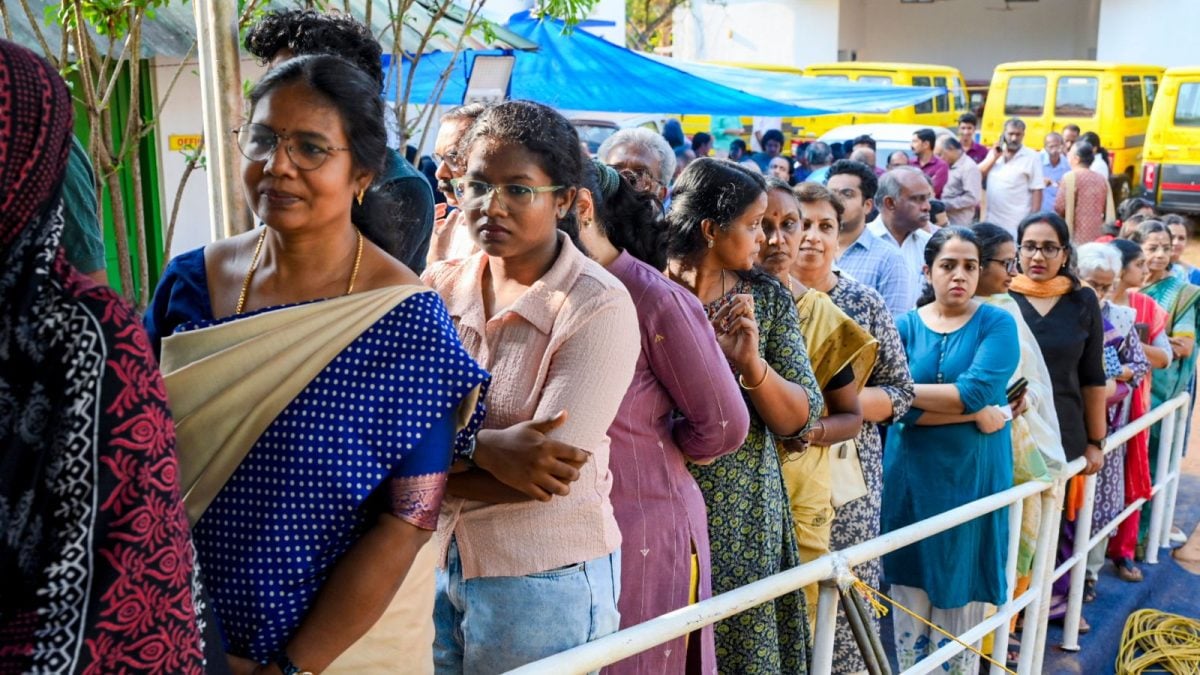
Figures released by the Election Commission of India at 7 pm showed a turnout of 77.45 percent, a notable increase from the 74.06 percent recorded in the 2021 assembly polls
As Keralam turned out to cast the ballot on Thursday, the state recorded a surge in voter turnout as compared to the 2021 assembly elections when polling ended at 6 pm.
While the final figures are not out yet, voting trends suggest a higher voter turnout for the assembly elections this time as the numbers of those who showed up at polling booths steadily grew from morning to evening.
But what does that have to do with how the state voted overall? Let’s take a look.
MORNING ‘SURGE’ OR EVENING ‘PUSH’?
Polling in Keralam took place with more than 2.71 crore eligible voters and 883 candidates. Figures released by the Election Commission of India (ECI) at 7 pm showed a turnout of 77.45 percent, a notable increase from the 74.06 percent recorded five years ago.
In a state where political literacy is high, the timing of these votes – from the early morning “surge" to the final evening “push" – is used to analyse voting trends in different constituencies and the likely result. In Keralam, the time of day a voter reaches the booth is often as telling as the vote itself.
According to experts, the early morning surge between 7 am and 11 am, is typically driven by the “committed cadre". Strong grassroots organisations, such as the CPI(M) and the RSS-BJP, excel at early “booth management" ensuring their loyalists vote before the humid weather intensifies. A record-breaking morning turnout can signal a “silent wave" of anti‑incumbency, where voters are eager to record their dissent.
Experts indicate that the midday lull from noon to 3 pm, meanwhile, helps distinguish between urban apathy and rural engagement. While urban centres like Kochi often see a dip due to the heat, sustained turnout in rural belts indicates that the working class – a core block for the Left – is turning out in force.
The evening push from 4 pm to 6 pm is frequently the domain of the undecided or neutral voter, including younger professionals. A late‑day spike often favours the opposition UDF or the emerging NDA “third pole", as per experts.
Kerala ElectionsAssam ElectionsPuducherry ElectionsKerala Voter TurnoutAssam Voter TurnoutPuducherry Voter TurnoutMy Own Morning Walk to the Booth
Honestly, I wasn’t planning on being a big early‑bird. I usually hit the tea stall first thing, grab a steaming cup of chai, and then head out. But that Thursday, I woke up at 5:30 am because my neighbour, who’s a staunch party worker, knocked on my door and politely insisted I join the early crowd. He said, “If we want the vote counted, we must be there before the sun gets too hot.” I chuckled, put on my kurta, and trekked down the narrow lane to the nearest polling booth, which was set up in the school’s front courtyard.
The sight was something else – rows of people, some in crisp shirts, others in simple cottons, all clutching their voter slips. The air was cool, a gentle breeze from the backwaters, and the whole atmosphere felt like a festival. I spotted an elderly gentleman from my village, his silver mustache swaying as he chatted with a group of youths about the latest cricket scores. He told me, “I’m here early because I want to avoid the crowd later. Plus, it feels good to be part of something bigger.” That conversation, simple as it was, gave me a glimpse of what the experts call the “committed cadre” – people who treat voting like a ritual, not a chore.
By the time I cast my vote, the early‑morning tally in the booth’s logbook showed around 15‑percent of the total electorate had already marked their choice. That figure, though still modest, was already higher than the average morning share reported in many other states. For me, it reinforced the idea that the morning surge isn’t just about weather; it’s about community spirit and a sense of duty that many in Keralam seem to carry.
Midday Heat and the Urban Drop‑off
After the morning rush, I decided to take a break and grab a banana leaf snack from a roadside vendor. The streets of Kochi were quieter than usual – a noticeable dip in footfall that matched what analysts describe as the “midday lull". By noon, the temperature had risen, and the bustling traffic that usually clutters the city centre seemed to slow down. I overheard a group of office workers complaining about the heat, saying they would head to the booth only after finishing work.
What struck me was the contrast between the city and a nearby village I visited later in the afternoon. While the urban booths showed a marked dip – some booths had a visible line of empty chairs – the rural ones were still busy. Farmers, already done with the morning ploughing, lined up with their wives, chatting about the upcoming harvest and how a change in policy could affect their yields. One farmer leaned in and whispered, “If the new government can give us better irrigation, I’ll make sure my whole family votes for them.” The dedication was palpable and clearly different from the urban fatigue.
These observations line up with the expert view that the midday lull helps differentiate urban apathy from rural determination. In Keralam, where agriculture still employs a large chunk of the population, the consistent rural turnout suggests that the working class – historically a stronghold of the Left – is still mobilising in large numbers. The city, on the other hand, seemed to be waiting for the evening wave, perhaps because the younger, more mobile professionals were still at work.
The Evening Surge – Youth, Professionals, and the ‘Undecided’
As the clock ticked towards 4 pm, a new kind of energy began to pulse through the streets. Office lights flickered on, and a wave of young professionals in smart shirts started streaming towards the polling stations. I saw a group of three friends, still in their corporate attire, laughing and debating whether the new education policy mattered more than infrastructure promises. One of them, a software engineer, said, “I’m not a die‑hard supporter of any party; I’m just hoping someone will actually fix the traffic in the city.”
The evening push is something the Election Commission of India data often highlights – a surge of “undecided" or “neutral" voters who make their decision at the last moment. In Keralam, this group is particularly influential because a large number of younger voters have grown up with multiple parties vying for their attention through social media, WhatsApp groups, and even meme‑based campaigns.
By the time the polls closed at 6 pm, the tally books showed a steep rise – the final turnout of 77.45 percent was almost 3.4 percentage points higher than the 2021 figure. The evening spike undoubtedly contributed to this uplift. Some political commentators argue that a strong evening performance often benefits the opposition UDF or the newer NDA “third pole", as they tend to attract the fresh‑minded, aspirational voters who only decide after hearing the final arguments.
Walking back home, I reflected on how the day’s voting pattern felt like a micro‑cosm of Keralam’s diverse society – the early‑morning patriots, the hardworking rural voters, and the evening‑time youngsters all coming together under one democratic roof.
Why the Numbers Matter – A Simple Breakdown
Let’s put the facts together in a straightforward way, without any jargon. First, the turnout this time was 77.45 percent – that means out of the 2.71 crore eligible voters, more than two‑crore‑sixty‑four lakh people actually cast their votes. Compare that with the 74.06 percent in 2021, where roughly two‑crore‑sixty‑two lakh turned up. The difference is about 2.2 lakh more voters this time around.
Second, the surge was not just a single burst. It started early, dipped a bit at midday, and then rose again in the evening. This pattern tells analysts a lot about who is motivated and who might be swayed. For example, a strong early‑morning number often points to organized party workers – the CPI(M) and the RSS‑BJP have deep grassroots networks that mobilise their cadres before the heat sets in.
Third, the midday dip in cities versus steady rural turnout hints at differing priorities. While city dwellers may be juggling jobs and traffic, rural folks are often more concerned about immediate issues like irrigation, crop prices, and local infrastructure.
Finally, the evening boost, largely driven by youths and professionals, could be the deciding factor for parties that are trying to break the traditional vote bank patterns. In Keralam, where the electorate is known for its political awareness, this late‑day shift can tilt the balance towards the opposition or the emerging third pole.
Personal Takeaways and What Might Come Next
Having spent the whole day moving between booths, chatting with voters, and observing the ebb and flow of people, I feel that the numbers are more than just percentages – they are stories. The early‑morning crowd showed the power of organised commitment. The midday lull reminded me that a lot of people still prioritize work and family, especially in the cities, while the evening surge highlighted a generation that is asking for something fresh.
If I were to guess what this means for the political landscape in Keralam, I’d say a few things. First, any party hoping to win must now pay attention not only to its core workers but also to the undecided voters who show up later in the day. Second, rural outreach programmes will continue to be crucial, because those numbers stayed robust despite the heat. Third, the youth vote is becoming a decisive factor, and parties will likely ramp up digital campaigns, youth rallies, and promises around jobs and education.
The Election Commission of India’s final report will, of course, give a deeper statistical breakdown, but from what I saw on the ground, the message is clear: Keralam’s voters are eager, engaged, and they are voting at all hours. Whether this translates into a shake‑up of the existing power balance or a reinforcement of the status quo will be clear only after the seats are counted, but the turnout itself is already a victory for democracy.