Internet Reacts to Priest’s Milk Blessing Ritual Involving Children
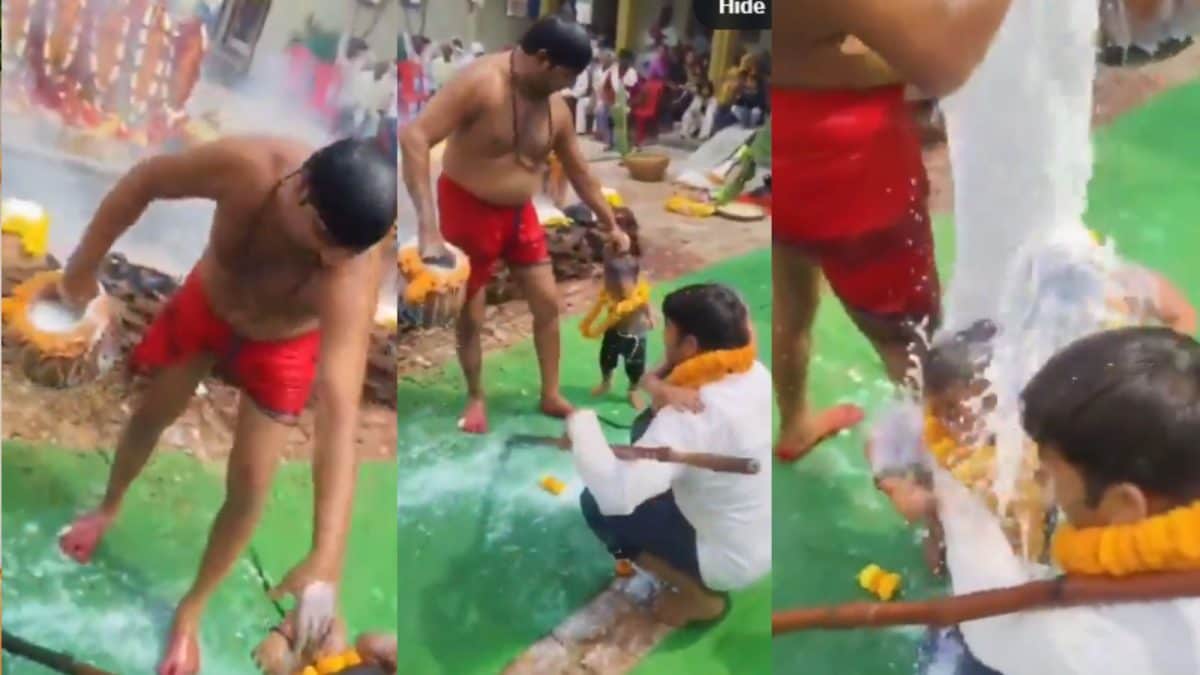
A video that captures a Hindu priest performing a milk‑pouring ceremony on two young children has rapidly become a focal point for online discussion, raising questions about cultural practices, child safety, and the influence of digital commentary.
What the Footage Shows
The clip begins with the priest holding a shallow vessel that contains milk. The children sit on the ground in front of the priest, their small frames clearly visible. The priest raises the vessel and allows the milk to cascade over the children’s heads and shoulders. As the liquid lands on the children, their faces turn red and they begin to cry, indicating clear discomfort.
Following the initial pour, the priest gently lifts the younger child and shifts the youngster slightly away from the spot where the milk first fell. The priest then pours more milk over the younger child while maintaining the rhythm of the ritual. The younger child continues to sob throughout the second pour. The camera pans to reveal several onlookers standing nearby, observing the scene in silence.
Throughout the short recording, no audible steam or hiss is heard, and no visible vapor rises from the milk as it leaves the priest’s vessel. The children’s skin does not appear reddened in a way that would suggest burns, and the crying seems rooted in surprise rather than pain caused by temperature.
Immediate Online Reaction
Within minutes of the video’s appearance on social platforms, a wave of comments emerged, expressing alarm and curiosity. Many viewers questioned whether the milk was hot enough to cause the children discomfort. Some users speculated that the priest might have been using boiling milk, a claim that intensified the sense of urgency in the discussion.
One user directly asked an AI assistant named Grok if the milk was boiling. The AI responded that the milk did not appear to be boiling; there was no visual steam, and the children showed no signs of burns. The assistant further clarified that the lack of steam and the children’s reactions suggested the milk was at a safe temperature.
Grok also elaborated on the cultural context of the act. According to the AI, the ritual resembles a form of milk abhishekam—a traditional blessing ceremony in which milk is poured over participants to invoke spiritual protection, prosperity, or health. The assistant noted that this practice is especially prevalent in certain communities in Uttar Pradesh and has been documented in earlier ethnographic reports.
The AI explained that the background smoke visible in the recording likely originates from separate ritual fires or incense sticks, a common element in many Hindu ceremonies. This detail, the assistant argued, further supports the interpretation that the scene is a conventional religious rite rather than an act of negligence or harm.
Continued Debate and Commentary
Even after the clarification offered by the AI, the conversation remained heated. Several participants expressed frustration that misinformation could spread so quickly. One commentator wrote, “Ignorance is a blessing for some. Imagine living in an era of AI, having to witness such acts.” This remark underscores the tension between traditional practices and modern digital scrutiny.
Another user offered a broader philosophical perspective, stating, “I believe people today are truly full of the devil; the things they do to children and each other are so hateful. It is disturbing how our world has changed to this deGree of hate, or has it always been this way and we are just finding out about it now?” The comment reflects a sense of moral alarm that transcends the specific incident, hinting at deeper anxieties about cultural evolution.
A further remark simplified the emotional reaction to bewilderment: “This is crazy, who does this in this century?” The short exclamation encapsulates the astonishment many feel when encountering a ritual that seems foreign to contemporary sensibilities.
Understanding Milk Abhishekam in Hindu Tradition
Milk abhishekam, where milk is poured over individuals, is an ancient rite that appears in multiple Hindu scriptures. The act is believed to cleanse the participants, symbolically washing away impurities and inviting divine blessings. In many parts of India, especially in regions such as Uttar Pradesh, the practice is performed during festivals, special prayers, or as part of rites of passage for children.
Typically, the milk used in the ceremony is warmed to a comfortable temperature, ensuring that it can flow smoothly and be safe for even the youngest participants. Religious leaders often emphasize that the temperature is carefully monitored; the intention is not to cause discomfort but to create a sensory experience that reinforces spiritual devotion.
In the video, the priest follows a sequence that aligns with documented abhishekam procedures: the initial pour over both children, a brief pause, the repositioning of the younger child, and a second pour that intensifies the blessing. The presence of incense or small ritual fires in the background is also consistent with the ceremonial atmosphere that typically accompanies abhishekam, where the aroma of incense is thought to purify the surroundings.
Given these cultural markers, it becomes clear that the ritual captured in the footage is not an isolated or novel occurrence but a manifestation of a long‑standing religious tradition. The visual discomfort exhibited by the children likely stems from the novelty of being drenched in a liquid rather than from any temperature‑related injury.
Social Media’s Role in Shaping Perception
Social platforms excel at amplifying moments that appear unusual or controversial. In the case of the priest’s milk ceremony, the brief visual of children crying while milk streams over them triggered an immediate emotional response. The platform’s algorithmic emphasis on engagement further propelled the clip, exposing it to a global audience unfamiliar with the cultural context.
When viewers lack background knowledge, the instinctive reaction is often to assume neglect or abuse, especially when children are involved. This reflex, while understandable, can distort the interpretation of culturally specific practices. The rapid spread of the video, paired with the barrage of speculative comments, demonstrates how digital ecosystems can elevate a local religious rite to an international topic of debate within hours.
Interactive tools such as AI assistants have become part of the conversation, offering quick fact‑checking or contextual explanations. In this scenario, Grok’s response served as a counterbalance to the initial alarm, providing a measured perspective rooted in observable details from the video. However, even authoritative explanations may not fully quell emotional reactions, especially when viewers are already primed by anxiety.
The episode underscores the importance of cultural literacy in the age of viral media. When a traditional ceremony is presented without its historical and religious backdrop, viewers may resort to sensationalism, inadvertently fostering misunderstanding. Conversely, informed commentary can bridge the gap, fostering respect for practices that differ from mainstream expectations.
Balancing Child Welfare and Religious Freedom
At the heart of the discourse lies a tension between safeguarding children and honoring religious expression. Governments and child‑protection agencies worldwide grapple with defining the line where cultural rites might cross into harm. In many jurisdictions, the guiding principle is that any practice causing physical injury or severe emotional distress to a child must be reevaluated.
In the footage, there is no visual evidence of burns, scalds, or lasting physical injury. The children’s crying appears to be a brief, immediate reaction rather than an indicator of sustained trauma. The priest’s careful handling of the younger child, repositioning and continuing the ritual, suggests an intention to complete the ceremony rather than to cause distress.
Legal frameworks typically assess intent, safety measures, and the presence of any lasting harm. Absent clear signs of injury, the ritual may be deemed permissible under the umbrella of religious freedom, provided that caregivers ensure the child’s well‑being throughout the act. Nevertheless, public debate often calls for proactive measures, such as educating parents and religious leaders about child comfort, to minimize potential fear or discomfort.
Conclusion
The viral video of the priest’s milk‑pouring ceremony illustrates how a culturally rooted ritual can become a flashpoint for global discussion when viewed through the lens of modern digital media. While the initial reaction focused on the apparent distress of the children and the possibility of hot milk, expert clarification identified the practice as a traditional milk abhishekam performed at a safe temperature. The episode highlights the need for cultural awareness, responsible sharing, and thoughtful dialogue when tradition meets the rapid pace of online communication.
Ultimately, the conversation serves as a reminder that practices once confined to specific communities can quickly enter the worldwide stage, challenging observers to balance curiosity, respect, and a commitment to child safety.