Student Exhausted While Hand‑Fanning Teacher on Call Sparks Outcry Over Madhya Pradesh School Conditions
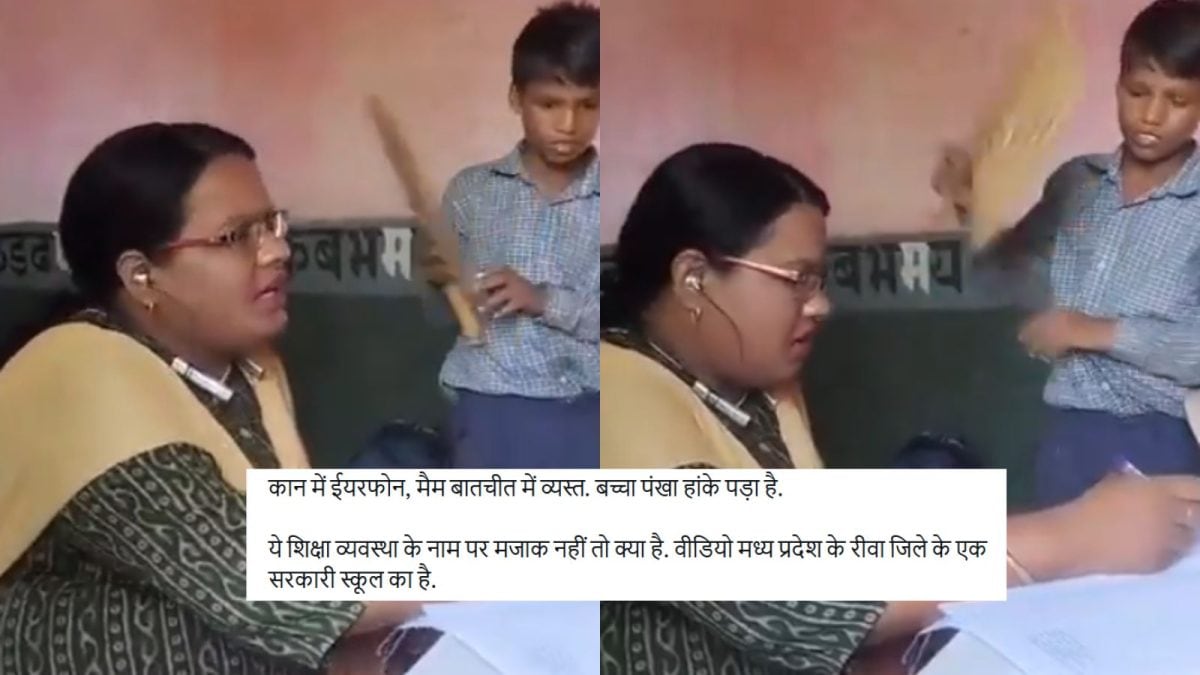
A short clip circulating on social media depicts a stark illustration of classroom dynamics in a government school in Rewa district, Madhya Pradesh. In the footage, a teacher is heard speaking on a telephone while wearing earphones, and a young student stands nearby, repeatedly waving a handheld fan to provide relief. The scene has quickly become a focal point for debate about teaching practices, student welfare, and the broader state of government‑run schools in the region.
What the Video Shows
The recording, originally posted on the platform X by user Priya Singh, captures a moment that has resonated with viewers across the country. In the frame, the teacher holds a telephone to the ear, appears engaged in a conversation, and continues to address a group of children. Simultaneously, a student holds a small, portable fan in one hand, then switches it to the other hand as fatigue becomes evident. The repeated motion of the fan, combined with the student’s shifting grip, underscores a palpable sense of exhaustion.
The visual narrative is stark: while the teacher remains occupied with an external dialogue, the student shoulders the burden of providing a cooling breeze. The student's face reveals signs of weariness, and the act of alternating hands with the fan suggests an attempt to manage fatigue. The teacher, meanwhile, remains oblivious to the student's evident strain, continuing the phone conversation without interruption.
This juxtaposition of responsibilities—teacher engaged with a phone call and student attempting to maintain a comfortable environment—has become a symbol for many of the perceived imbalances within certain educational settings.
Social Media Reaction and Public Outcry
The clip ignited a wave of commentary on X, with users expressing a mixture of empathy, frustration, and condemnation. One commenter wrote, “Poor little kid got exhausted fanning with both hands,” highlighting the visual evidence of the student's tiredness. Another user described the incident as “tampering with the future,” implying that such classroom practices could have lasting negative effects on children’s education.
Calls for immediate disciplinary measures against the teacher quickly emerged. A particularly forceful remark demanded, “Immediately suspend the teacher,” reflecting a desire for swift accountability. In Hindi, another response labeled the teacher as “Such people are a burden on society,” reinforcing the perception that the observed behavior is not merely a lapse but a societal concern.
Beyond the raw condemnation, several participants in the discussion used the clip as a springboard to raise broader questions about the quality of education in government schools, especially in rural locations where resources and oversight may be limited. The conversation evolved from a single incident to a larger dialogue about systemic challenges.
Underlying Issues Highlighted by the Video
While the video depicts a specific moment, it resonates with existing narratives about the state of government schools in Madhya Pradesh. Observers point to recurring themes such as insufficient supervision, lack of adequate infrastructure, and the occasional prioritisation of personal matters over classroom duties. The teacher’s decision to conduct a phone conversation during instructional time suggests a possible lapse in professional conduct, raising questions about the mechanisms in place to enforce teaching standards.
Furthermore, the student's willingness to continuously fan the teacher underscores a dynamic where student responsibilities extend beyond learning to compensate for deficiencies in the learning environment. The visual evidence of the student swapping the fan between hands illustrates not just physical fatigue but also the psychological pressure of meeting an expectation that is arguably outside the scope of a child's role in an educational setting.
These observations dovetail with past reports that have highlighted challenges such as inadequate classroom ventilation, limited access to functional cooling equipment, and the need for teachers to manage large class sizes without adequate support. Though no official data is presented within the clip, the visual narrative aligns with anecdotal accounts that many students in government schools confront similar hardships.
Absence of Official Commentary
As of the time of writing, there has been no formal statement from the administration of the government school in Rewa district, Madhya Pradesh, nor from higher educational authorities within the state. No verification of the identities of the teacher or the student has been provided, and no official response confirming or refuting the circumstances shown in the video has emerged.
The lack of an immediate official response has prompted additional speculation, with some observers arguing that silence may be indicative of systemic reluctance to confront uncomfortable realities. Others caution against premature conclusions, emphasizing the need for a thorough investigation before attributing blame or implementing policy changes.
Calls for Reform and Future Directions
Amid the furor, a number of commentators have suggested concrete steps that could mitigate the type of scenario captured in the video. Recommendations include establishing stricter guidelines that limit teachers’ use of mobile devices during class, enhancing monitoring mechanisms to ensure that classroom conduct aligns with educational standards, and providing schools with adequate cooling infrastructure to reduce reliance on students for temperature regulation.
Other voices have emphasized the importance of teacher training programs that reinforce professional ethics, classroom management skills, and the prioritisation of student welfare. By reinforcing a culture where teachers are expected to remain fully engaged with their pupils, the need for students to assume auxiliary roles—such as providing ventilation—could be substantially reduced.
Stakeholders also propose the creation of a transparent grievance redressal system that allows students, parents, and staff to report instances of neglect or misconduct without fear of retaliation. Such a system could facilitate faster responses to concerns similar to those highlighted in the video, ensuring that issues are addressed promptly and constructively.
Broader Implications for Education in Madhya Pradesh
The incident captured in the video serves as a microcosm of broader educational challenges that have been discussed in policy circles for years. It underscores the delicate balance between resource constraints, teacher accountability, and student well‑being. While the clip centres on a single classroom episode, the emotional resonance it has generated suggests that many parents, educators, and citizens view it as indicative of a larger pattern.
For Madhya Pradesh, a state with a diverse educational landscape that includes both urban and remote rural schools, the incident may act as a catalyst for renewed focus on the quality of teaching environments. It invites policymakers to re‑examine budget allocations for school infrastructure, to strengthen professional development pathways for teachers, and to ensure that monitoring frameworks are robust enough to detect and address lapses before they become public spectacles.
In the realm of public perception, the video has also contributed to a heightened awareness among citizens about the everyday realities that students in government schools may face. This awareness can translate into increased civic engagement, prompting community members to advocate for improvements, demand accountability, and collaborate with authorities to foster safer, more conducive learning spaces.





.jpg?type=mq)