What happened to the Indian rupee this morning?
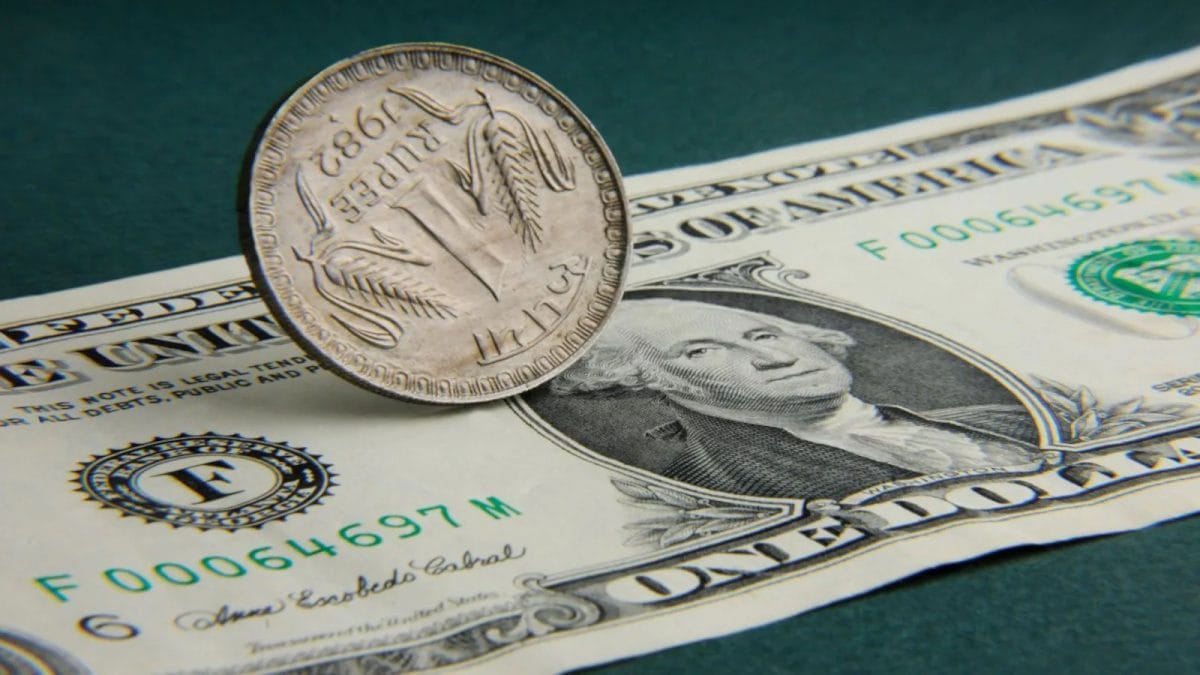
So, early this morning the Indian rupee opened at 93.30 per US dollar and then slipped a little more, finally trading at 93.32 in the early deals. That means the Indian rupee lost 49 paise compared to where it closed the day before.
If you look at the interbank forex market, that tiny move might not sound huge, but in the context of what’s happening globally it becomes quite telling. The number 93.32 is now the headline, and many traders are already chatting about why the Indian rupee is under pressure today.
Crude oil price shock – a big piece of the puzzle
In fact, Brent crude was trading about 7.28 per cent higher at $102.13 per barrel in futures after the US announced it would start a blockade of Iranian ports from Monday. The blockade was said to be “enforced impartially against vessels of all nations” entering or leaving Iranian ports, although ships not heading to Iran could still pass through the Strait of Hormuz. This news added fuel to the fire – quite literally – and pushed the Indian rupee a little lower.
Strong US dollar – the other side of the coin
While oil was getting dearer, the US dollar was also picking up strength. The dollar index, which measures the Greenback against a basket of six major currencies, was up by 0.38 per cent, sitting at 98.81. A stronger US dollar means you need more Indian rupee to buy a single US dollar, which directly translates into a higher rupee‑dollar rate.
For many of us in India, seeing the dollar get stronger is a familiar story – especially when the Federal Reserve signals higher interest rates or when there’s a global risk‑off sentiment. In this case, the combination of an appreciating US dollar and spiking oil prices created a perfect storm for the Indian rupee.
Equity markets react – Sensex and Nifty tumble
The weakness in the Indian rupee wasn’t confined to the forex market. The Indian equity indices also opened on a soft note, with the Sensex and Nifty 50 sliding more than two per cent in early trade.
The Sensex dropped close to 1,700 points, reaching an intraday low of about 75,868, while the Nifty 50 slipped around 500 points, landing near 23,556. By the time the market settled a little later, the Sensex had recorded a fall of roughly 1,600.73 points (about 2.06 per cent) to 75,949.52, and the Nifty 50 was down about 468.85 points (1.95 per cent) at 23,581.75.
For a regular market‑watcher, it feels like the Indian rupee’s slip and the equity market dip are two sides of the same coin – foreign investors start pulling money out of Indian stocks when the currency looks weak, and domestic investors also get jittery.
Foreign Institutional Investors and capital flows
Speaking of investors, the data shows that Foreign Institutional Investors (FIIs) bought equities worth Rs 672.09 crore on the previous Friday. That amount is decent, but it wasn’t enough to offset the broader outflow triggered by the oil‑price shock and the strong dollar.
When we talk about capital flows, it’s often useful to remember that many foreign investors look at the rupee‑dollar rate as a barometer of risk. If the Indian rupee weakens, they may decide to reduce exposure, which in turn adds more pressure on the rupee – a bit of a feedback loop.
RBI’s foreign‑exchange reserves – a modest boost
On the policy side, the Reserve Bank of India (the RBI) announced that the country’s foreign‑exchange reserves rose by $9.063 billion, reaching $697.121 billion for the week ended early April. In the prior reporting week, reserves had fallen by $10.288 billion, slipping to $688.058 billion.
Even though the RBI’s buffer grew, the rise is relatively modest compared with the size of the reserves, and it didn’t immediately stop the rupee from slipping. Nevertheless, the RBI’s reserves act as a cushion and signal that the central bank is ready to step in if the market goes sideways.
Asian Development Bank’s warning – why the Middle East matters for India
The Asian Development Bank (the ADB) warned that a prolonged conflict in the Middle East could hurt India’s macro‑economic performance through several channels – higher energy prices, disruptions in trade flows, and weaker remittance inflows.
In its Asian Development Outlook report, the ADB still expects India’s GDP growth to stay “robust” at 6.9 per cent for the current fiscal year and to climb to 7.3 per cent the next year. The optimism is grounded in strong domestic demand, easing financing conditions, and lower US tariffs on Indian goods. Still, the ADB’s caution reminds us that external shocks, especially from the oil‑rich Middle East, can quickly change the picture.
From a personal viewpoint, I often hear my uncle, who works in a logistics firm, talk about how a tiny uptick in oil price can push up transport costs, and that in turn affects everything from mango shipments to mobile‑phone imports. That chain reaction can subtly bleed into the rupee’s value.
Wrap‑up – what to watch next?
All in all, the Indian rupee’s dip to 93.32 against the US dollar is the result of a mix of higher oil prices, a firm US dollar, and geopolitical jitters stemming from the US‑Iran situation. The equity markets echoed that sentiment, and while the RBI’s reserves gave some comfort, the underlying pressures remain.
Going forward, traders will likely keep an eye on three things: first, any fresh development in the Middle East that could move oil prices again; second, the US dollar’s trajectory – especially any Fed announcements; and third, the RBI’s readiness to intervene if the rupee slides past another significant threshold.
For ordinary Indians, the key takeaway is that currency movements do affect everyday life – from the price of cooking oil to the cost of a flight to Dubai. So, staying informed and watching how these macro trends translate into your grocery bill or travel plans can be quite useful.
Until next time, keep sipping your chai and watching the market – because every paise counts.