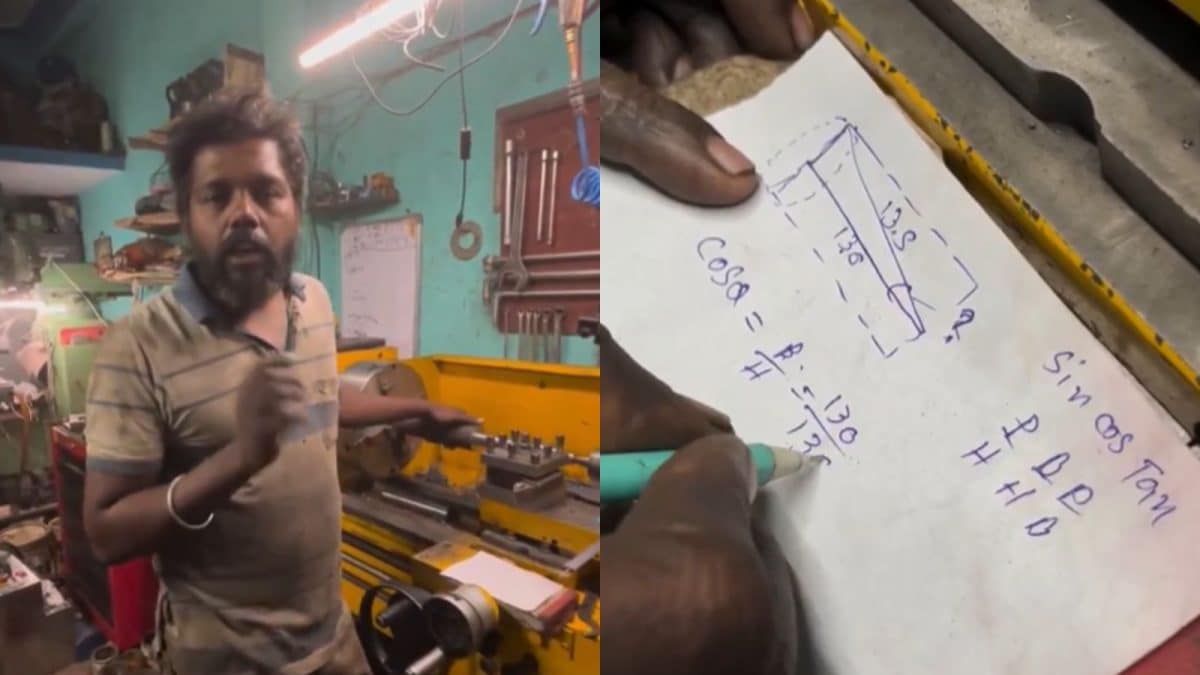
A man’s simple and easy-to-follow explanation of how trigonometry is used in real life is winning hearts online
Honestly, I was just scrolling through X on a lazy Sunday evening, looking for some light entertainment, when a video popped up that instantly caught my eye. It was tagged as a "must‑watch" and the thumbnail showed a guy standing next to a hefty metal machine, holding a protractor like a seasoned teacher. The caption read something about "Cos Θ in the real world" and, being the curious person I am, I clicked. What happened next is interesting – the man started talking about a basic trigonometry formula and, without any fancy graphics, he actually applied it to the machine in front of a group of engineers. It felt like watching a live workshop rather than a typical classroom lecture, and that’s probably why the clip has become such a piece of breaking news on the internet.
Most of us remember the endless nights spent solving sine, cosine and tangent problems for board exams, only to wonder whether any of that ever mattered after we left school. The formulas seemed to float in a vacuum, stuck between the pages of a textbook and the occasional pop‑quiz. But this video turned those abstract symbols into something you could see, touch and feel. The man, who remains unnamed in the clip, started with the classic right‑triangle relationship – the opposite side, adjacent side, hypotenuse – and then pointed at the machine, showing how the angle of a taper could be measured and used to calculate the necessary cut. In most cases, it was the kind of practical illustration you wish your teachers had shown back in class.
What makes the demonstration stand out is its simplicity. No high‑tech animation or complicated jargon – just a chalk‑board style explanation, a protractor, and a sturdy piece of equipment that the engineers were clearly familiar with. The man recalled the formula cos θ = adjacent/hypotenuse, then moved the protractor to the machine’s taper, measured the angle, and walked us through the math step by step. As he spoke, he kept the tone conversational, using phrases like “actually, when you look at this angle here…” and “basically, this is what we do in the workshop.” It felt like he was talking to a friend, not a class full of strangers.
Seeing the calculation unfold, I could hear a faint hum of curiosity from the engineers gathered around – they nodded, asked a couple of quick questions, and then the man demonstrated the final step: finding the length of the hypotenuse using the cosine value he’d just measured. He showed how the machine’s specifications – the larger and smaller diameters, the length of the taper – all fed into a single, tidy equation. The whole thing lasted just a few minutes, but the clarity was striking. For anyone who’s ever felt lost in a sea of trigonometric symbols, this was a breath of fresh air.
The post accompanying the video simply read, “Man explains how Cos Θ learnt in school is used in real world.” That line alone turned the clip into trending news India within hours. People started sharing it across various platforms, tagging it as the latest news India that actually mattered to students, engineers, and even parents trying to help their kids with homework. You could see the comment section light up with reactions: “I wish I had seen this when I was in 10th standard,” “Better than any IIT professor I’ve heard,” and “Finally, someone taught me why we learn these formulas.” It was clear that the video struck a chord among a wide audience.
One user wrote, “Reminds me of mechanical workshop days. All the fitters and turners are taught this. But instead of actually making them understand the concept, templates are provided explaining how to work for each job. Very few people, like this gentleman here, learn the overall concepts.” That comment summed up the general sentiment – many saw this as a rare instance where a teacher focused on the underlying principle rather than just a step‑by‑step recipe. Another user tried to break down the calculation, saying, “How is he able to calculate the hypotenuse? In machining, Tan of the taper angle is found by subtracting the smaller dia from the bigger dia and dividing the result by 2 times length. Then, taking the inverse of that.” The discussion quickly turned into a mini‑tutorial, with folks adding their own tips and variations.
What surprised many people was the sheer simplicity of the setting. There were no high‑definition graphics, just a plain workshop floor, a few tools, and the man’s clear voice. Yet, it became a piece of viral news that spread like wildfire. Some commenters even joked that if this were a school lesson, the entire class would have gotten straight A’s without the usual panic. One fan exclaimed, “I would love him as my maths teacher; I’d finally be fond of maths.” The phrase “explained better than what my teacher taught in the 10th standard many years ago” was repeated a few times, underscoring how many felt they missed out on such practical teaching during their own school years.
Man Explains Trigonometry Using Real Example
The core of the video is the man’s ability to translate a textbook formula into a real‑world problem. He starts by recalling a basic trigonometric identity, then asks the engineers to measure the taper angle of the machine. He shows how the cosine of that angle, when multiplied by the length of the adjacent side, gives the hypotenuse – essentially the length of the cut needed. As he calculates, he writes the numbers on a board, making sure even a layperson can follow along. The engineers in the background occasionally nod, indicating they see the relevance instantly. It’s the kind of teaching method that could easily be incorporated into school labs, but sadly, most curricula stick to abstract problems.
He also points out that in many machining operations, the same trigonometric relationships appear over and over again. For instance, when a lathe operator needs to set the tool at a precise angle, they use the same cosine rule to ensure the cut is accurate. In most workshops, this knowledge is passed down through experience, not textbooks. The man’s demonstration bridges that gap, showing that the math we learn isn’t just for exams – it’s a daily tool for engineers, fitters, and anyone working with angles and measurements.
Internet Praises His Teaching Style
The video didn’t just stay within engineering circles; it quickly became a piece of breaking news across social media. Users flooded the comments with praise, comparing the man’s clarity to that of seasoned professors. One comment simply said, “Better than IIT professors!” while another added, “Why don’t they teach with a practical example like this in school in the very first place?” These remarks highlight a common frustration among Indian students – the lack of real‑life context in school mathematics.
Another comment that made me smile was, “I wish he were my maths teacher, I would be fond of maths.” It’s a sentiment many of us share; back in the day, I remember dreading trigonometry because the teacher never showed how it could be used beyond the textbook. Seeing this video reminded me of the feeling of finally “getting it.” The thread turned into a mini‑forum where people exchanged their own experiences of learning maths the hard way, and how a simple real‑life example could have made a huge difference.
What’s interesting is how the video also sparked discussions about improving the curriculum. A few educators chimed in, suggesting that schools could incorporate short, practical demonstrations like this one into their maths lessons. They argued that when students see the direct application – be it in construction, automotive repairs, or even everyday tasks like measuring a roof slope – the motivation to learn the underlying theory skyrockets. This conversation, spreading across the internet, turned the simple clip into more than just a viral meme – it became a catalyst for debating education reforms in India.
Why This Video Resonated With So Many
From my perspective, the video resonated because it answered a question we’ve all asked at one point or another: "When will I ever use trigonometry?" The man didn’t just answer; he showed, in a setting that looked familiar to anyone who has ever visited a workshop or a construction site. It felt relatable, like a friend explaining a trick you can actually use at home. The fact that the video spread as part of the latest news India, labeled as “viral news” by several portals, shows how powerful a simple, well‑delivered explanation can be.
Moreover, the authenticity of the setting added to its charm. There were no glossy studio lights or scripted actors – just a genuine conversation between the man and a group of engineers. The informal language, the occasional "you know" and "actually," made it sound like a chat over chai rather than a lecture hall. This informal tone is something Indian audiences often connect with, especially when the content is educational. It’s why the clip quickly turned into trending news India, shared across family WhatsApp groups and school chat rooms.
What Could Schools Learn From This?
If I were to suggest one change for schools, it would be to bring more of these real‑world demos into the classroom. Imagine a math teacher pulling out a simple tool, measuring an angle on a piece of wood, and then calculating the hypotenuse right there on the blackboard. Students would instantly see the connection between the formula and the task at hand. The video shows that such an approach is not only possible but also highly effective. It turns abstract symbols into something tangible, which is exactly what education should aim for, especially in a diverse country like India where practical skills are valued alongside academic knowledge.
Another takeaway is the power of storytelling in teaching. The man didn’t just present a problem; he narrated a short story of an everyday engineering task. Storytelling keeps the audience hooked, and as the comments reveal, people love content that feels personal and relatable. That’s a lesson for educators and content creators alike – blend the facts with a narrative, sprinkle in some real‑life examples, and you have a recipe for viral, share‑worthy learning material.
Final Thoughts
All in all, the video has become more than a simple explanation; it’s a piece of breaking news that highlights a gap in our education system while also offering a glimpse of how that gap can be filled. From my side, I’ll definitely keep an eye out for more such practical demos, and I hope teachers across the country take note. After all, if a short clip can win the hearts of thousands and become trending news India, imagine the impact if schools started using similar methods daily.
And just to wrap things up, the original post also contained a couple of unrelated tags – "Israel Iran War News" and "Iran US Ceasefire" – probably left over from a copy‑paste. They don’t affect the story, but they remind us how quickly content can get mixed up online, making it all the more important to focus on clear, relevant, and engaging information.