- Buzz Staff
Clip shows baby set adrift in decorated pot as online reactions question safety, faith and accountability
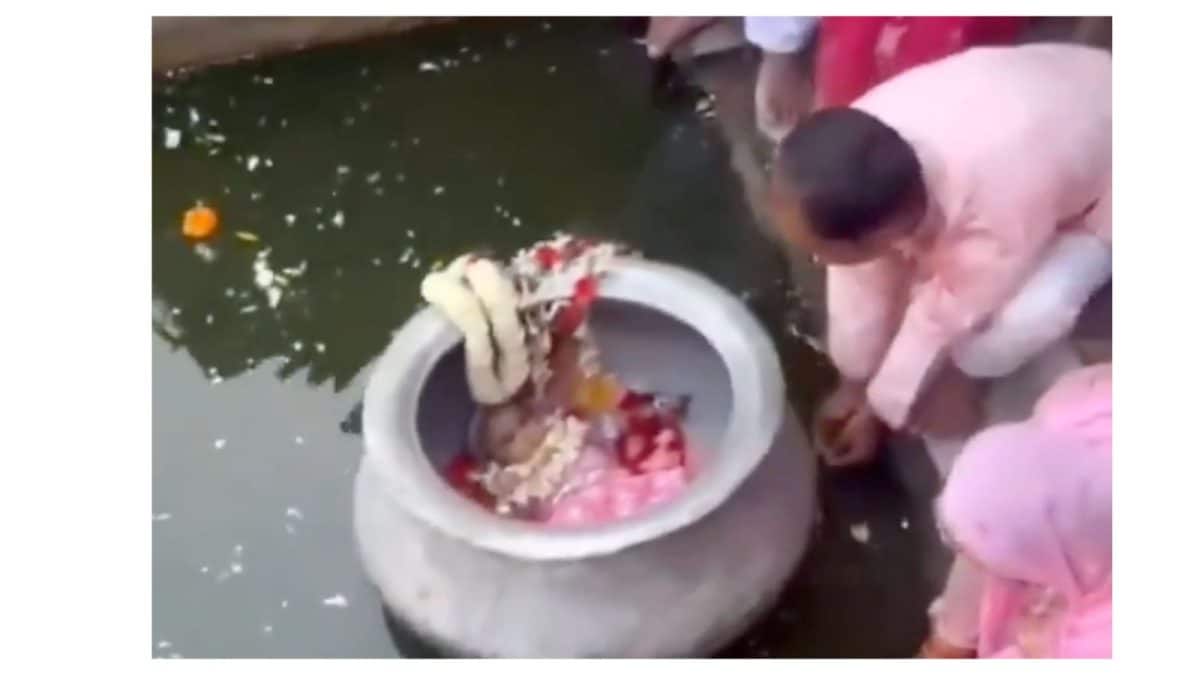
Honestly, when I first saw the video on my phone, I thought it was some kind of prank. But the moment the tiny pink frock and flower garlands appeared, my heart sank. It was a baby girl, not a prop, lying inside a big metal vessel that was being pushed into a river that looked nothing short of filthy. The whole thing was being treated like a ritual, and that’s what made it so unsettling.
The clip, which has become part of the breaking news cycle, was posted with the caption “Another day, another ‘ritual’ putting a child at risk.” Two men wearing skull caps gently placed the infant inside an open pot, laying a sheet beneath her. A third man then pushed the pot into the water, and the whole thing started floating. At one point someone even tossed money into the vessel, as if offering a sacrifice. The pot bobbed for a few seconds before a stick was used to guide it back towards the men.
What happened next is interesting – the child remained completely still, as if she were scared or perhaps accustomed to being held tightly. The water around the pot was visibly polluted, with floating flower waste and bits of trash. It looked like the same river that many of us in the neighbourhood use for washing clothes or bathe our cattle. Seeing a child threatened in that environment felt like a personal affront, even though I don’t know the exact location.
Now, you might wonder why this is getting so much attention. Apart from the sheer shock factor, the video touched upon a few hot topics that are always part of India updates: child safety, superstitious practices, and the role of religion in daily life. In most cases, the comment sections blew up with people sharing their own anecdotes about similar rituals they’ve seen during festivals, or even during weddings, where small objects, not babies, are floated on water as a sign of letting go.
One of the first comments I read said, “Has everyone lost their brain?” Another user wrote, “Anyone who endangers the lives of children because of their superstitions must be punished by law.” A lot of folks were quick to point out that this wasn’t an isolated incident; it made them recall how, during certain local fairs, people would set small pots filled with oil or flowers on the river as a prayer. But the moment a child is involved, the line between tradition and negligence becomes razor‑thin.
Religious undertones quickly entered the conversation. Some people argued that the practice was part of the local culture and had nothing to do with any specific faith. Others were blunt, saying “This is not Islam. They should stop this.” The discussion turned into a mini‑debate on whether the act had any scriptural backing. A user posted a snippet from the Quran, saying that no such practice is mentioned in the holy text. The same point was echoed with references to the Hadith, reinforcing the claim that these are nothing but “pure superstition.”
In my own experience growing up in a small town, I remember seeing similar rituals during the monsoon, when folks would float tiny bamboo boats with incense sticks down the river to appease the water deity. It was always a visual treat, and no child was involved. The line of thought that these are harmless cultural displays changes the moment a human life, especially a child’s, becomes a prop.
Many commenters shifted the focus from religion to safety. One said, “Those who propagate such unscientific beliefs should be charged for negligence and putting life at risk.” That sentiment resonated with me because, frankly, the child’s safety was clearly compromised. The water was dirty, the pot could have tipped, and any sudden wave could have thrown the baby into the water. Even the act of dropping money into the pot seemed bizarre – what was the purpose? In most cases, money is offered as a token of gratitude to the deities, but why involve a child in that exchange?
Someone else simply noted, “The water body is dirty. Not any real danger to the child, but surely uncomfortable.” That remark reminded me of the daily reality for many Indians: rivers that we rely on for daily chores are often polluted beyond belief. The fact that this video went viral shows how people are now more aware of the environmental decay, and it adds another layer to the outrage – not only is a child at risk, but the water itself is a health hazard.
What makes the whole episode even more striking is how quickly it turned into trending news India. Within hours, the clip was being shared across multiple platforms, accompanied by hashtags like #SafetyFirst, #EndSuperstition, and #RiverRights. The comments started to feel like a live report – people were posting their own pictures of the same river, pointing out the garbage, and demanding immediate clean‑up drives. Some even suggested that authorities should step in and stop such rituals altogether.
From a personal viewpoint, I think this reflects a larger shift in how Indians are reacting to age‑old customs that clash with modern sensibilities. There’s a growing awareness that ‘faith’ should never be an excuse for putting children in harm’s way. The sentiment can be summed up by a comment that said, “Superstition shouldn’t endanger lives. Real faith protects the innocent, doesn’t test fate with them.” That line captured the mood of many who are tired of hearing “it’s just our way” as a defence.
But the conversation isn’t just about this one video. It’s emblematic of a wave of incidents that have been surfacing in the news lately – from cases of ‘chhati sparsh’ ceremonies where newborns are tied to a rope and swung across a river, to the controversial ‘child sacrifice’ rumors that sometimes haunt rural areas during festivals. While many of these stories turn out to be exaggerated or misinterpreted, they collectively push the narrative that we need clearer guidelines and stricter enforcement when it comes to children and public rituals.
Interestingly, the video also sparked a discussion on legal accountability. A few users quoted sections of the Child Protection Act, suggesting that anyone found guilty of endangering a child could face severe penalties. Others mentioned that local police have sometimes turned a blind eye, labeling such acts as “cultural” and therefore not worth intervening in. That led to a heated back‑and‑forth about whether the law should be amended to include specific clauses against ritual‑based endangerment of minors.
Adding another twist, several people began sharing personal anecdotes about how their grandparents used to perform small ‘river‑offering’ rituals for health and prosperity, but never involved children. They highlighted that the original intent was always symbolic, not literal. The shift to using a live infant, they argued, is a modern distortion driven perhaps by a hunger for sensationalism on social media, where people chase ‘likes’ by flaunting more extreme versions of age‑old customs.
As the internet lit up with the viral video, reporters from various news channels started covering it as part of the latest news India feeds. The story even found its way into editorial columns, where journalists debated the fine line between respecting cultural diversity and enforcing universal child‑rights standards. It’s safe to say that this incident will remain a reference point for future discussions on the topic.
One thing that kept popping up in comments was the plea for education. Many felt that if rural communities were taught about child safety, modern medical standards, and scientific reasoning, practices like this would soon become obsolete. “Education is the only way to end such superstitions,” one user wrote, echoing a sentiment that feels both urgent and hopeful.
To wrap up, the whole episode is a stark reminder that while India is a land of vibrant traditions, we also have to evolve with the times. The outrage and debates reflected in the comment sections show that the majority are not willing to accept blind rituals that put a child’s life at stake. Whether it’s through stricter legal measures, better education, or cleaner rivers, the path forward seems clear – protect the innocent and let faith be a source of comfort, not fear.
As the video continues to circulate, the reactions remain mixed but increasingly vocal. The conversation has moved from a simple “what is happening?” to a broader dialogue about responsibility, accountability, and the role of modern India in shaping safe cultural practices. What we see here is an evolving society that refuses to let superstition outweigh common sense – a sign that perhaps, after all, progress is on the horizon.
Israel Iran War NewsIran US Ceasefire