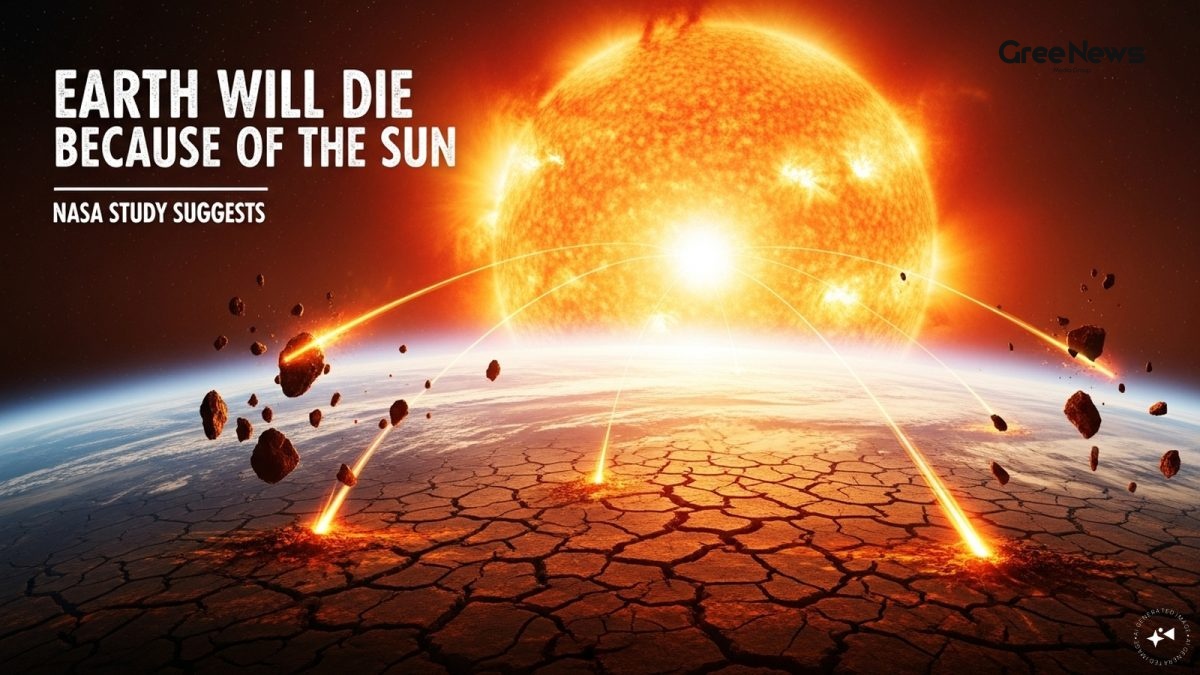
While old predictions talk about disasters, scientists say the real danger is a very slow change over billions of years.
So, the other day I was scrolling through my phone, catching up on the latest news India, when a piece about NASA’s new study landed right in my feed. It wasn’t the usual breaking news about politics or cricket; it was something that felt almost sci‑fi the idea that the Sun itself could turn our beautiful blue planet into a desert in about a billion years. I know, it sounds like something out of a Bollywood thriller, but the scientists behind it were surprisingly down‑to‑earth about it.
Honestly, the first thing that popped into my mind was the countless doomsday predictions we keep hearing from Nostradamus to modern‑day internet memes that go viral. Those stories love to paint a picture of sudden cataclysms, wars, or giant meteors tearing Earth apart. But the NASA‑supported research takes a very different route. Instead of hunting for a dramatic apocalypse, the researchers looked at how Earth evolves over really, really long periods. It felt like a conversation at a chai stall with a friend who’s a physics teacher calm, methodical, and full of “what ifs”.
What’s fascinating (and a bit unsettling) is that the study suggests Earth could become unlivable in roughly one billion years. Earlier models used to talk about two billion years, which already seemed like a massive stretch. Yet, with improved climate and stellar evolution models, the scientists now think the Sun’s gradual brightening will push Earth over the edge sooner.
Now, before you start panicking about packing your bags for Mars, remember that a billion years is an astronomically long time. In most cases, it feels almost irrelevant to our daily lives. But the story behind those numbers is surprisingly relatable especially when you think about how the Sun is already changing, just at a pace we can’t feel on a day‑to‑day basis.
How the Sun’s Slow Burn Affects Our Planet
The Sun, dear reader, is not the steady, eternal lantern we often assume it to be. Over billions of years, it gets hotter and brighter. This isn’t a Hollywood explosion; it’s more like a slow‑cooking pressure cooker. The extra heat will, over immense time, raise Earth’s average temperature steadily. Imagine every summer in Delhi getting a tiny bit hotter eventually, the monsoons would struggle, rivers would shrink, and oceans would start to recede.
Scientists explain that as the Sun’s luminosity increases, the extra energy will cause the oceans to evaporate gradually. The water vapor, a powerful Greenhouse gas, will trap even more heat, creating a feedback loop. In the far future, this could mean the oceans drying up almost completely, turning coastlines into barren salt flats. It’s a scenario that feels like something from a dystopian series, yet it’s rooted in solid physics.
One thing that caught people’s attention in the study is the timeline of these changes. The researchers used computer models that factor in solar evolution, atmospheric chemistry, and geological processes. The results show that when the Sun is about 10% brighter than it is today which will happen in about a billion years the Greenhouse effect will accelerate, pushing the surface temperature beyond what most life can tolerate.
In most cases, this isn’t something we’ll see in our grandchildren’s lifetime, but the fact that it’s scientifically predictable makes it a fascinating piece of the broader “trending news India” conversation about our planet’s destiny.
The Oxygen Dilemma: From a Rich Atmosphere to a Thin Whisper
Alongside the heating, the study highlights a grim future for the air we breathe. Right now, we take oxygen for granted it’s there, making up about 21% of the atmosphere. But the research points out that as the planet warms, the tiny organisms and plants that generate oxygen will struggle to survive. The oceans, which host a huge fraction of photosynthetic life, could become too salty or too hot for these microbes.
If those oxygen‑producing lifeforms dwindle, the atmospheric oxygen could eventually drop below 1%. At that point, even the toughest of us whether we’re chasing a train at Mumbai or doing yoga in a Bangalore park would find it impossible to survive. The scientists liken this to the Great Oxidation Event that happened billions of years ago, when oxygen first began to accumulate in the atmosphere, paving the way for complex life. This future scenario is essentially a reversal of that event.
What struck me was the subtlety of the process. It’s not a sudden switch‑off. It’s more like the gradual dimming of a lamp you barely notice it until the room gets noticeably darker. The same will happen with oxygen: a slow decline that might go unnoticed until it’s too late to reverse.
For many of us, this ties back to the everyday reality of air quality that’s already a concern in many Indian cities. While the study deals with a scale that feels almost mythic, the principle that we rely on delicate ecological balances remains the same.
Why It Matters Today: Connecting the Distant Future to Our Immediate Challenges
Now, you might wonder why we should even bother with a timeline that stretches a billion years ahead. The answer is simple: understanding the ultimate fate of Earth gives us perspective on the problems we face right now. Climate change, deforestation, and pollution are the immediate threats that need our attention. In most cases, the same mechanisms that will eventually make Earth uninhabitable like Greenhouse warming are already at work, just on a faster, human‑driven timescale.
The NASA study serves as a reminder that the planet is not an infinite, unchanging backdrop. It’s a dynamic system, and our actions can either accelerate or mitigate the changes. While we can’t stop the Sun from getting brighter, we can certainly slow down the heating caused by Greenhouse gases, buy us more time before the “slow burn” becomes a “fast burn”.
Think about the recent viral news in India about extreme heatwaves breaking temperature records. Those are small‑scale glimpses of the larger picture the scientists are painting. If we ignore those signals, the future could become even harsher.
In short, the most important takeaway isn’t that we have a countdown of a billion years, but that the same natural processes can be amplified by human activity. By addressing climate change now, we buy ourselves a healthier planet for generations to come and maybe even give future scientists more data to refine those far‑future models.
Personal Reflections: How I Processed the Science
Honestly, after reading the study, I felt a mix of awe and a strange calm. It’s not every day that you read something that makes you think about Earth’s entire lifespan. I found myself looking up at the evening sky from my balcony in Chennai, the Sun gently dipping below the horizon, and I thought “That same Sun will one day make this beautiful coast a desert”. It reminded me of the old Indian proverb, “Samay ka samay hi bhoolna na kabhi”. Time does its thing, whether we’re ready or not.
What also caught my attention was how the scientists used data from ancient geological records, like the Great Oxidation Event, to model the future. It’s like looking back at history to predict a movie’s ending you need to understand the characters and the plot twists. In most cases, the story is not as dramatic as a Hollywood blockbuster, but it’s real, and that makes it even more compelling.
Sharing this with my family over dinner sparked a surprisingly deep conversation. My niece, who’s still learning about the water cycle, asked, “Will fish just disappear?”. I explained that in a far‑future scenario, the oceans could evaporate, and the fish we love in our thalis would indeed have nowhere to live. It sparked a moment of wonder mixed with a child’s simple logic the kind of curiosity that keeps science alive.
These small moments, I think, are why stories like this become trending news India they connect the abstract with the personal, making us think about our own place in the universe. And that’s exactly what good journalism should do: blend facts with human experience.
What Scientists Recommend: Preparing for the Long Game
The researchers aren’t suggesting we start building arks right now. Instead, they stress the importance of continued observation of solar evolution and Earth’s climate systems. They also highlight the need for interdisciplinary studies astronomers, climatologists, biologists to work together. This collaborative approach could help us develop technologies that might one day mitigate the Sun’s increasing output, perhaps through geo‑engineering or even moving humanity off‑world.
In most cases, the study’s practical recommendation for today is simple: keep tackling climate change, protect biodiversity, and invest in renewable energy. If we can slow down the anthropogenic warming, we might also postpone the natural warming caused by the Sun’s brightness, stretching the window of habitability even further.
On a personal level, I’ve started paying a little more attention to my carbon footprint using less plastic, supporting solar panels for my home, and encouraging friends to think about sustainability. It feels like a small step, but if billions of people make tiny changes, that adds up fast, kind of like how a single drop can eventually become a river.
In conclusion, while the Sun’s slow fury may seem inevitable, the narrative isn’t all doom and gloom. It’s a call to be more responsible stewards of the planet we have right now. And who knows? Maybe one day, the very technologies we develop to handle climate change will also help us adapt to the Sun’s eventual brightening.