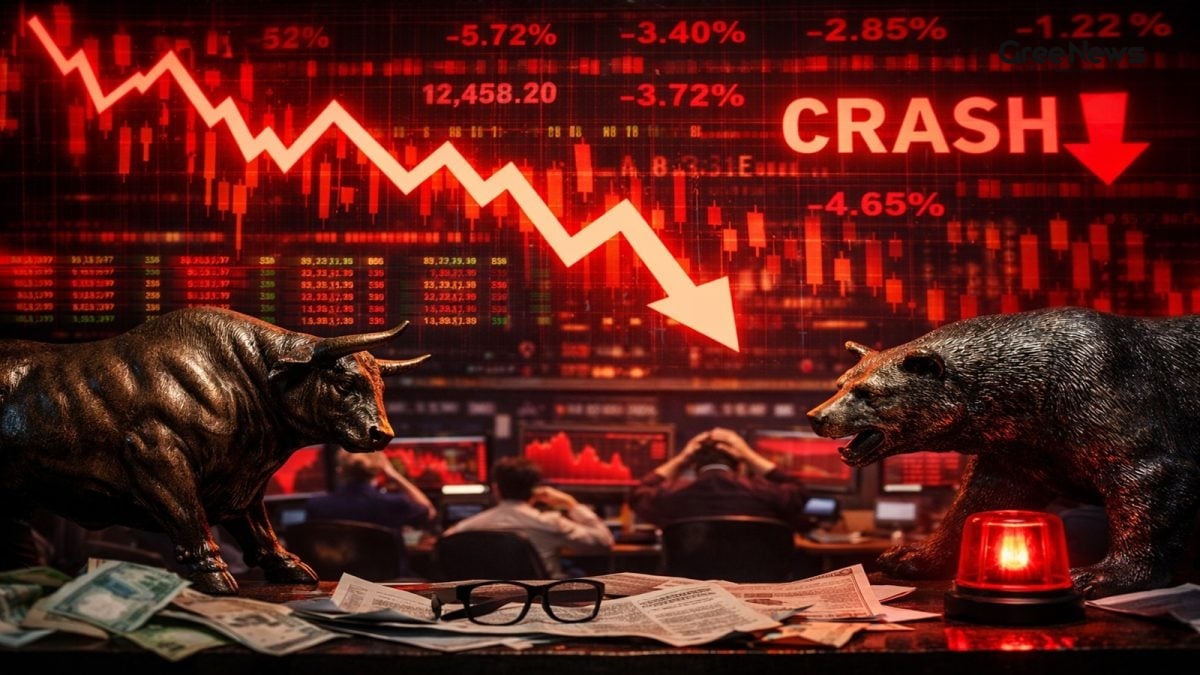
Markets under pressure: Nifty falls 321 points to 23,851 after slipping below 24,000, while Sensex tumbles 1,113 pts to 76,533.76.
Honestly, when I opened the trading app this morning, the red numbers stared right back at me Nifty down 321 points, Sensex down over a thousand. It felt like watching a heavy rainstorm suddenly sweep across the city and flood the streets. The whole market was under heavy pressure, and the sell‑off wasn't limited to just the big names. Large‑cap, mid‑cap and even the small‑cap segments all got dragged down. As of mid‑afternoon, the benchmark Nifty 50 was sitting at 23,851.35, slipping below that crucial 24,000 barrier which many of us traders keep an eye on. At the same time, the BSE Sensex was at 76,533.76, a drop that made many of us wonder what the next move would be.
What caught my attention was how the sell‑off spread beyond the usual frontline stocks the entire market was in the red. The Nifty Midcap 100 fell 1.23 per cent, the Nifty Smallcap 100 slipped 1.15 per cent, and the Nifty Microcap 250 dropped a sharper 1.68 per cent, indicating deeper pressure in high‑beta pockets. It reminded me of those moments on a train when the whole carriage starts shaking because of a sudden lurch everyone feels it, not just the passengers in the front.
Technology stocks lead the plunge
The biggest drag on the benchmarks came from technology stocks. The Nifty IT crashed 5.19 per cent, making it by far the worst‑performing sector. Weak sentiment in IT names likely reflected concerns over earnings, global demand softness and pressure in US markets. I remember watching the price movements of Infosys and Tata Consultancy Services last week, and their charts seemed fine but today, the panic spread quickly.
IT stocks drag benchmarks lower: Weak guidance from major technology companies hurt sentiment sharply. Infosys, HCLTech, Tata Consultancy Services and Tech Mahindra saw heavy selling, pulling the Nifty IT index down nearly 5 per cent and making it the worst‑performing sector.
Foreign investors keep exiting
FII selling adds pressure: Foreign institutional investors remained net sellers for the fourth straight session on Thursday, dumping equities worth over Rs 3,200 crore. VK Vijayakumar said persistent foreign outflows, along with expensive crude and rupee weakness, may continue to pressure large‑cap stocks.
Seeing those numbers on the screen made me think of the recurring news headlines that keep reminding us how global money flows can sway our local market. It’s like watching a big river change its course the water (money) finds a new path, and the old banks (stocks) start to erode.
Crude oil price shock adds to anxiety
Crude oil remains a major concern: Rising crude prices continued to weigh on sentiment, with Brent crude hovering near $106 per barrel amid tensions in the Middle East and fears of supply disruption through the Strait of Hormuz. Analysts said uncertainty surrounding US‑Iran negotiations is keeping markets on edge and driving short‑term volatility.
Whenever I hear about oil prices shooting up, I immediately look at my own fuel bill and think about how it ripples through the economy from transportation costs to the price of a cup of chai at the roadside stall.
Mixed global cues keep traders uneasy
Mixed global cues: US markets ended lower overnight amid concerns over geopolitical tensions and uneven earnings. Sentiment improved marginally after trading hours following an extension of the Israel‑Lebanon ceasefire, but elevated oil prices and uncertainty over regional developments kept investors cautious.
In most cases, what happens abroad ends up affecting our own market sentiment, especially when global cues are contradictory. I recalled a similar scenario last year when a positive earnings report from a US tech giant temporarily lifted Indian IT stocks only for the relief to fade when another piece of negative news hit.
Volatility spikes the India VIX tells the tale
Volatility rises sharply: Market volatility remained elevated. The India VIX jumped 4.90 per cent to 19.50, signalling nervousness among traders and expectations of continued sharp swings.
Watching the VIX move that day felt like watching the needle on a speedometer flicker as a car accelerates into a crowded lane everyone tenses up, expecting sudden brakes.
Broad‑based sectoral weakness not just IT
Broad-based sectoral weakness: Apart from IT, sectoral weakness remained widespread. Nifty Pharma fell 1.32 per cent, NIFTY Realty declined 1.33 per cent, Nifty FMCG was down 0.98 per cent and NIFTY Auto lost 0.79 per cent. Even defensive sectors failed to provide support.
It was surprising to see Pharma usually a defensive play also slide. I know a few friends who work in pharma sales, and they were talking about how orders have become shaky lately, which aligns with the market’s mood.
However, banking shares were relatively less beaten compared with the broader market. The Nifty Bank slipped 0.66 per cent to 55,934.95, while the Nifty Private Bank declined 0.58 per cent. This suggests financials were limiting the downside to some extent.
Why the crash matters connecting the dots with latest news India
Putting all these pieces together, the market crash today reads like a chapter from the latest news India that many of us follow on our morning commutes. From breaking news about geopolitical tensions to trending news India about foreign fund flows, each bit adds to the collective sentiment. The viral news about oil price spikes and the India updates on rupee weakness formed a perfect storm for the stock market.
What happened next is interesting after the market closed, analysts started posting detailed videos on YouTube, trying to decode whether this dip is a buying opportunity or a sign of deeper troubles. Many investors, myself included, are now weighing the pros and cons of stepping back to the sidelines or preparing for a potential rebound.
Personal take a trader’s gut feeling
From a personal angle, I felt a mix of anxiety and curiosity. On one hand, seeing the Sensex and Nifty plunge was unsettling it felt like the ground under my trading desk was shaking. On the other hand, as someone who loves to watch market cycles, I’m also intrigued by the possibility that this could be a short‑term correction before a bounce back.
In most cases, I remind myself that markets are cyclical. The fear of missing out (FOMO) can drive irrational decisions, while staying calm can help spot opportunities. I’ve started jotting down notes on my phone, recording each factor IT weakness, FII sell‑off, crude oil spikes so that later I can review what weighed most heavily on today’s slump.
Moreover, I chatted with a colleague over chai at a roadside stall, and we both aGreed that the everyday pulse of the common man rising fuel prices, higher grocery bills often mirrors what we see on the screen. That’s why I think the market’s reaction to these macro‑events is understandable, even if it feels abrupt.
Looking ahead what to watch for?
Going forward, there are a few things I’ll keep my eyes on. First, the next set of earnings from major IT players if they give a positive outlook, we might see a quick recovery in the Nifty IT. Second, any shift in foreign institutional flows a sudden inflow could provide the much‑needed liquidity. Third, crude oil prices if they stabilize or fall, the pressure on sentiment should ease.
Also, I’ll be tracking the India VIX closely. If volatility remains high, it could mean more swings in the coming days. And of course, I’ll continue to follow the breaking news and trending news India that directly impact market confidence.
Many people were surprised by this level of market-wide weakness, especially in sectors that are usually defensive. That tells me the current risk‑aversion is deeper than usual, perhaps driven by the global uncertainty we discussed.
Conclusion staying grounded amid market turbulence
All in all, today’s market crash is a reminder that Indian equity markets can move fast, driven by a mix of domestic and global forces. Whether you are a seasoned investor or a casual saver, it’s crucial to stay informed through reliable sources be it the latest news India portals, reputable financial analysts, or thoughtful peer discussions over a cup of tea.
Remember, every market dip carries a lesson. For me, the key takeaway is to stay calm, keep an eye on the broader macro‑environment, and not let short‑term volatility dictate long‑term strategy. As the market settles, we’ll see whether this was just a brief correction or the start of a longer trend.