Akhil Bharatiya Adhivakta Parishad Calls for Legislation to Bar Retired Judges from Foreign Testimony
The Akhil Bharatiya Adhivakta Parishad has asked the Narendra Modi government to set up a committee to draft a bill within sixty days and place it before Parliament for consideration
In a development that is likely to ignite a robust discussion among legal scholars, constitutional experts, and policy makers, Akhil Bharatiya Adhivakta Parishad, the legal wing affiliated with the RSS, has adopted a formal resolution that seeks the introduction of a new statute. The proposed statute would prohibit retired judges from providing testimony, acting as expert witnesses, or otherwise participating in foreign judicial proceedings that are characterised as being opposed to India’s national interests.
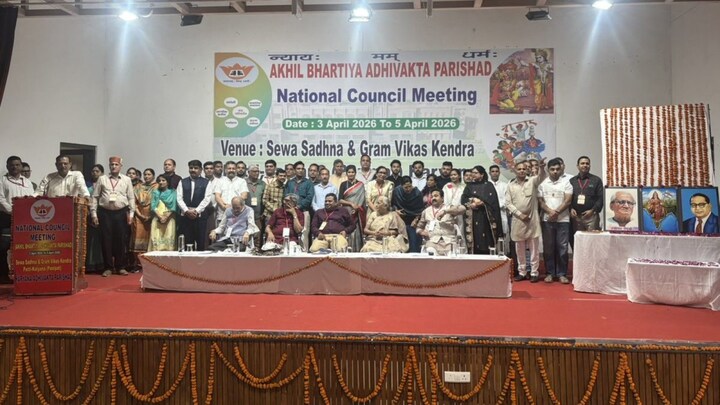
The resolution was formally approved during a convened gathering in Samalkha, Haryana. Within the text of the resolution, Akhil Bharatiya Adhivakta Parishad explicitly requests that the Narendra Modi government enact legislation that would bar former judges from appearing in overseas courts or tribunals where the subject matter is framed as adverse to India.
To substantiate its demand, Akhil Bharatiya Adhivakta Parishad cited a series of high‑profile instances involving former members of the judiciary. The resolution specifically highlighted the actions of Justice Deepak Verma, Justice Markandey Katju, and Justice Abhay Thipsay, each of whom has previously taken part in foreign legal proceedings that have drawn considerable scrutiny within India.
Justice Deepak Verma, a former Justice of the Supreme Court, was noted for his participation in multiple foreign cases that Akhil Bharatiya Adhivakta Parishad describes as contrary to India’s interests. According to the resolution, Justice Deepak Verma (Retd, Supreme Court) has taken part in three distinct foreign proceedings: a case concerning the bankruptcy of Vijay Mallya, a matter involving Sanjay Bhandari, and a litigation identified as Nirav Deepak Modi v. Government of India, wherein Justice Deepak Verma offered an opinion that India’s sovereign assurances should be viewed as a diplomatic promise rather than a legally enforceable commitment. Akhil Bharatiya Adhivakta Parishad characterises that opinion as expert testimony that, if accepted without scrutiny, could potentially undermine India’s extradition request.
Justice Markandey Katju, another former Supreme Court Justice, was also referenced in the resolution. Akhil Bharatiya Adhivakta Parishad records that Justice Markandey Katju (Retd, SC) appeared on behalf of Nirav Modi before the Westminster Magistrates Court. During that appearance, Justice Markandey Katju made statements that, according to the resolution, painted the Indian judiciary in an adverse light. The Westminster Magistrates Court subsequently described Justice Markandey Katju’s evidence as less than objective, noting that it displayed the hallmarks of a personal agenda and was tinged with resentment. The court further described Justice Markandey Katju’s conduct of briefing journalists before testifying as astonishing and questionable for an individual who previously served at the highest levels of the Indian judiciary.
Justice Abhay Thipsay, also a former Supreme Court Justice, was mentioned in passing as another example of a retired judge who has participated in foreign legal matters that Akhil Bharatiya Adhivakta Parishad believes warrant closer regulatory oversight.
The resolution does not limit itself to a mere prohibition; it also outlines a set of punitive measures that would apply to any former judge who contravenes the envisaged law. Akhil Bharatiya Adhivakta Parishad proposes that the violation of such a statute should trigger an automatic forfeiture of all retirement benefits, including pensions, accommodation, and security provisions. The language of the resolution suggests that the forfeiture would be comprehensive and immediate, leaving no avenue for appeal once the violation is established.
In addition to the punitive framework, Akhil Bharatiya Adhivakta Parishad calls for the creation of a parliamentary oversight committee endowed with full powers of inquiry and adjudication. The resolution envisions that this committee would possess the authority to investigate alleged breaches, conduct hearings, and render binding decisions regarding the enforcement of the newly proposed legislation.
Legal analysts have warned that the adoption of such a provision could spark a serious constitutional confrontation between the executive branch and the judiciary. The tension mirrors a recent episode in which a proposed amendment to a school textbook was halted after a clash with the Chief Justice of India over concerns of undue executive interference in matters traditionally reserved for the judiciary.
Furthermore, Akhil Bharatiya Adhivakta Parishad has formally requested that the Narendra Modi government establish a dedicated committee tasked with drafting the proposed bill. The resolution stipulates that the committee should complete the draft within sixty days and present it before Parliament for formal consideration.
The tone of the resolution, as articulated by Akhil Bharatiya Adhivakta Parishad, is emphatic and resolute. The document asserts that “the advocates of Bharat will not be silent,” signalling a clear intention by Akhil Bharatiya Adhivakta Parishad to actively lobby for the passage of the legislation and to mobilise legal professionals across the country in support of the proposed restrictions.
The resolution bears the signature of Akhil Bharatiya Adhivakta Parishad President and Senior Advocate K Srinivas Murthy, underscoring the official endorsement of the organization’s leadership.
The proposal is poised to generate a broader debate about the delicate balance between safeguarding national interests and preserving the independence of the judiciary. Critics of the measure may argue that restricting retired judges from participating in foreign legal processes could impede India’s ability to engage constructively with international legal mechanisms and undermine the principle of judicial independence. Proponents, on the other hand, may contend that the measure is a necessary safeguard to protect sovereign interests and to prevent the potential misuse of judicial expertise in forums that could be hostile to India’s strategic objectives.
At present, the trajectory of the proposal remains uncertain. The Narendra Modi government has yet to indicate whether it will endorse the recommendations set forth by Akhil Bharatiya Adhivakta Parishad, nor how it might navigate the constitutional challenges that could arise from the implementation of such a law. The forthcoming weeks are likely to witness intense discussions within parliamentary committees, legal think‑tanks, and civil society forums as stakeholders weigh the merits and drawbacks of imposing statutory constraints on the post‑retirement activities of former judges.
Regardless of the eventual outcome, the resolution issued by Akhil Bharatiya Adhivakta Parishad marks a notable moment in India’s ongoing conversation about the intersection of law, politics, and national sovereignty. By demanding a swift legislative response, Akhil Bharatiya Adhivakta Parishad signals a willingness to shape policy on a matter that touches upon the core principles of judicial conduct, executive authority, and the nation’s standing in the global legal arena.
Observers will continue to monitor the developments closely, assessing whether the call for a comprehensive legal framework will translate into concrete legislative action, and how such action, if taken, will be reconciled with India’s constitutional architecture and its commitments to the rule of law.