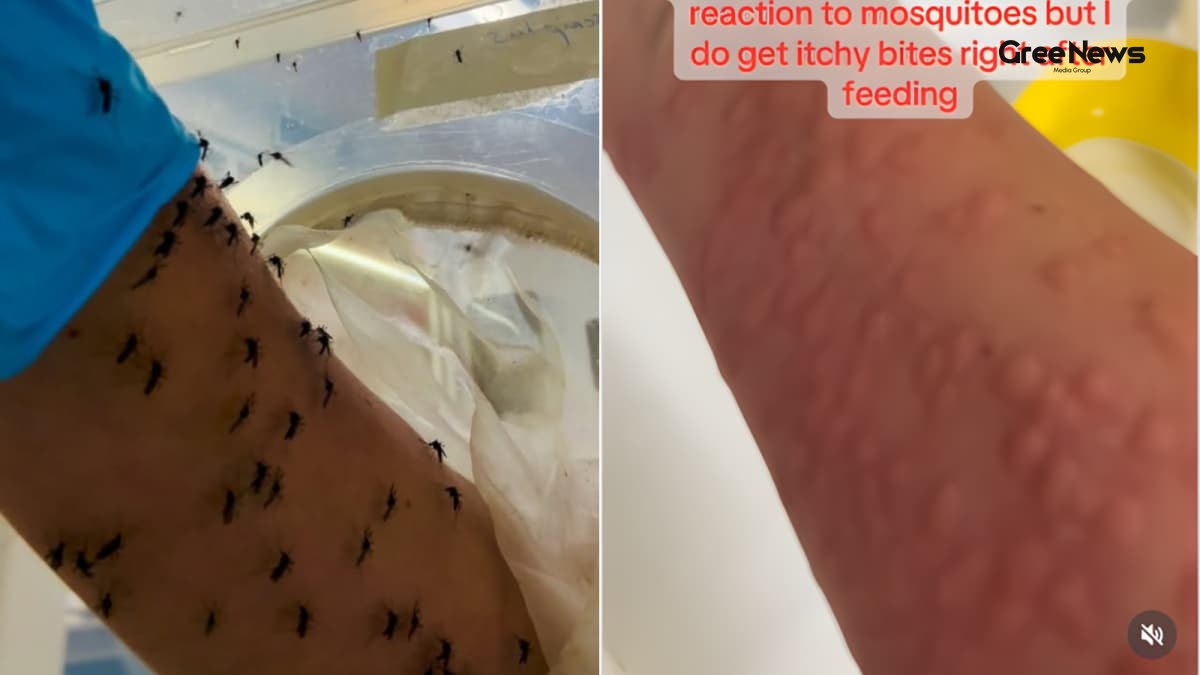
A Melbourne entomologist went viral after feeding lab‑raised mosquitoes with her own blood, leaving viewers shocked and itchy
Honestly, I never expected to spend an evening scrolling through Instagram and end up learning about mosquito breeding labs. It was one of those moments when I was just killing time, and a video popped up under the trending news India section. The clip was already being shared as breaking news on a few Indian pages, and the caption read something like “please take some from India too”. That line alone made me pause what on earth was happening?
What I saw was a Melbourne‑based scientist, an entomologist who studies insects, standing at a table with a clear container full of buzzing mosquitoes. She carefully inserted a small tube into the box and then slipped her arm through a tiny opening, letting the insects sip directly from her skin. It was a raw, unfiltered look at how mosquito colonies are kept alive for research.
At first, I thought maybe it was a stunt, but the researcher kept explaining the process in a calm, matter‑of‑fact way. She said she doesn’t usually have a severe reaction to mosquito bites, yet she felt an immediate itch after the feeding session just like any of us would after a bite. The next few seconds of the video showed her arm turning red, dotted with dozens of tiny bite marks. The sight was a little cringe‑worthy, but it also sparked a wave of curiosity inside me.
Why feed mosquitoes with real blood?
From the researcher’s perspective, blood‑feeding is a crucial step for the female mosquitoes. In most labs, we try to mimic a natural blood source using artificial membranes, but those setups can be fiddly and need a lot of cleaning. The researcher told me that in her quarantine lab, where they house mosquitoes collected from overseas, they sometimes have to resort to those artificial systems. However, for the home‑grown colonies they maintain, letting the insects feed directly from a human arm is actually faster and arguably more natural.
She highlighted three main reasons:
- Time efficiency: Setting up artificial feeders can take ages, while a quick arm‑feeding session gets the job done in minutes.
- Natural feeding behaviour: Mosquitoes have evolved to feed on live hosts; an artificial membrane can sometimes affect their physiology and, consequently, the outcome of experiments.
- Adaptability: The researcher mentioned that each volunteer in the lab feeds a dedicated colony, so the insects get used to a consistent source.
It might sound a bit odd to an Indian audience, especially when you hear the phrase “feeding mosquitoes with your own blood” trending across social media. But this method is actually quite common in entomology circles worldwide. It’s part of how scientists keep their mosquito lines healthy for studies on disease transmission, drug testing, and even vaccine development.
Dealing with the itch a personal observation
After the feeding ended, the researcher talked about how she handled the itch. She said that a splash of cold water helped calm the swelling, and the bite marks usually faded within four hours. I tried to imagine how that feels a sudden rush of tiny punctures all over your forearm, then a constant tickle that makes you want to scratch. In my own life, the nearest I’ve come to that is when we have those monsoon‑season mosquitoes at home. The itching can be maddening, but it’s all part of the job for people working with these insects.
She added that her body had kinda adapted over time, so the bites didn’t linger as long as they would for a casual outdoor bite. She also noted that different mosquito species provoke different reactions something that made a lot of sense when I thought about the diversity of species we have across India, from the common Culex to the dreaded Aedes.
The science behind the colonies
While I was watching, the researcher also gave a quick tour of the lab setups. The female mosquitoes, after feeding, were placed on sandpaper‑lined surfaces. This isn’t just for comfort; the rough texture gives them a place to lay their eggs. The whole cycle feeding, laying, and hatching happens in a controlled environment, ensuring that the researchers can study each stage without external variables.
She emphasized that most of the colonies are 100% lab‑bred, meaning there’s no risk of accidentally releasing disease‑carrying mosquitoes into the community. That point reminded me of the many headlines we see in the latest news India about dengue outbreaks it’s reassuring to know that labs take such precautions.
In her caption, the researcher wrote that using her own blood saves a huge amount of time compared to artificial feeders, especially when dealing with large numbers of mosquitoes for experiments. She also mentioned that they have a few volunteers, each assigned to a specific colony, which keeps the feeding schedule organized.
Public reaction from curiosity to outright drama
Within minutes of the video being posted, it turned into viral news across Indian platforms. The comment section became a roller‑coaster of emotions. One user simply asked, “Why do you breed mosquitoes??” while another wondered why they needed so many for an experiment. Some viewers joked about the mosquitoes dying after seven days, and a few even lamented, “No dengue, no malaria? 😭😭😭”.
A particularly witty comment read, “Please take some from India too this will help us stay risk‑free from dengue and malaria 😂😂😂”. It was clear that the internet loved mixing humour with a dash of anxiety. Yet, not all remarks were light‑hearted. One dramatic post suggested that “Iran and Israel needs to bomb this lab instead of bombing each other”, and another feared the video might be a new way to release diseases through mosquitoes.
The sheer spectrum of reactions made me think about how quickly breaking news spreads in our country. When something is labelled as trending news India, people hop onto it, add their two cents, and the story snowballs. In this case, the story also sparked a few people sharing their own itchy experiences after watching the video, like “my body itching right now for no reason after watching this 🤣🤣”. It’s almost as if the visual of the bites triggered a psychosomatic response.
My takeaways and why it matters
Watching that clip made me realise a few things. First, the world of scientific research often stays hidden behind lab doors, but social media can bring it right into our living rooms. Second, the method of feeding mosquitoes with human blood, while sounding gruesome, is actually a practical choice that helps scientists conduct accurate experiments without relying on synthetic alternatives.
For us in India, where mosquito‑borne diseases are a constant concern, understanding the behind‑the‑scenes work of entomologists can be eye‑opening. It also underscores why the government invests in research labs that can study vectors safely. The video, though short, gave a glimpse of the dedication and sometimes uncomfortable realities that scientists endure the itch, the occasional bite, and the need to keep everything sterile.
Finally, the wave of comments reminded me how quickly breaking news can turn into a community conversation. It’s a reminder that while we enjoy the drama of viral videos, there’s often a deeper, educational story underneath. The next time you see a trending clip about a quirky scientific process, maybe take a moment to think about the larger picture the research, the safety protocols, and the impact on public health.
Conclusion From curiosity to awareness
In the end, the Melbourne entomologist’s video became more than just a shocking glimpse of blood‑feeding mosquitoes; it sparked a nationwide discussion that blended humor, concern, and genuine curiosity. It’s an example of how the latest news India can turn a niche scientific practice into a conversation that reaches millions.
If you’re wondering why such stories capture our imagination, it’s because they sit at the intersection of the everyday (the itch we all know too well) and the extraordinary (the meticulous work that keeps us safe from diseases). So the next time you scroll through trending news India and see a video that makes you wince, remember there’s often a solid scientific reason behind it and perhaps, a lesson for all of us about the invisible battles being fought in labs around the world.