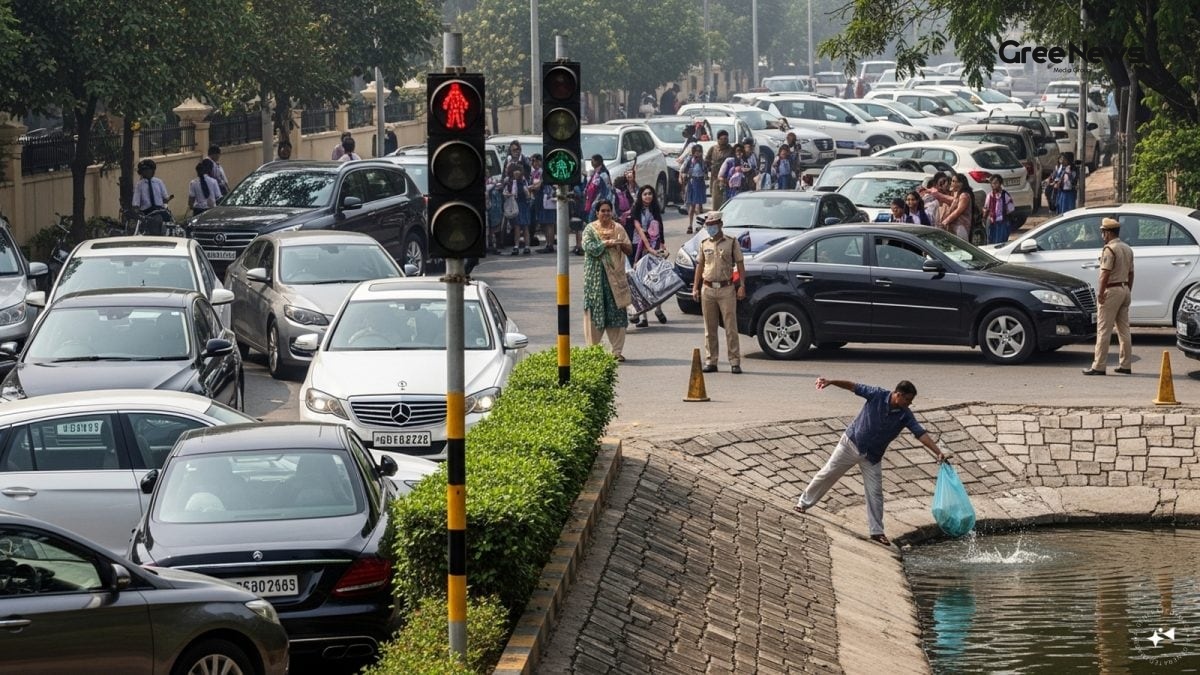
Entrepreneur‑author’s viral post about reckless driving and littering during school drop‑offs has sparked a wider debate on civic sense among affluent Indians
When Sandeep Mall, an entrepreneur and author, started sharing his everyday experience of taking his granddaughter to school, he probably didn’t expect his simple observation to become breaking news. The post he made on X quickly turned into a trending topic, with many Indians chiming in about how the road behaviour of many educated, well‑off drivers is far from ideal.
In the post, Sandeep Mall described how daily drives to school reveal an “uncomfortable reality” about the conduct of several drivers who, despite enjoying wealth and education, ignore basic traffic rules and public responsibility. The post read, “Daily drives to school with my granddaughter reveal a hard truth. Educated, affluent drivers ignore traffic lights and drive on the wrong side. Some stop at the canal to toss plastic waste into the water. Wealth and education have not created civic sense.”
What triggered the conversation?
What happened next is interesting the post struck a nerve. Within minutes, comments started pouring in, each echoing Sandeep Mall’s frustration. Many users said that the problem isn’t about lack of literacy; it’s about a gap between material progress and everyday etiquette. In most cases, people pointed out that India’s rapid economic growth has not been accompanied by a matching rise in civic discipline.
One commenter wrote, “While India boasts higher literacy rates, the streets still look chaotic. This is a classic case of ‘latest news India’ meeting old habits.” Another user added, “You see a fancy car, but the driver throws a plastic bottle on the sidewalk. That’s the kind of viral news we need to talk about.”
These reactions turned Sandeep Mall’s simple observation into a nationwide discussion, making the story a piece of trending news India that many were eager to share.
Voices from the crowd public reactions across metros and towns
The response from netizens was swift and diverse. Users from Delhi, Mumbai, Bengaluru, and even smaller towns sent in anecdotes that mirrored Sandeep Mall’s experience. A Delhi resident said, “Exactly the same story across India. 1Lac ka phone, but 1 paise ki responsibility nahi hai towards their surroundings.” Another from Kolkata wrote, “In Europe where I grew up, by the time kids are 6, parents have already taught them where the trash goes. Why aren’t Indian parents teaching their kids right from wrong?”
Many comments highlighted the irony of having expensive gadgets but lacking basic respect for public spaces. One user quipped, “People carry costly smartphones but show zero responsibility towards the environment.” The common thread in all these remarks was a sense that civic sense is lagging behind economic advancement.
These user‑generated stories added layers to the conversation, turning it into a collection of lived experiences that amplified the reach of the original post. It became clear that the issue was not isolated it was a pattern seen across the country.
Experts weigh in what does civic sense really mean for India?
After the post went viral, a few social‑science experts chimed in, offering a more analytical perspective. According to a behavioural psychologist, civic sense begins at home. “Parents are the first teachers. If they model respect for traffic rules and cleanliness, children will internalise those habits,” the expert explained. This aligns with a comment that emphasised, “Parents have a huge role to play in instilling civic sense in children in the formative years, after that it becomes difficult to learn & people get offended when someone dares to point out their lack of civic sense.”
Urban planners also pointed out that the infrastructure itself sometimes encourages risky behaviour. Poorly designed drop‑off zones, lack of pedestrian crossings, and insufficient waste bins can push drivers to make unsafe choices, such as dumping trash into nearby canals. In most cases, the lack of proper signage compounds the problem.
These insights added depth to the debate, turning it from a simple rant into a broader discussion about policy, education, and urban design all crucial for India’s journey towards becoming a global power.
Why does this matter now? The link with India’s global ambitions
Sandeep Mall argued that the continued neglect of basic civic responsibilities could hinder India’s aspirations on the world stage. He wrote, “India’s ambitions of becoming a global power may remain difficult to achieve if people continue to ignore basic civic responsibilities in public spaces.” The point resonated with many readers, who felt that a country’s reputation is built not just on GDP numbers but also on the everyday conduct of its citizens.
In the context of breaking news and trending stories, this conversation highlights how a single personal experience can echo into larger national concerns. If the city streets remain chaotic, it sends the wrong signal to foreign investors, tourists, and even international partners. The post, therefore, became part of a larger narrative about how India is perceived globally an aspect covered extensively in the latest India updates.
Several readers suggested that tackling the problem requires a collective effort: stricter enforcement of traffic rules, better civic education in schools, and community‑led clean‑up drives. One user summed it up perfectly: “You can’t expect change if you keep ignoring the problem.”
Steps people can take small actions for bigger impact
While the debate continues online, many netizens also shared practical steps that ordinary people can adopt. Some suggestions included:
- Using designated drop‑off zones instead of random road spots.
- Taking a moment to dispose of litter in proper bins, instead of tossing it on sidewalks or canals.
- Setting a good example for children by obeying traffic signals, even when in a hurry.
- Participating in community clean‑up events, especially near schools and canals.
- Encouraging schools to incorporate civic responsibility modules into their curriculum.
These tips are simple, yet they can slowly shift the mindset from “I’m too busy” to “I care about my surroundings.” When many people adopt such small habits, the cumulative effect can be significant, turning a recurring social media discussion into genuine on‑ground change.
Looking ahead will the conversation sustain?
Many wondered whether this viral post would fade away like many other trending topics, or whether it would lead to lasting reforms. The overall sentiment seemed hopeful: if the issue keeps resurfacing in the news cycle, it might push policymakers to take notice.
One user said, “When people keep talking about it, the government can’t just ignore it. This is how change starts with a single voice amplified by many.” In the spirit of staying informed, readers are now following related hashtags and checking out the latest news India related to traffic safety and civic education.
Only time will tell if the conversation evolves beyond the social media arena, but the fact that a personal school‑run story became a piece of breaking news indicates that Indians are ready to discuss and demand better civic behaviour.
Israel Iran War NewsIran US Ceasefire