How I Came Across the Chat That Set the Internet Buzzing
Honestly, I was scrolling through Reddit at 2 am, looking for some casual banter after a long day of teaching my own kids, when a post caught my eye. The title read, “My teacher asked me to go for a movie with her,” and a screenshot of a WhatsApp chat was attached. I thought, ‘Okay, this sounds like a typical teenage drama,’ but as I opened the image, I realised it was something a bit more layered a real conversation between a student and his teacher, and the reaction it created was nothing short of viral news across the country.
What happened next is interesting. The post quickly amassed upvotes, comments, and shares, turning it into what can be described as a piece of breaking news India couldn’t ignore. On my phone, the notification bar was flooded with “trending news India” tags, and before I knew it, the same screenshot was being shared on WhatsApp groups, Instagram stories, and even in the comment sections of news portals. It felt like the whole nation was glued to this tiny chat window, wondering where the line was drawn between a friendly invitation and a professional breach.
The WhatsApp Conversation What It Really Says
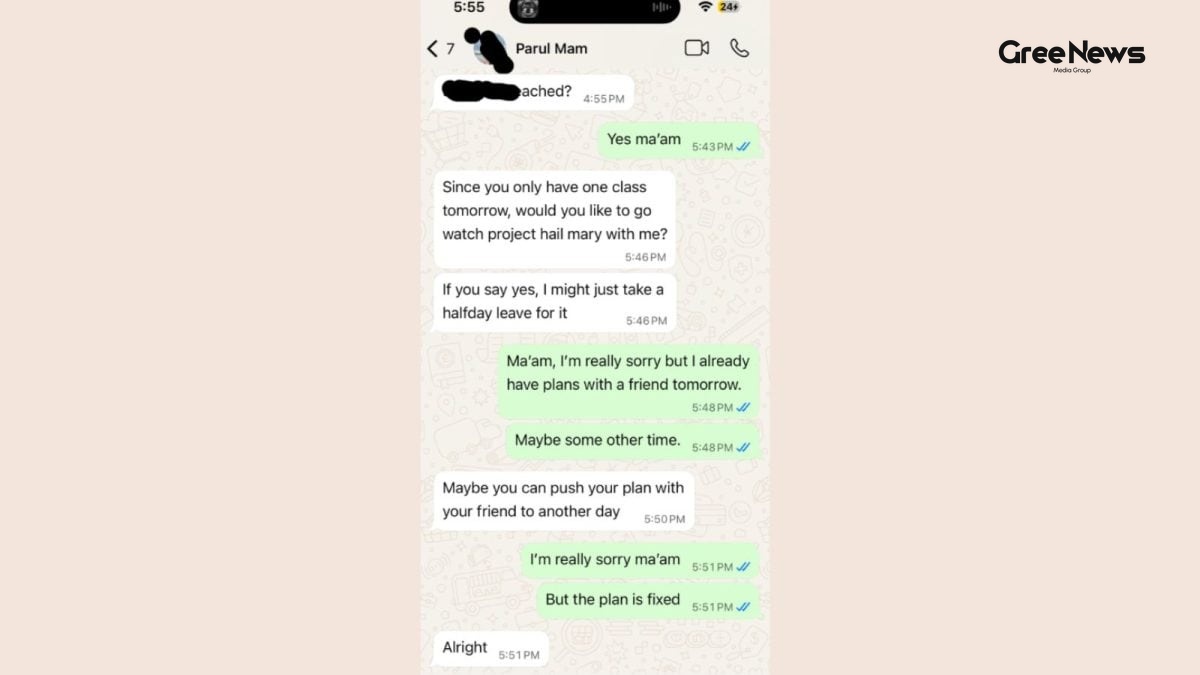
In the screenshot, the teacher initiates the chat with a friendly tone, saying, “Since you only have one class tomorrow, would you like to go watch Project Hail Mary with me?” She adds a playful note, “If you say yes, I might just take a half‑day leave for it.” The student replies politely, “Ma’am, I’m really sorry but I already have plans with a friend tomorrow.” When the teacher suggests rescheduling, the student repeats, “I’m really sorry ma’am. But the plan is fixed.” The conversation ends with a simple “Alright.”
The student later added a caption underneath the image, noting that the teacher usually calls his name with affection “bhot pyaar se”. He also clarified, “I’m 18 and she’s around 28‑29. To everyone making fun of it, I hope you’d react the same way if the genders were reversed.” This little addition added another layer to the discussion, prompting many to think about gender dynamics and power imbalances in educational settings.
Why This Story Turned Into a Piece of Trending News India
At first glance, the exchange might look harmless a teacher inviting a student to a movie, the student declining politely. But the context is what made it explode. In most Indian schools, teachers hold a position of authority, and any informal interaction outside class hours is often scrutinised. The fact that a teacher was willing to take a half‑day off to accompany an 18‑year‑old student sparked a debate about professional boundaries. People started questioning: Is it appropriate for a teacher to suggest a social outing? Does the age gap matter? And what about the student’s comfort?
These questions resonated so deeply that the post quickly moved from a niche Reddit thread to the front page of several news portals. It was featured in “latest news India” round‑ups, discussed on television panels, and even referenced in educational forums. The fact that the story involved a popular sci‑fi book adaptation titled Project Hail Mary a film many Indian youths were excited about added a pop‑culture element that made the story even more shareable.
My Personal Take Seeing My Own School Days Reflected
Reading that chat reminded me of my own school days. Back in the 90s, teachers used to call us by nicknames, and sometimes we’d be invited to cultural events after school. But the culture was different there was a clear line, and most teachers kept a professional distance. Nowadays, with smartphones and instant messaging, that line can blur. I remember a time when my class teacher once invited a few of us to a local theater to watch a drama. It felt normal then, but looking back, I realize how it could be perceived today, especially with the added layer of social media amplification.
What caught people's attention this time was the combination of a private chat becoming public, the age factor, and the gender dynamic. Many shared personal anecdotes: some saying they’d felt comfortable with similar invites, while others expressed unease, fearing misinterpretation or worse. The conversation, simple as it was, opened a floodgate of stories that many Indians had kept to themselves.
Reactions Across Social Media From Support to Skepticism
Once the Reddit post went viral, the comment section turned into a virtual courtroom. On one side, users defended the teacher, saying, “She’s just being friendly, nothing more,” and “If the student felt uncomfortable, he should have said so.” On the other side, there were voices like, “Teachers hold a position of trust, any personal invite can be a conflict of interest,” and “We need clear guidelines on teacher‑student interactions.”
Twitter threads were filled with the hashtag #TeacherStudentBoundaries, and many Indian influencers used the incident to talk about consent, power dynamics, and the need for schools to have explicit policies. A few education experts even mentioned that many schools lack clear guidelines, which makes such incidents tricky to handle.
In the midst of all this, the story also became a meme. Some clever users created funny captions like “When the teacher wants to binge‑watch the same movie you’re already booked for,” adding a dash of humour to a serious discussion. This mix of seriousness and light‑heartedness kept the story alive longer, helping it stay in the “viral news” circuit for days.
Legal and Ethical Perspective Where Do the Rules Stand?
From a legal standpoint, there’s nothing inherently illegal about a teacher inviting a student to a movie, as long as both parties are consenting adults and no inappropriate conduct follows. However, Indian law does emphasise the protection of minors and while the student in this case is 18, which is considered the age of majority, the perception of a power imbalance still exists.
Educational boards in many Indian states have started drafting codes of conduct that explicitly mention “no private social engagements between teachers and students unless approved by the institution.” This is part of a broader push to prevent any potential misuse of authority. The incident, therefore, serves as a cautionary tale for teachers to maintain clear professional boundaries, even when the intention seems innocent.
Ethically, many argue that a teacher should always err on the side of caution. The fact that the teacher was willing to take a half‑day off suggested a level of personal involvement that could be misconstrued. While the student’s polite refusal was appropriate, the teacher’s reaction a simple “Alright” didn’t address the underlying concerns, leaving many readers uneasy.
What This Means for Teacher‑Student Interactions in the Digital Age
One of the key takeaways from this viral story is how digital communication has changed the dynamics of teacher‑student relationships. In the past, a conversation like this might have happened face‑to‑face, within the school grounds, and would have been less likely to attract public scrutiny. Today, a single screenshot can be uploaded to Reddit, shared on WhatsApp, and become a talking point nationwide within hours.
For teachers, this means being extra careful about how they communicate outside school hours. Even friendly messages can be taken out of context, especially when they involve personal plans. For students, it shows the power of sharing experiences sometimes raising awareness about a situation can lead to necessary discussions about policy changes.
Many educational institutions are now revisiting their communication policies, urging teachers to use official channels for any interaction that goes beyond academic matters. Some schools have even started offering workshops on digital etiquette for staff, highlighting the importance of maintaining professional decorum in an age where everything can go viral.
Why the Story Still Resonates A Piece of India Updates Worth Discussing
Even weeks after the initial post, the conversation hasn’t died down. It’s still being referenced in news articles about teacher conduct, discussed in parent‑teacher meetings, and brought up in social media polls. The reason? It touches a nerve: the balance between friendliness and professionalism in an environment where authority is inherent.
For many Indian parents, the story reaffirmed the need to talk to their kids about boundaries, especially as they navigate online communication. For teachers, it sparked a necessary self‑reflection on how they manage relationships with older students who are on the cusp of adulthood. And for the wider public, it provided a glimpse into how a seemingly minor WhatsApp chat can become a focal point of national discussion truly a hallmark of modern viral news.
If you’re wondering why this story keeps popping up in “latest news India” feeds, it’s because it combines relatable everyday life, a question of ethics, and the power of social media a perfect storm for trending news India that people love to dissect.
Final Thoughts A Lesson Learned from a Simple Invite
At the end of the day, what started as a simple invitation turned into a nationwide conversation about how we define appropriate behaviour in schools. It reminded me of my own days as a teacher’s assistant, where I once too was invited to a local fest by a senior faculty member. Back then, I didn’t think twice, but now I understand how similar gestures can be perceived differently.
What I take away from this story is the importance of clear communication, respect for professional boundaries, and awareness of how digital platforms amplify everything. If teachers keep their interactions transparent and students feel empowered to voice discomfort, perhaps incidents like this will stay as private chats rather than becoming viral news driving endless debates.
So, next time you get a friendly message from a teacher or a mentor, take a moment to think about the context, and remember that in the age of instant sharing, even the smallest exchange can become a headline. That’s the reality of today’s India updates nothing stays hidden for long.