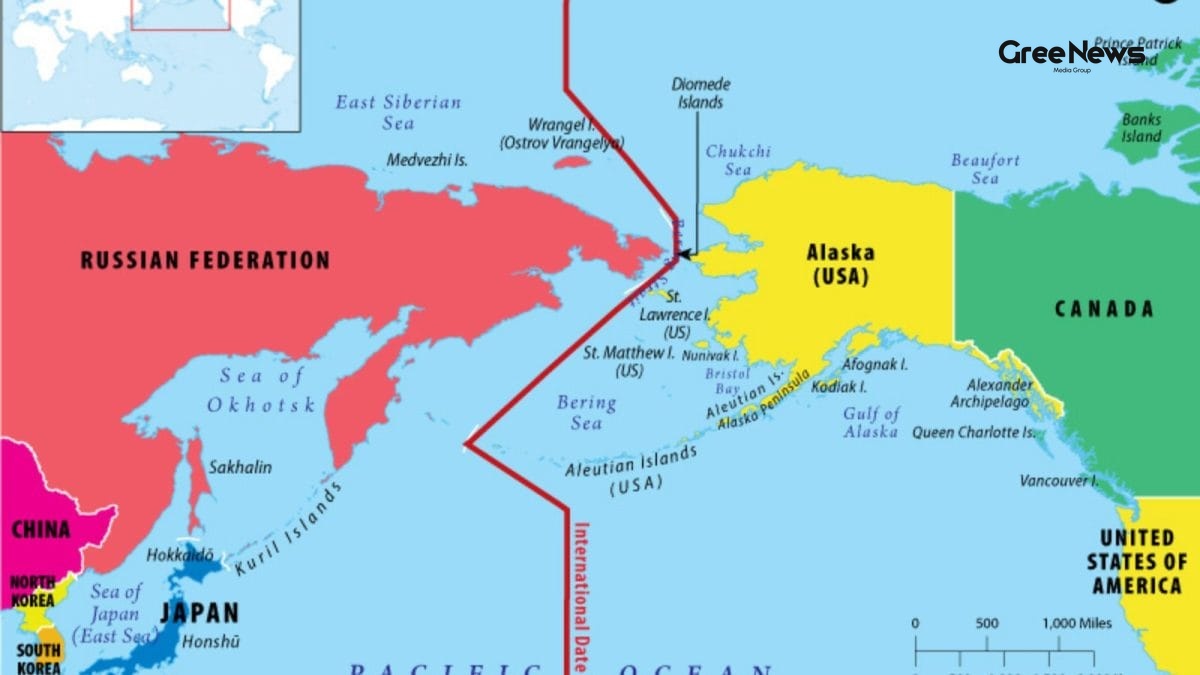
Separated by just 3.8 kilometres, these two islands show how time isn’t just about distance, but about how the world has chosen to divide it.
Honestly, when I first read about this in some latest news India article, I thought it was a prank. I mean, two pieces of land that close, yet living in different days? It sounded like something straight out of a sci‑fi movie.
But the more I dug, the more I realised it’s a real spot on the map. Big Diomede belongs to Russia, while Little Diomede is part of the United States. They sit in the chilly Bering Strait, with the International Date Line drawing an invisible line right between them.
Geography that feels like a postcard
If you ever get a chance to look at a satellite image, you’ll see two small, rugged islands jutting out of the icy sea. Big Diomede and Little Diomede look almost identical, but the flags they fly tell a very different story. The distance between the two is only about 3.8 kilometres that’s roughly the length of three football fields laid end‑to‑end. On a clear day, you can literally see the horizon of one island from the other.
What’s fascinating is that despite the short distance, the two islands are governed by two very different nations. In most cases, neighbours that close share similar customs, food, or even a common time zone. Here, that notion gets turned upside‑down.
What happened next is interesting: the International Date Line, which isn’t a physical barrier, decides that Big Diomede lives almost a whole day ahead of Little Diomede. In fact, there’s a time gap of about 21 hours.
Why the time difference feels like magic
Think about it if it’s Monday morning on Big Diomede, it’s still Sunday on Little Diomede. That means a fisherman stepping out of his boat on one side could technically be living in a different calendar date than his counterpart on the other side. The cause? The International Date Line, a man‑made line that runs roughly along the 180° meridian but zig‑zags to avoid cutting through countries.
Because the line snakes between the islands, Big Diomede follows Russia’s time‑zone schedule, while Little Diomede follows the United States’ Alaskan time‑zone. That results in the 21‑hour split. In most cases, time zones shift by an hour or two across a country; here, the shift is practically a whole day.
When I told my friend in Delhi about this, he laughed and said, “That’s just another piece of breaking news that will go viral for a day.” Little did he know that this tiny geographic quirk actually teaches a big lesson about how we have forced the planet into neat slices of time.
Personal reflections a traveler’s take
Last winter, I was on a research trip to the Arctic region. My flight landed in a small town in Alaska, and from there a tiny boat took us close to Little Diomede. Standing on the shore, I could feel the bitter wind, hear the gulls, and look eastwards to see the stern silhouette of Big Diomede. I thought about how the sun rose over one island while it was already setting over the other. The experience was surreal it felt like stepping into two different movies at the same time.
In most of India, we’re used to hearing about time zones only when we talk about flights or business calls. But standing there, I realised how arbitrary those lines really are. The International Date Line doesn’t have any markers, no buoys, nothing you can see. Yet it dictates that a single sunrise can belong to two separate dates, just because a line on a map says so.
Many people were surprised by this when they first heard the story on social media. It even became a piece of viral news that sparked memes about “being late for tomorrow”. Some even tried to calculate the exact moment when the two islands were exactly 12 hours apart a fun little maths puzzle for students across India.
What this tells us about borders and time
Time isn’t a natural force that behaves the same everywhere. It’s a human construct designed to help us coordinate trade, travel, and communication. The story of Big Diomede and Little Diomede is a perfect illustration of that. The International Date Line was created to avoid chaos when ships circumnavigated the globe, ensuring that the calendar date would change only once while sailing across the world.
Because of that decision, we now have places where geography and chronology don’t line up. It makes you wonder how many other hidden quirks exist on maps that we never notice because we’re busy living our daily lives.
In most cases, the world’s time‑zone system works smoothly. But in some fringe locations like these islands, the system highlights the tension between natural geography and the artificial lines we draw. That’s why trending news India often picks up on such oddities they remind us that the planet is bigger and stranger than the grids we use.
Why should we care?
Besides being an eye‑catching fact for trivia nights, the Big DiomedeLittle Diomede scenario has practical relevance. Imagine coordinating rescue missions, scientific expeditions, or even simple phone calls. Knowing that a 21‑hour difference exists helps planners avoid mix‑ups that could cost time or money.
Moreover, the story feeds into a larger conversation about how we manage global standards. From internet protocols to financial markets, everyone relies on synchronized clocks. When a tiny stretch of ocean disrupts that sync, it serves as a reminder that our systems need flexibility.
And for us, readers of India updates, it’s a fresh piece of information that adds colour to the world stage. It shows how even remote corners can become part of our collective imagination, especially when they appear in breaking news or become part of a trending discussion online.
Wrapping up a day apart, yet so close
So, the next time you glance at a world map and see the thin line slicing the Pacific, remember Big Diomede and Little Diomede. Two islands, less than four kilometres apart, yet living almost a whole day apart because of a line we drew decades ago.
It’s a small detail that quietly reshapes how we think about borders, time, and the way the world is organised. In a country as diverse as India, where we constantly juggle different languages, cultures, and time‑tables, this story feels oddly familiar a reminder that distance doesn’t always dictate experience.
Who knows? Maybe one day, a traveler from Delhi will board a flight to Alaska, stand on Little Diomede, look east, and feel a strange sense of stepping into yesterday. Until then, the islands keep doing their quiet dance across the International Date Line, a tiny but powerful illustration of humanity’s attempt to tame time.