Delhi Police’s CyHawk 4.0 Operation Uncovers Rs 519 Crore Cyber Fraud Web
Overview of the Nation‑Wide Sweep
In a concerted effort that ranks among the most extensive cybercrime crackdowns in recent memory, Delhi Police launched an operation known as CyHawk 4.0. The sweep spanned multiple districts across the capital, resulted in the detention of 8,371 individuals for questioning and led to the arrest of more than 1,400 suspects. The coordinated raids exposed fraud networks responsible for siphoning over Rs 519 crore from victims throughout the country.
CyHawk 4.0 was the product of a month‑long intelligence‑gathering phase carried out in partnership with the Indian Cyber Crime Coordination Centre (I4C) and the Ministry of Home Affairs. The operation unfolded simultaneously in several locations, demonstrating a high deGree of logistical synchronization and inter‑agency cooperation.
Scale of Detentions and Legal Actions
Delhi Police detained 8,371 suspects during the course of the operation, subjecting each individual to formal questioning. In addition to the detentions, Delhi Police placed over 1,400 persons under arrest or preventive legal custody. Notices under Section 35 of the Bharatiya Nyaya Sanhita (BNSS) were served to 2,203 individuals, signaling a continued legal pursuit of those named in the investigation.
The crackdown generated 499 fresh First Information Reports (FIRs) and registered measurable progress in 324 ongoing investigations. Moreover, Delhi Police linked 3,564 complaints lodged on the National Cybercrime Reporting Portal (NCRP) to mule bank accounts that functioned as conduits for the illicit transfer of funds.
Dissection of a Vast Fraud Network
Investigators uncovered a sprawling cyber fraud ecosystem composed of mule bank accounts, counterfeit call centres and a host of agents who facilitated an array of scams. The scams encompassed fabricated job offers, so‑called “digital arrests,” fraudulent customer‑care operations and deceptive tech‑support schemes. Several illegal call centres were shut down as a direct outcome of the raids.
Digital and physical evidence seized by Delhi Police included mobile phones, laptops, SIM cards, debit and credit cards, hard drives and comprehensive financial records. The emphasis of the operation rested heavily on tracing monetary trails, dissecting layering techniques and mapping hotspots of cybercriminal activity across the capital.
High‑Profile Case Involving a Prominent Restaurant Chain
One of the most conspicuous cases tied to CyHawk 4.0 centered on a mule bank account associated with a well‑known food‑service establishment in Khan Market. The account was allegedly employed in a “digital arrest” scam that diverted approximately Rs 3.3 crore from unsuspecting victims.
According to Delhi Police, the account, registered under a business linked to the restaurant, received Rs 54 lakh from defrauded individuals. The amount was subsequently funneled through a series of layered transactions. Directors Mohammad Saleem and Mohammad Javed were accused of providing the account details for a commission ranging between 2 percent and 3 percent. Mohammad Javed was taken into custody, while Mohammad Saleem was released on a legal bond.
During the raid, Delhi Police seized two mobile phones along with associated SIM cards from the individuals connected to the case. Ongoing investigative efforts aim to identify additional participants and fully reconstruct the money‑laundering circuitry.
District‑Wise Highlights of the Operation
Outer North Delhi
In Outer North Delhi, Delhi Police dismantled a syndicate that bilked victims of roughly Rs 2 crore by exploiting 18 distinct bank accounts. The illicit proceeds were converted into the cryptocurrency USDT and transferred abroad, with investigative trails pointing toward Cambodia. Five individuals were apprehended in connection with this scheme. In a separate matter, Delhi Police uncovered a corporate account linked to 336 complaints and a cumulative loss of Rs 16.59 crore.
North‑West Delhi
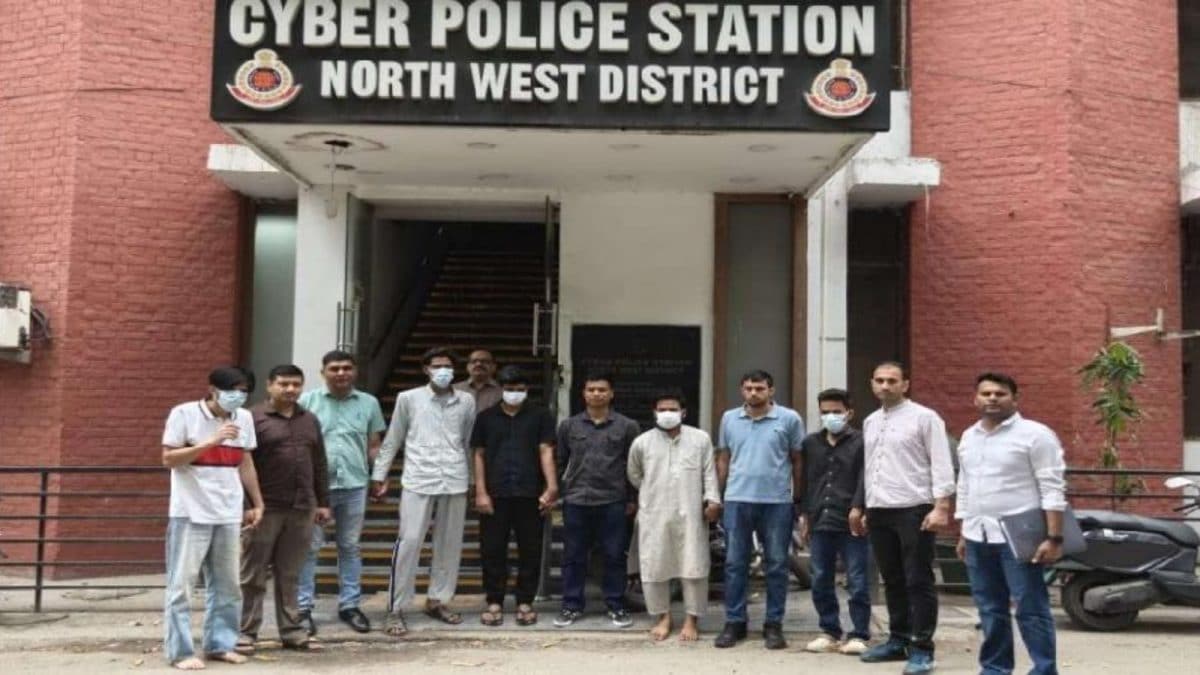
North‑West Delhi witnessed the arrest of seven suspects in a “digital arrest” scam that targeted a senior citizen, resulting in a loss of Rs 8 lakh.
Pune‑Linked Cases
A cluster of seven arrests in Pune‑linked activities pertained to a fraud totaling Rs 29 lakh, with one individual caught withdrawing Rs 6.9 lakh from the fraudulent accounts.
Shahdara
Shahdara was the scene of a mobile‑hacking operation that employed malicious APK files to defraud victims of Rs 6.65 lakh. Two suspects, whose connections extended to Cambodia and Thailand, were taken into custody.
East and Preet Vihar
Authorities in East and Preet Vihar dismantled a honey‑trap gang that preyed on foreign nationals, siphoning off Rs 31.5 lakh. In a separate stock‑market manipulation case, victims incurred losses amounting to Rs 56 lakh. Multiple arrests followed each investigation.
North District
North District saw a single arrest connected to an OLX‑based scam that involved the sale of counterfeit mobile phones.
Outer District
In the Outer District, Delhi Police busted an international fake‑loan call centre, resulting in 19 arrests and the seizure of 36 mobile phones.
Dwarka
Dwarka became the focal point of a nationwide fraud network responsible for Rs 67 crore in losses. Two arrests were made and assets totaling Rs 83 lakh were frozen. Investigators recovered 109 chequebooks and a suite of documents tied to shell companies.
South‑West Delhi
South‑West Delhi witnessed the cracking of loan‑app based extortion schemes with alleged links to Pakistan and Bangladesh, as well as an air‑ticket fraud. Four arrests were recorded in each case, alongside the seizure of Rs 47 lakh in cash and a luxury automobile.
South‑East Delhi
South‑East Delhi saw the resolution of several cases, including matrimonial fraud and bank‑account hacking. Multiple suspects were apprehended and misappropriated funds were recovered.
South Delhi
In South Delhi, Delhi Police dismantled visa and job‑fraud operations that hinged on counterfeit documentation, as well as a fraudulent health‑products call centre. Multiple arrests were effected and a mastermind behind the health‑products scheme was identified.
International Connections and the Role of Cryptocurrency
Across the myriad cases, Delhi Police identified a recurring reliance on cryptocurrency as a vehicle for moving illicit proceeds beyond national borders. The use of digital assets such as USDT complicated traditional tracking mechanisms, prompting Delhi Police to employ specialized blockchain‑analysis tools. Investigative leads revealed ties to jurisdictions including Cambodia, Thailand, Pakistan and Bangladesh.
The cross‑border dimension of these operations underscored the necessity for coordinated international intelligence sharing. Delhi Police highlighted that many of the fraud networks operated as trans‑national syndicates, leveraging offshore accounts and crypto‑exchange platforms to obscure the origin and destination of stolen funds.
Continuing Investigative Efforts
Delhi Police described CyHawk 4.0 as a pivotal milestone in the systematic dismantling of organized cybercrime structures. Nonetheless, Delhi Police emphasized that the investigation remains ongoing, with efforts focused on locating additional conspirators, fully charting the financial circuitry and securing further asset seizures.
Official statements from Delhi Police asserted that the operation demonstrated the unwavering resolve of law‑enforcement agencies to bring cybercriminal networks—whether operating domestically or abroad—under stringent legal scrutiny. Delhi Police pledged to persist in the identification and neutralization of every link within the uncovered fraud webs, while concurrently bolstering preventative mechanisms designed to shield the public from future cyber‑based deception.